
On the heels of a strict cellphone ban that went into effect this month, Oakland Unified School District leaders are now looking at restrictions on other screens in the classroom.
The OUSD board will consider a resolution this week that could end the practice of letting students spend their free time on laptops or school-issued Chromebooks, such as watching YouTube during recess or lunch. It would also direct the superintendent to develop age-appropriate guidelines for screen time in class by consulting research, teachers and school administrators. And it would require OUSD to provide training to school principals about the risks of excessive screen time.
The resolution proposes that the new guidelines be implemented for the 2027-2028 school year.
The policy is a response to an increased reliance on devices dating back to pandemic remote schooling, and it echoes similar actions taken recently in the Los Angeles and San Diego school districts.
During remote learning, school buildings were closed and students primarily learned over Zoom from March 2020 until the fall of 2021. OUSD undertook a massive effort to distribute Chromebook laptops and internet hotspots to every student who needed them.
When students returned to school, the Chromebooks and personal laptops remained. Teachers continued posting lessons and assignments online out of habit or because attendance was still inconsistent; the rules around COVID-19 meant individual students might be out for several days at a time, or occasionally an entire class would go back to remote learning if there was a concentrated outbreak.
Over time, the Google-connected devices became the default learning device, but the district never developed guidelines for when they should and shouldn’t be used.
 Former Superintendent Kyla Johnson-Trammell hands a Chromebook to student Diana Zapata during a distribution at Coliseum College Prep Academy on Aug. 17, 2020. Credit: Pete Rosos for The Oaklandside
Increasing time spent on screens
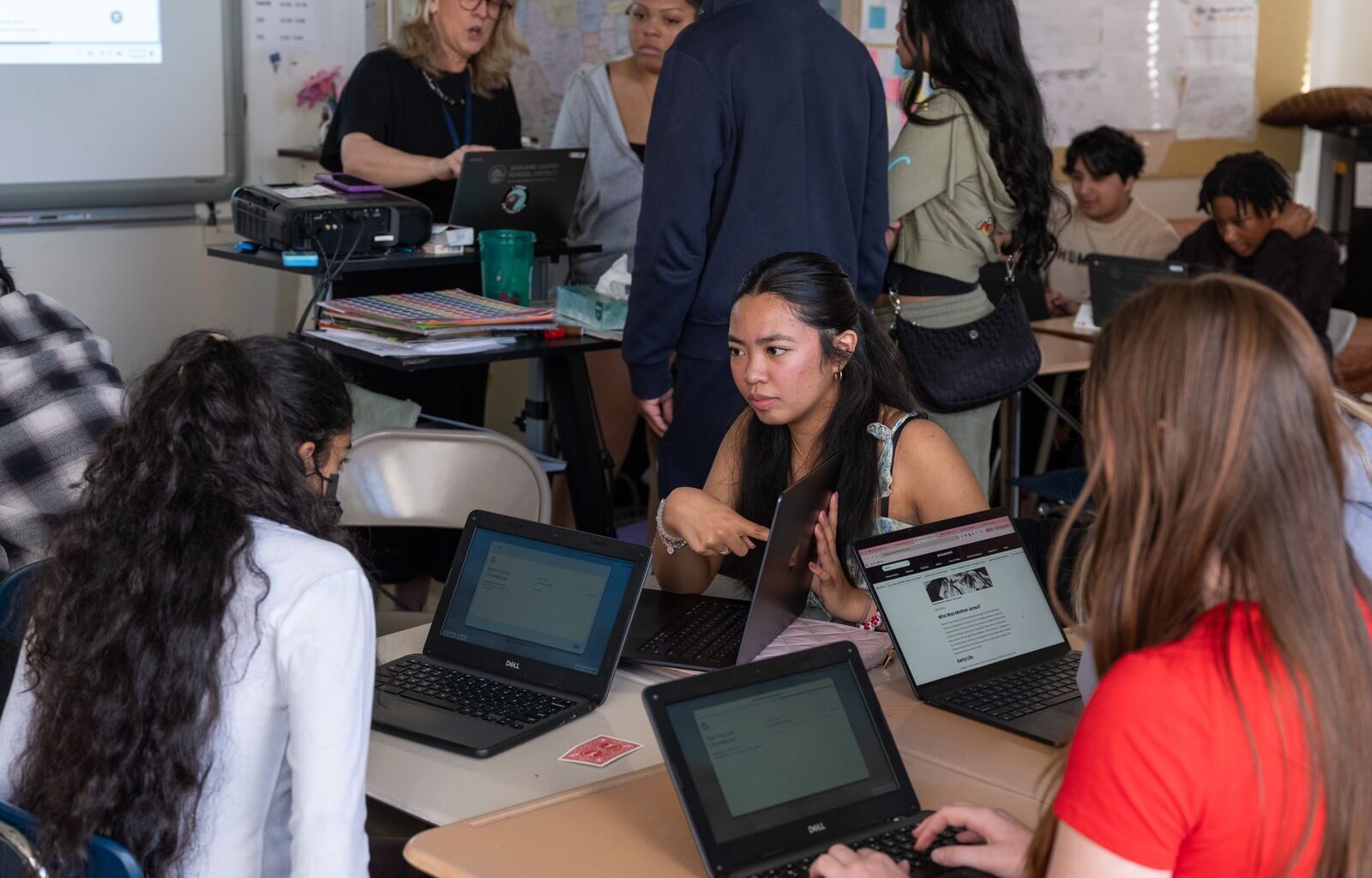
District 1 director Rachel Latta, who is sponsoring the resolution alongside District 2 director Jennifer Brouhard and District 5 director Patrice Berry, said she has sometimes visited schools and seen entire classes of students not speaking to each other, but working independently on laptops with headphones on, which struck her as odd.
“While it made sense during the pandemic, I started to get pretty nervous about how much I would see kids on screens,” she told The Oaklandside. “It wasn’t until I really started feeling like, ‘Usage isn’t happening less after the pandemic, it’s happening more,’ that I started getting skeptical about how much time we were spending on screens.”
Latta, a parent to three OUSD students, is also a nurse midwife who said she has learned more about appropriate screen time in her professional capacity. She began working with other parents and teachers in the Oakland chapter of Schools Beyond Screens, an organization that advocates for responsible screen time in schools. Diane Colquhoun, a second grade teacher at Peralta Elementary School, and Lara Clayman, an OUSD parent of two, surveyed teachers and parents during the summer on their support for a policy restricting devices in the classroom.
Earlier drafts of the resolution proposed banning Chromebooks and other laptops entirely from transitional kindergarten through second grade, similar to a restriction that Los Angeles has implemented. That met some resistance from teachers who felt it would be too disruptive to implement immediately. Instead, the directors’ goal is now for the district to work with teachers and administrators to come up with reasonable restrictions for each grade level, including appropriate use of artificial intelligence tools. The district created a draft AI policy last spring, but it has yet to be approved by the school board.
“I got a lot of feedback from talking to teachers that they wanted to feel like they were included in the decisionmaking process,” Colquhoun told The Oaklandside. “If this passes, it will be in August and partially into the school year. I really want to make sure we’re giving teachers time to process things and adjust their instruction as necessary, which is why we avoided language about limits at certain grade levels. But that would hopefully come next year after engagement with teachers and staff.”
‘Productive boredom’
Leana Rosetti, a parent of two students at Melrose Leadership Academy, a K-8 school, said she tries to keep her kids’ screentime to a minimum at home. But she’s seen how her children have wanted to spend more and more recreational time on their Chromebooks at home because of exposure at school.
“In general, I think we should default to direct instruction, paper and pencil, and real books,” Rosetti told The Oaklandside. “If there’s going to be educational technology used, show me the evidence that this is better than what traditional teaching looks like.”
Rosetti also questions the district’s reliance on i-Ready, a software program OUSD implemented during the pandemic as an assessment tool. Over the course of each school year, students take two to three I-Ready tests in math and reading, plus one in Spanish literacy for dual language students, which provide teachers with a diagnostic evaluation of where their students are at. It also generates individualized practice lessons for each student based on their proficiency level. The software, in use at districts across the country, has recently come under fire by parents, teachers, and students for its repetitive assignments.
Lara Trale, an English teacher at Oakland High School, encourages her students to write essays by hand in class, in part to ensure that they aren’t using artificial intelligence to enhance their writing. While she understands why laptops became such a necessity during and immediately after the pandemic, she has also observed how their use has caused students to devalue interactive classroom time with each other.
Trale, who teaches sophomores and seniors, spoke to The Oaklandside one recent school day while her students spent a few minutes of free time making bookmarks. She said she’s already seen the district’s cellphone ban foster stronger relationships among Oakland High students.
“Despite some of my reservations about it, I think it’s so wonderful seeing students who are conversing more. I’m seeing students playing card games during down time or talking to each other about their studies,” she said. “My last several years of students have been denied the opportunity to have a little productive boredom together and figure out how to exist in community without screens.”
“*” indicates required fields