
Imagine pursuing your dream career only to realize that people who look like you are almost nowhere to be found. Their work rarely appears in museums, textbooks or conversations about the field they helped shape.
What would you do?
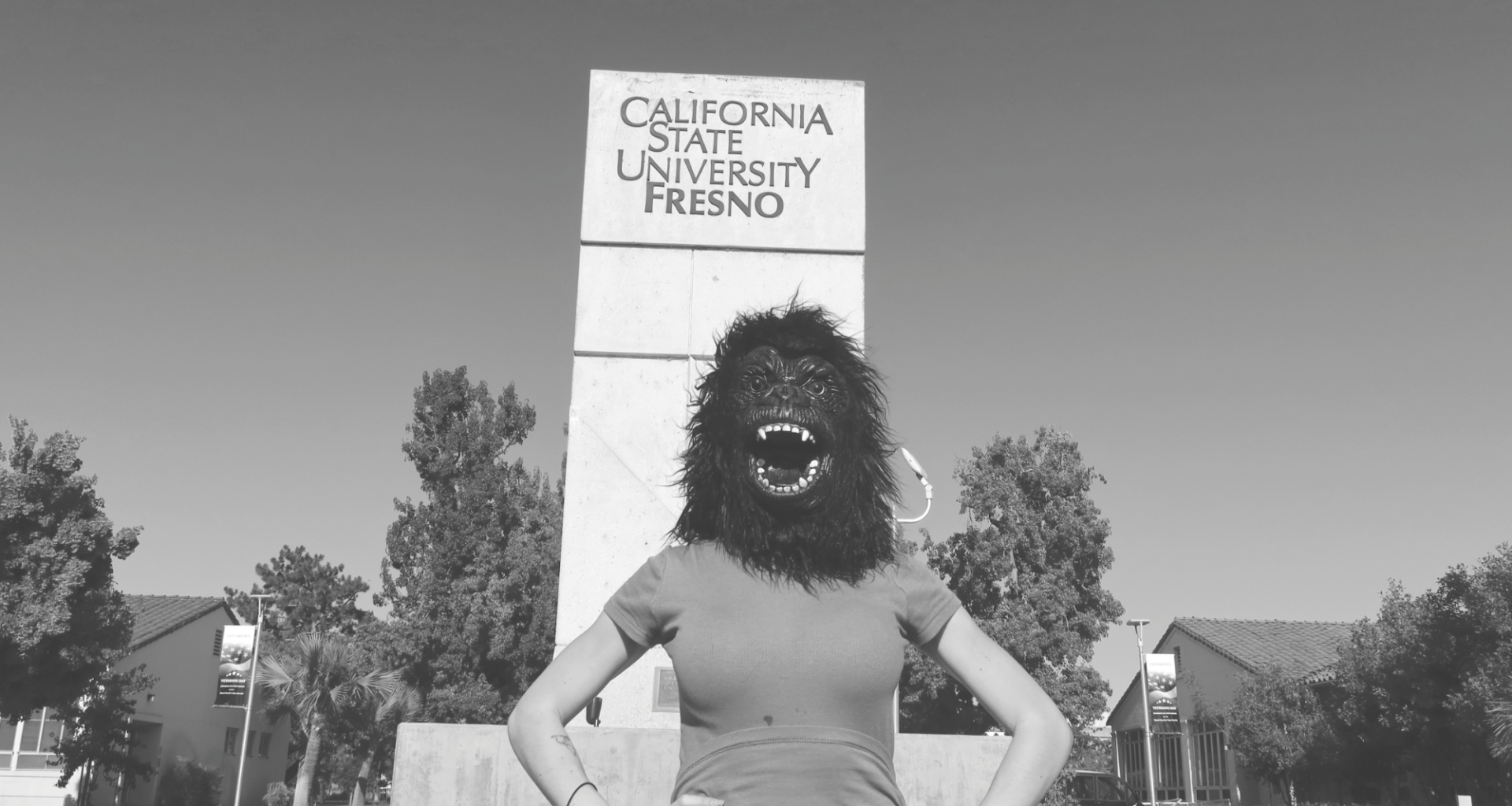
Forty years ago, a group of women artists answered that question by putting on gorilla masks.
This fall, the anonymous feminist art collective known as the Guerrilla Girls will bring four decades of activism, humor and criticism to Fresno State. Their visit connects the group’s work to a campus with its own place in the history of feminist art education.
The Guerrilla Girls formed in New York City in 1985 in response to the underrepresentation of women artists in museums and galleries. The anonymous collective became known for using statistics, satire and provocative graphics on posters, billboards and other public medium to call attention to discrimination in the art world.
The group’s gorilla masks eventually became part of its identity. Members appear publicly under pseudonyms borrowed from women artists and conceal their identities, keeping attention on the issues they address rather than the individual artists behind the collective.
One of the Guerrilla Girls’ best-known works asked, “Do women have to be naked to get into the Met. Museum?”
The 1989 poster reported that less than 5% of artists in the Metropolitan Museum of Art’s modern art sections were women while 85% of the nudes were female. The image paired those statistics with a reproduction of Jean-Auguste-Dominique Ingres’ “Grande Odalisque,” altered to give the reclining nude a gorilla head.
The poster was originally commissioned as a billboard by New York’s Public Art Fund, but the organization rejected the design. The Guerrilla Girls instead brought the campaign to New York City buses.
The collective’s work has continued to question who receives recognition in cultural institutions, who is excluded and whose work becomes part of the historical record.
That conversation has a particular connection to Fresno State.
Artist Judy Chicago established one of the country’s first feminist art programs at Fresno State in the early 1970s. The experimental program encouraged women to examine their experiences through art and helped establish Fresno State’s place in the development of feminist art education.
More than five decades later, the Guerrilla Girls are bringing similar questions about gender, representation and power to the same university.
For students, the exhibition offers more than a look at one influential art collective. It also provides an opportunity to discover a piece of Fresno State’s history that can be easy to overlook.
Students don’t have to agree with every message in the exhibition to engage with the questions behind it: Who gets represented? Who decides which artists matter? And whose work becomes the history future generations learn?
The Guerrilla Girls exhibition will run Aug. 24 through Oct. 9 at Fresno State’s Phebe Conley Art Gallery. The gallery is open Monday through Friday from 10 a.m. to 4 p.m. Admission is free.
Most students probably won’t leave wearing a gorilla mask.
But they may leave seeing museums and the history they hold a little differently.