
For the last decade, genealogical consultant Grant Din has helped Asian Americans find information about their ancestors, many of whom passed through San Francisco’s Angel Island Immigration Station in the 1900s.
Knowing how important these family histories are to his clients, Din — an expert at interpreting complex documents, from immigration records to marriage certificates — says he can’t understand why the federal government would want to abruptly empty out and shut down the National Archives buildings in San Bruno, Chicago and Seattle, which are home to millions of historical records and other federal documents.
San Bruno’s 1-million-cubic-foot facility alone holds more than 750,000 immigration case files, many of which document Asian American and Pacific Islander history on the West Coast.
The National Archive and Records Administration, or NARA, is the federal agency that preserves and provides public access to the nation’s historical and governmental records. There are 40 facilities located across 17 states, including the District of Columbia.
There have been no public updates so far from NARA about where the San Bruno files, and those of Chicago and Seattle, will go. No one knows when that process will even begin, or if the archive’s centuries-old documents can be digitally preserved, Din said.
The uncertainty comes at a time when local Asian American communities say they are worried that their ancestors’ troubled history under the American government — including the 1882 exclusion acts against thousands of Chinese migrants and incarceration of Japanese Americans during World War II,— will be overlooked in the Bay Area’s academic institutions and local governments.
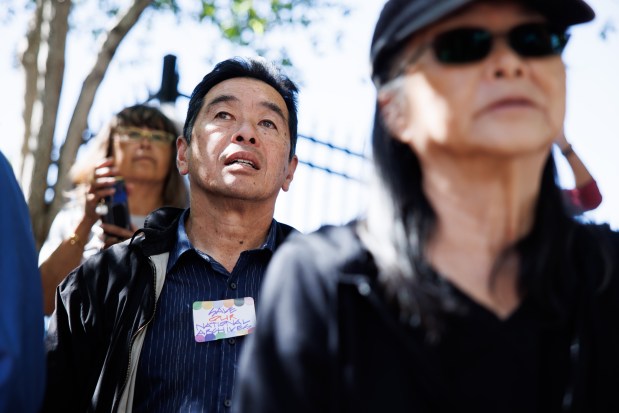 Save Our National Archives communication co-chair Grant Din listens to a speaker during a press conference where U.S. Rep. Kevin Mullin (CA-15) on Monday, Aug. 24, 2026, announced efforts to stop the planned closure of the National Archives at San Francisco facility located in San Bruno, Calif. (Dai Sugano/Bay Area News Group)
On Monday morning, Din joined community members, local AAPI organizations and Rep. Kevin Mullin in front of the archive’s entrance of the National Archives building in San Bruno to protest the closure.
“To help people learn about their own history in the U.S. is pretty amazing,” he said. “It’s such an important thing to continue to do.”
Din is now a leader of Save Our National Archives (SONA), a group of Bay Area locals and nonprofits pushing to keep all the records in San Bruno. SONA claims NARA did not hold public hearings with the community or issue an announcement to explain their decision
The only information SONA has heard about where the San Bruno, Chicago and Seattle records will go is in a document created last month by NARA calling for vendors to help move the archives to existing Federal Records Centers in Boston, Denver and Fort Worth. The work period would begin Sept. 1 of this year and end Sept 30, 2029.
In response, Mullin, whose 15th Congressional District includes South San Francisco, recently introduced a new federal bill that would prevent NARA from closing any of their facilities — such as archives, records centers or research rooms — without Congressional approval. The bill is co-authored by San Gabriel Valley Rep. Judy Chu, along with congressmembers who represent Seattle and Chicago.
“NARA has not provided sufficient information to justify its plans and whether potential cost savings outweigh the harm to the community.” Mullin said.
Mullin and Chu are also leading a coalition of 37 lawmakers across the country in calling upon NARA for more information about why the agency is shutting the facilities.
The closures are meant to help NARA save money and ensure the “long-term financial health and viability” of the administration, according to a June internal email to staff from Chief Operating Director Jay Trainer. The email did not disclose how much it would cost to keep the facilities open.
NARA did not respond to requests for comment about the facilities closure. National Archive at San Francisco Director Stephanie Bayless also did not respond to questions about the San Bruno closure.
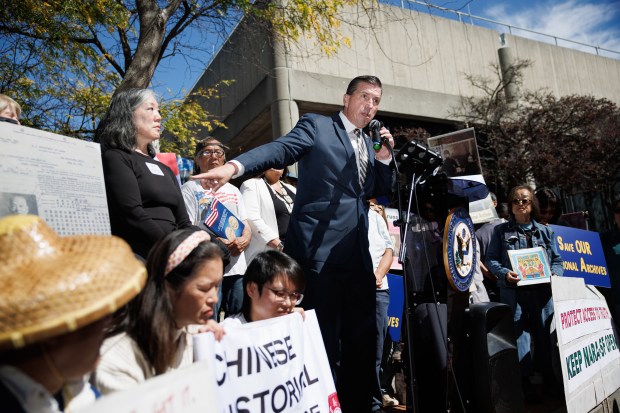 U.S. Rep. Kevin Mullin (CA-15) speaks during a press conference on Monday, Aug. 24, 2026, announcing efforts to stop the planned closure of the National Archives at San Francisco facility located in San Bruno, Calif. (Dai Sugano/Bay Area News Group)
The San Bruno facility is most known for holding the original immigration records of martial artist icon Bruce Lee and court records for United States vs. Wong Kim Ark, a landmark Supreme Court decision that established birthright citizenship under the 14th Amendment. The building also holds Alcatraz inmate records of Al Capone and Machine Gun Kelly, among others.
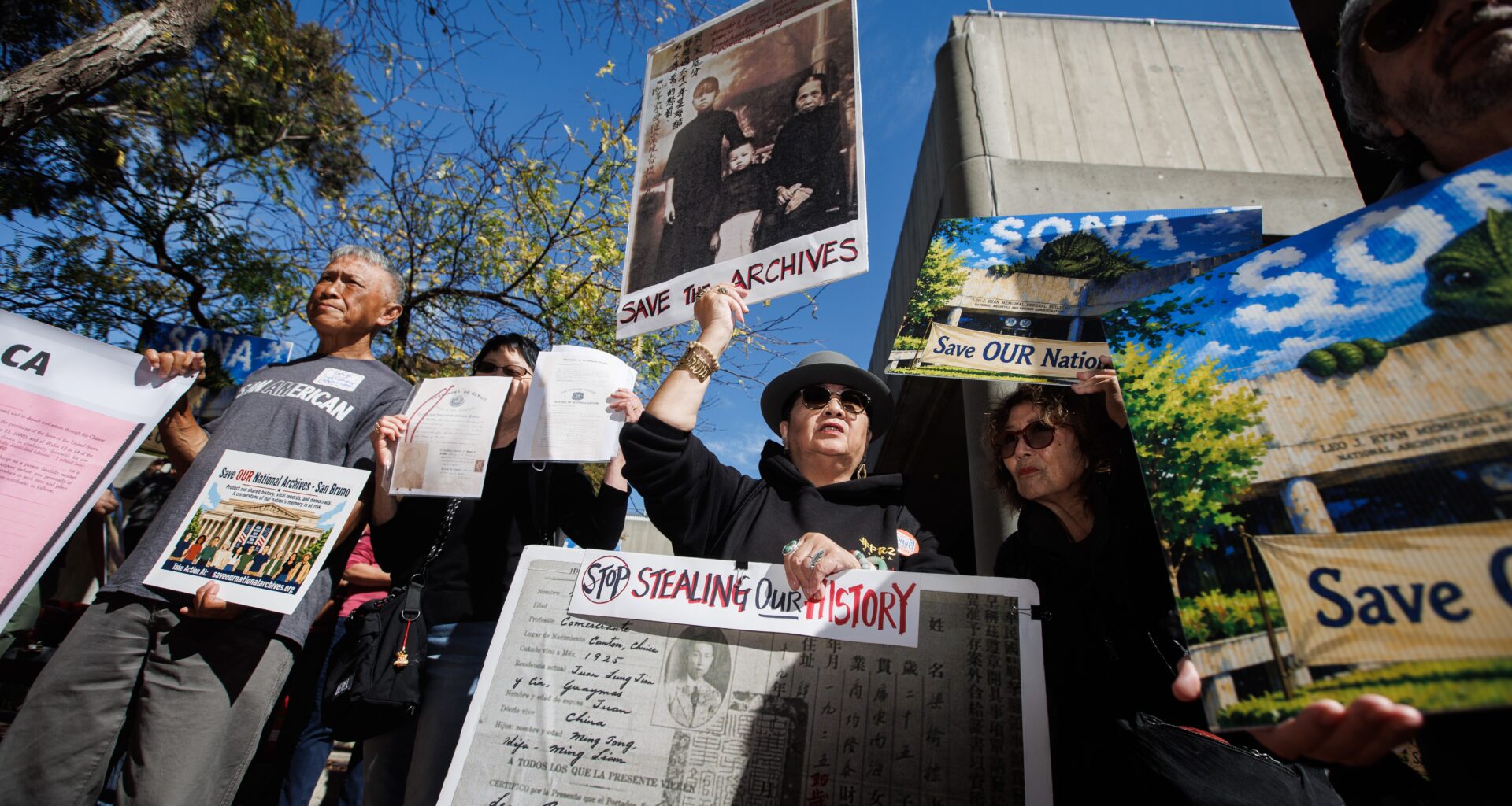
On Monday, protesters at the San Bruno archive held posters reading “Protect Access to Truth” and “Save Our National Archive.” Printed and mounted on pieces cardstock were photos of protester’s family members and immigration records which could be found at the archive.
Rosalyn Tonai, executive director of Japanese American Historical Society in San Francisco, said the archive holds documents on Japanese American incarceration in the U.S. during World War II. Many of these sensitive and delicate documents cannot be be fully digitized by NARA, and need to be accessed by locals, Tonai said.

Demonstrators opposing the closure of the National Archives at San Francisco facility listen to a speaker during a news conference on Aug. 24, 2026, where U.S. Rep. Kevin Mullin (CA.-15) announced efforts to stop the planned closure of the facility located in San Bruno, Calif. (Dai Sugano/Bay Area News Group)

Alan Lau, left, his sister Elizabeth Lee, right, and her two sons Gilbert and Jason Lee, standing,look through records of their grandfather Kung Soon Lau in the Tom Lantos Research Center at the National Archives Pacific Region in San Bruno, Calif., on Tuesday, May 22, 2012.The U.S. Citizenship and Immigration Services announced the transfer of approximately 44,000 additional alien records, known as “A-Files”, to the National Archives Pacific Region facility in San Bruno.The A-Files are a unique resource for family historians, especially descendants of the 20th century immigrants.
(John Green/Staff)

One of the documents that are part of the Alien files, otherwise known as the A-Files, are now part of the National Archives at San Francisco in San Bruno, Calif. Thursday, May 17, 2012 and will be available to the public beginning Tuesday. The roughly 40,000 files in San Bruno¿s new collection are specifically for immigrants or foreign visitors who were processed by immigration agents in San Francisco, Reno, Honolulu or Guam. Only pre-1910 files are currently available, but others will be released later. (Courtesy of the National Archives at San Francisco)

Stephen Low’s maternal grandparents’ original 1909 marriage contract at the National Archives Pacific Region in San Bruno, Calif. on Wednesday, August 26, 2009. (Dan Honda/Staff)

A collection of war-related documents stored at the National Archives office in San Bruno. (Jim Gensheimer staff archive)

Stephen Low takes photographs as his wife, Jeanie Low, points out details while viewing his maternal grandparents’ original 1909 marriage contract at the National Archives Pacific Region in San Bruno, Calif. on Wednesday, August 26, 2009. (Dan Honda/Staff)

Archive Specialist Bill Greene stacks a file at the at the National Archives and Records Administration in San Bruno on Friday
June 19, 1998. (Noah Berger file photo)

Jennifer Gee, a Stanford Phd student works on transfering Angel Island immigration records to a computer base. The records are stored at the National Archives office in San Bruno. (Jim Gensheimer staff archive)

Lenora Lee looks through records of her relatives at the National Archives Pacific Region in San Bruno, Calif., on Tuesday, May 22, 2012.The U.S. Citizenship and Immigration Services announced the transfer of approximately 44,000 additional alien records, known as “A-Files”, to the National Archives Pacific Region facility in San Bruno.The A-Files are a unique resource for family historians, especially descendants of the 20th century immigrants. (John Green/Staff)

An Elvis song book is one of the documents from a copyright case stored at National Archives office in San Bruno. (Jim Gensheimer staff archive)

Grant Din of the Angel Island Immigration Station Foundation, displays family photos in his San Francisco office on Tuesday, Sept. 6, 2011. Using the National Archives in San Bruno, Din was able to find a photograph of his maternal grandmother Gee Chew Lin, the only one the family has ever seen, and a photograph of his maternal grandfather Hoon Owyang, who Din learned, actually came to America in 1905, 15 years earlier than the family thought. The discriminatory legislation that created lengthy interrogations of Chinese and some other immigrants has a silver lining for genealogists like Din who can use the files to trace his roots. (Karl Mondon/Staff)

Gilbert Lee looks at a visa record of his grandfather Kung Soon Lau in the Tom Lantos Research Center at the National Archives Pacific Region in San Bruno, Calif., on Tuesday, May 22, 2012.The U.S. Citizenship and Immigration Services announced the transfer of approximately 44,000 additional alien records, known as “A-Files”, to the National Archives Pacific Region facility in San Bruno.The A-Files are a unique resource for family historians, especially descendants of the 20th century immigrants.
(John Green/Staff)
Show Caption
1 of 12
Demonstrators opposing the closure of the National Archives at San Francisco facility listen to a speaker during a news conference on Aug. 24, 2026, where U.S. Rep. Kevin Mullin (CA.-15) announced efforts to stop the planned closure of the facility located in San Bruno, Calif. (Dai Sugano/Bay Area News Group)
Tonai said NARA needs to preserve these fragile documents because they represent pieces of American history that should never be, “buried, destroyed or erased.”
Former SONA communication chair Jeanie Chooey Low came to the demonstration with colorful homemade quilts, which have her parent’s digitalized government files incorporated in them. Low, a genealogist, uses the San Francisco archive for personal and professional research. NARA’s online catalog can be difficult for finding exact records, and can’t provide the same experience as in-person visits, she said.
“Once records found on site are packed and shipped to other locations, those records may never be found again,” she said.
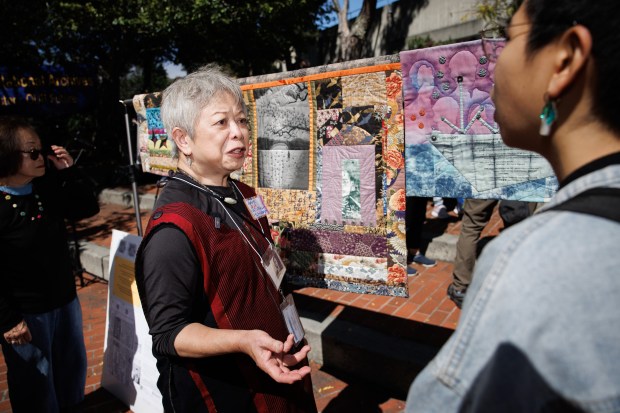 Former Save Our National Archives communication co-chair Jeanie Chooey Low shows quilts that she’s made with her parents’ printed government documents during a press conference where U.S. Rep. Kevin Mullin (CA-15) on Monday, Aug. 24, 2026, announced efforts to stop the planned closure of the National Archives at San Francisco facility located in San Bruno, Calif. (Dai Sugano/Bay Area News Group)