
California high-speed rail project faces delays, rising costs, and criticism

California’s high-speed rail project, once envisioned as a groundbreaking transportation system connecting San Francisco to Los Angeles by 2020, has been plagued by delays, soaring costs, and widespread criticism, with completion now projected for 2039.
David Tangipa, a Republican state assembly member representing the Fresno area, shared his frustration with the project, which began when he was a child.
“Whenever anybody asks me what my position on high-speed rail is, I tell them I did not vote for high-speed rail because I was 12 years old when this project started,” Tangipa said.
Now 30, he and other lawmakers, including Sen. Shannon Grove, R-Bakersfield, believe the project has derailed.
The rail system was initially estimated to cost $33 billion and connect San Francisco to Los Angeles by 2020. Nearly two decades later, no rail cars are running, and no tracks have been laid.
“The big reason why we ran for office was accountability,” Tangipa said. “If the people said, ‘We want a train,’ you build the damn train, and you give them what they want.”
At June’s High-Speed Rail Authority meeting, funding was a key focus as the authority requested an additional $3.5 billion for track construction. The authority’s CEO, Ian Choudri, presented his first business plan, which included updates on the project’s cost and timeline.
“I just want to say that today is really the turning point for high-speed rail,” Choudri said.
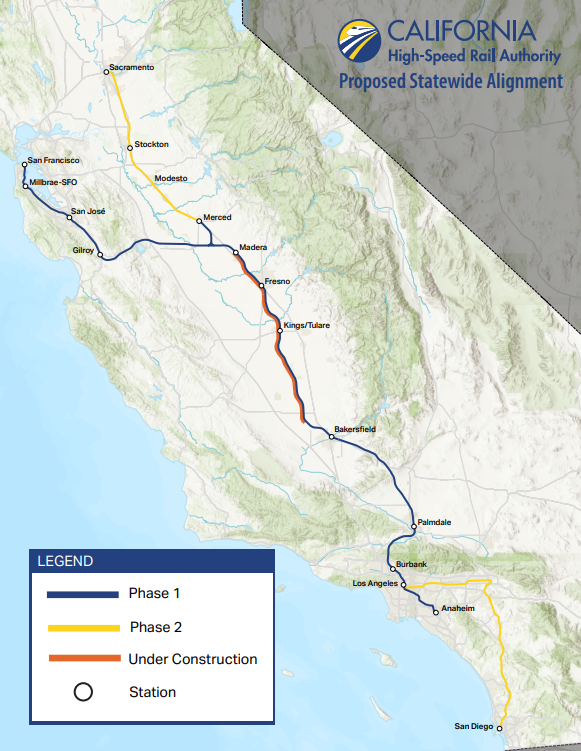
Crews in the Central Valley have completed 62 of the 90 structures needed to anchor the tracks, but construction remains focused on a 119-mile stretch between Merced and Bakersfield, now estimated to cost $36 billion—far exceeding the original $33.5 billion estimate for the entire project. The authority now projects the cost to connect the Bay Area to Los Angeles could reach $230 billion, with completion pushed to 2039.
This content is imported from infogram. You may be able to find the same content in another format, or you may be able to find more information, at their web site.
Choudri acknowledged flaws in the project’s early stages, including premature construction before utility lines were moved and land was acquired.
“Building a rail system like this, yes, it is complicated. Yes, it takes time. It’s not all about construction. It’s more about the process that it takes to get to construction and then get it to the finish line,” Choudri said.
The project has faced criticism from residents like Michael Dias, a farmer and attorney specializing in eminent domain cases. He lost 81 acres across seven ranches to the rail project.
“It’s affected a lot of people in the community. It’s been looked upon as a complete fiasco,” Dias said, explaining that he would eventually sell all of his orchards. “I would still be in if they weren’t here. But they’ve become such a problem for me I just don’t want to deal with it.”
Business owner James Weirick, whose property was used for relocating utility wires, described the project as a “constant disappointment and disruption of commerce and the way of life around here.” He noted delays and lawsuits, including one contractor billing the state $170,000 per day in delay fees.
The High-Speed Rail Authority has spent over $5.7 billion on delay and change order fees, including $537 million paid to one contractor in February. Choudri said most of the damage was done before he took over as CEO two years ago. He believes cutting red tape to expedite utility line relocation could save money.
Inspector General Ben Belnap, tasked with overseeing the project, raised concerns about the updated business plan, calling it “dramatically incomplete” and warning that the rail system could run out of money by December 2027.
The project was intended to be a public-private partnership, and the authority recently announced a deal with Momentum Alliance Partners, a group of companies experienced in high-speed rail development. While the group is evaluating potential investments, no commitments have been made.
Despite the challenges, Choudri remains optimistic.
“When we are done with this, I think this is a moment for the entire—not just for our team but the state to be proud of it but the country as a whole because we just created a template on how to build a high-speed rail system,” Choudri said.
However, skepticism persists.
“I honestly don’t think [it] will ever run,” Dias said. “By the time it’s ready to run, the technology will be outdated.”
Tangipa added that “the only thing California High-Speed Rail is on track for is to be the third most expensive infrastructure in the world.”
The High-Speed Rail Authority recently approved $3.5 billion for tracks for the 119-mile stretch, hoping to regain momentum.
“I like to say there are doers and doubters,” Board Member Anthony Williams said. “We are the doers because we know this is going to happen.”
For now, the biggest obstacle remains funding, with the state agreeing to provide $1 billion annually for the next 20 years. Whether the project will meet its ambitious goals remains uncertain.
See more coverage of top California stories here | Download our app | Subscribe to our morning newsletter | Find us on YouTube here and subscribe to our channel | Make KCRA a preferred news source in Google