
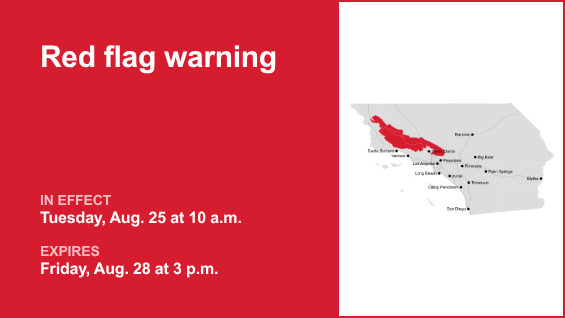
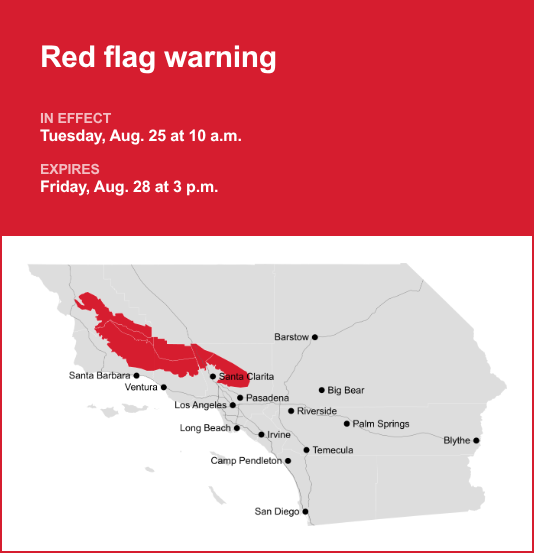
5 Freeway north of LA is under a red flag warning which was issued by the National Weather Service on Monday at 1:46 p.m. The warning is valid from Tuesday 10 a.m. until Friday Aug. 28, at 3 p.m.
Winds are forecasted to be local northwest to north winds 15 to 25 mph with gusts up to 35 mph at times, strongest across the I-5 and Highway 33 corridors. A slightly stronger northerly wind push is possible late Thursday night into Friday morning, with gusts up to 40 mph possible across the I-5 corridor and relative humidity minimum humidities 10 to 20% each day, with isolated values as low as 8% by Thursday and Friday. Poor recoveries overnight hours in the mountains and foothills with humidities in the 15 to 30% range.
“A very hot and unstable air mass combined with locally gusty winds and low humidities will bring a significant risk of large plume dominated fires with rapid spread and extreme fire behavior,” the NWS Los Angeles/Oxnard CA said. “There is a significant risk of large plume dominated fires with rapid fire spread and extreme fire behavior. There is a history of large plume dominated fires this time of year with similar weather and fuel conditions, including the Bridge, Bobcat, and Station fires.”
The full list of affected locations includes:
5 Freeway corridor near Santa Clarita
Cuyama Valley
San Luis Obispo County Mountains
Santa Barbara County Interior Mountains
Southern Ventura County Mountains
Northern Ventura County Mountains
Western San Gabriel Mountains/Highway 14 Corridor
Emergency alerts in Southern California
For “considerable or catastrophic” hazards, emergency alerts will be sent to all enabled mobile phones in the area. To monitor lesser risk, residents are advised to sign up for county alert systems and to monitor agencies’ social media. How to sign up for alerts in your area:
What is the significance of a red flag warning?
A red flag warning indicates that either extreme fire weather conditions are currently happening or will happen soon, as per the NWS. Warm temperatures, very low humidities, and stronger winds are expected to combine to produce an increased risk of fire to spread rapidly.
What steps should you follow during a red flag warning?
During a red flag warning, it is crucial to exercise extreme caution and be prepared to take immediate action in case a fire starts. The NWS offers these steps you can take to lower the risk of fires igniting and ensure your safety:
1. Secure burn barrels:
In areas where controlled burning is sanctioned, make certain that burn barrels sport a weighty metal cover, equipped with holes no larger than 3/4 of an inch.
2. Mindful disposal of smoking materials:
Prudently discard cigarette butts and avoid flinging cigarettes or matches from a moving vehicle. These seemingly innocuous actions can kindle dry grass, potentially triggering a wildfire.
3. Properly extinguish outdoor fires:
To prevent inadvertent fires, diligently douse all outdoor fires. Quench them with a copious deluge of water and stir to guarantee complete cooling. Submerge charcoal until it’s thoroughly bereft of residual heat. Never depart from live charcoal unattended.
4. Never desert a blaze:
Avoid leaving any fire unattended. Even sparks or embers carried by the wind can ignite nearby leaves or grass, triggering a fire that spreads rapidly.
Understanding the gravity of a red flag warning and adhering to these precautions is paramount in averting wildfires during these perilous conditions. Prioritize safety, stay impeccably informed, and assume responsibility to shield lives and property.
For more local weather alerts, visit our Weather Advisory page