
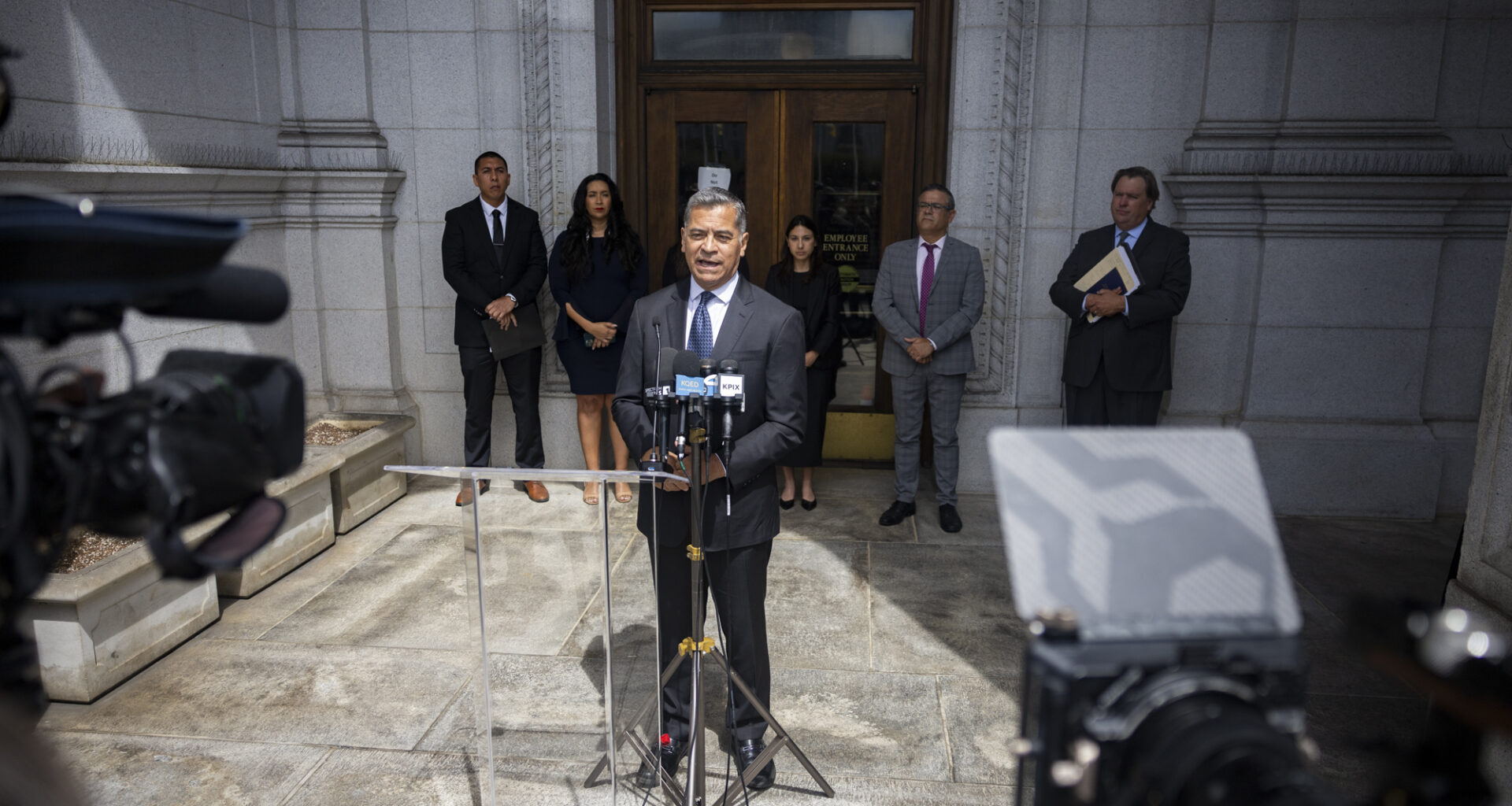
During oral arguments in San Francisco, justices questioned the Republican Riverside County sheriff’s seizure of more than 650,000 ballots cast in the November election.
Aug 24, 2026
Updated 3:11 pm PT
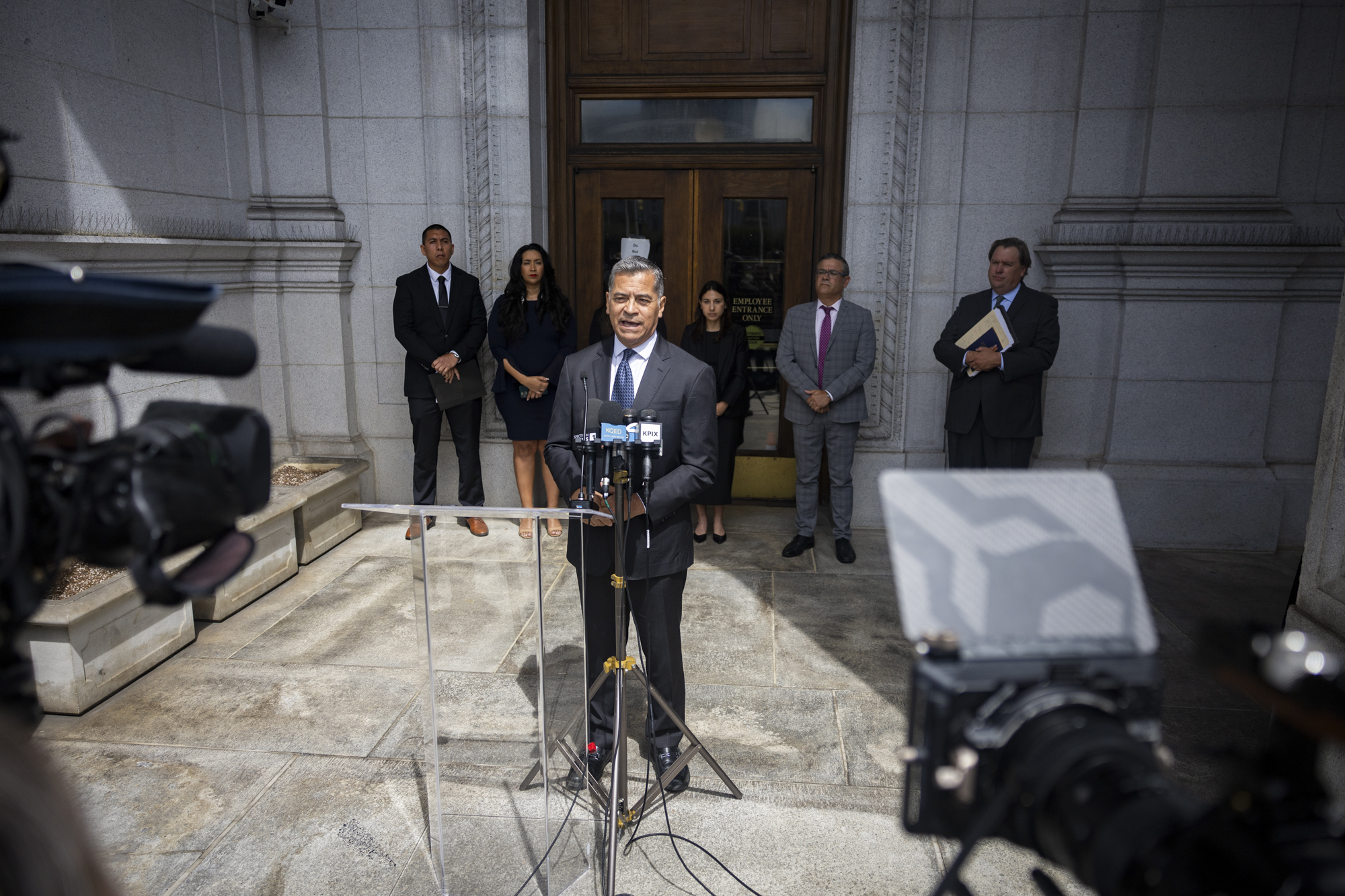
Xavier Becerra, Senior Advisor to the UCLA VRP and attorney on file in the case, speaks during a press conference following oral arguments in Cervantes et al. v. Bianco, a case challenging Riverside County Sheriff Chad Bianco’s seizure of more than 650,000 ballots cast in the November special election, at the steps of the Earl Warren Building at the California Supreme Court on Aug. 24, 2026. (Gina Castro for KQED)
California Supreme Court justices on Monday appeared skeptical of Riverside County Sheriff Chad Bianco’s unprecedented seizure of more than 650,000 ballots cast in last November’s special election.
Bianco, a Republican who unsuccessfully ran for governor in this year’s June primary, has said that his actions were part of an investigation into potential voter fraud in the election on California’s redistricting measure. But his move set off alarm bells among Democratic leaders who worried the ballot seizure was a local outcrop of conservative efforts to undermine vote-by-mail.
During oral arguments in San Francisco, the court’s justices peppered Bianco’s attorney, Bradley Hertz, with questions as to why the sheriff was not bound by state laws that restrict access to ballots during a criminal prosecution.
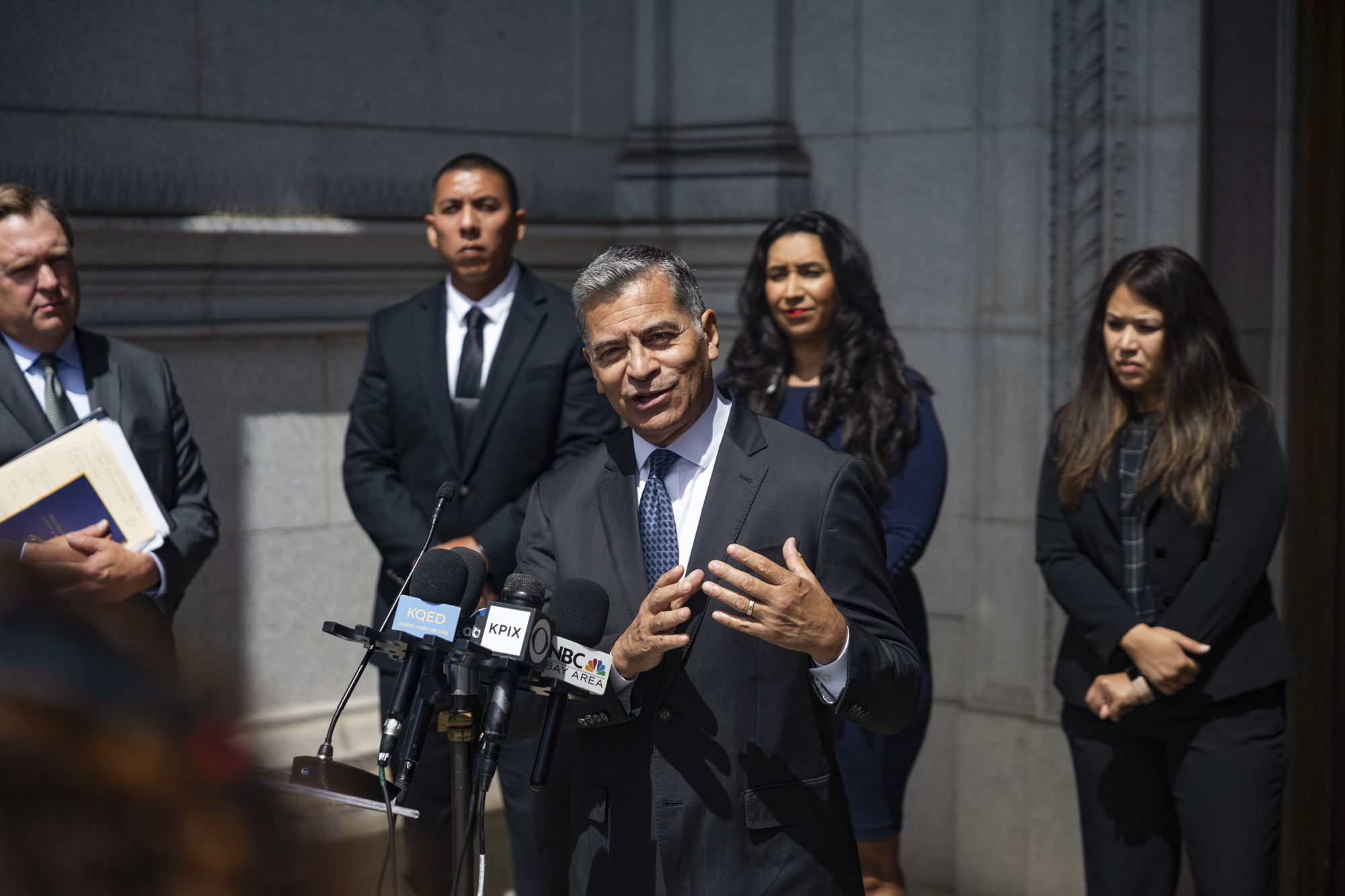 Xavier Becerra, senior adviser to the UCLA VRP and attorney on file in the case, speaks during a press conference following oral arguments in Cervantes et al. v. Bianco, a case challenging Riverside County Sheriff Chad Bianco’s seizure of more than 650,000 ballots cast in the November special election, at the steps of the Earl Warren Building at the California Supreme Court on Aug. 24, 2026.
“It says in no event shall the packet or its content be taken from the custody of the elections official,” Justice Kelli Evans said. “So I’m just not following your argument.”
Justice Joshua Groban questioned whether the case presented by Bianco would open the door for the seizure of ballots during an ongoing election.
“Under your broad view of the warrant power, pursuant to a lawful warrant, the sheriff could seize ballots even before Election Day, right?” Groban said.
Hertz said that state law limits access to ballots only during prosecutions — not investigations.
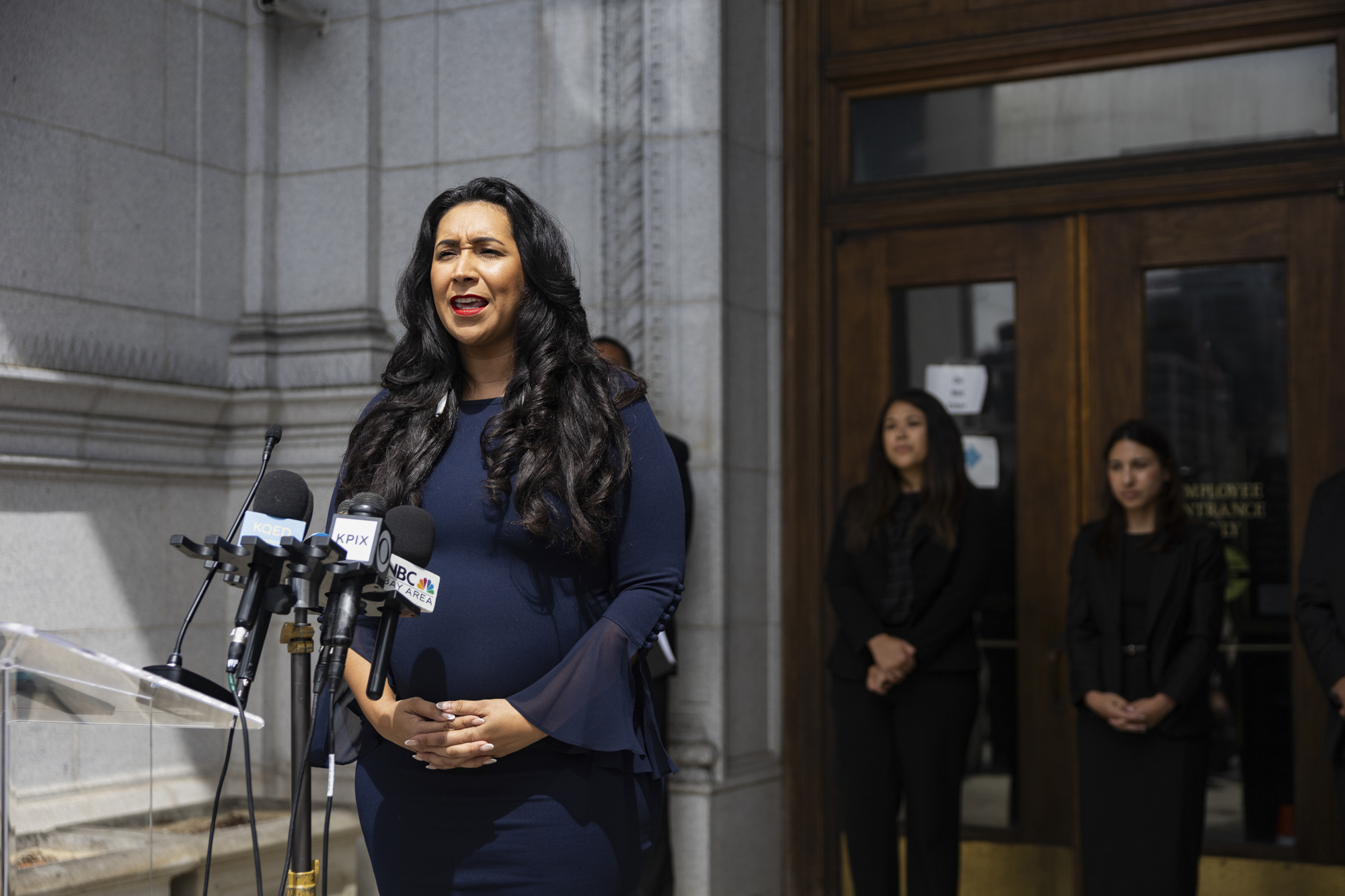 Clarissa Cervantes, Riverside City Council member and plaintiff, speaks during a press conference following oral arguments in Cervantes et al. v. Bianco, a case challenging Riverside County Sheriff Chad Bianco’s seizure of more than 650,000 ballots cast in the November special election, at the steps of the Earl Warren Building at the California Supreme Court on Aug. 24, 2026.
California Attorney General Rob Bonta brought a second suit, arguing that Bianco illegally ignored his direction as the state’s top law enforcement official to halt the investigation.
Riverside County sheriff’s deputies began seizing boxes of ballots in late February, in response to a complaint from a citizens group.
That group, the Riverside County Election Integrity Team, had conducted an audit of ballot intake forms — sheets filled out by election workers detailing how many ballots had arrived at their vote center. The audit concluded that the ballot intake forms had only detailed 611,426 ballots — 45,896 short of the county’s final count of 657,322 votes.
Art Tinoco, the county’s registrar of voters, described the intake forms as an unrefined count that does not provide an apples-to-apples comparison to the final count of ballots.
“These are completed in the field by election officers during long workdays — let’s keep that in mind; folks get tired,” Tinoco told the Riverside County Board of Supervisors. “It’s very possible that the staff may not have recorded the numbers accurately on these daily mail intake forms.”
Bianco said his deputies would be recounting ballot envelopes, but not reviewing the votes inside, in order to determine the reason for the discrepancy with the intake forms.
“It looks like well-meaning officers essentially trying to build a vote-counting airplane while they’re flying it,” said Chad Dunn, an attorney for the Riverside County voters who brought the suit against Bianco’s actions.
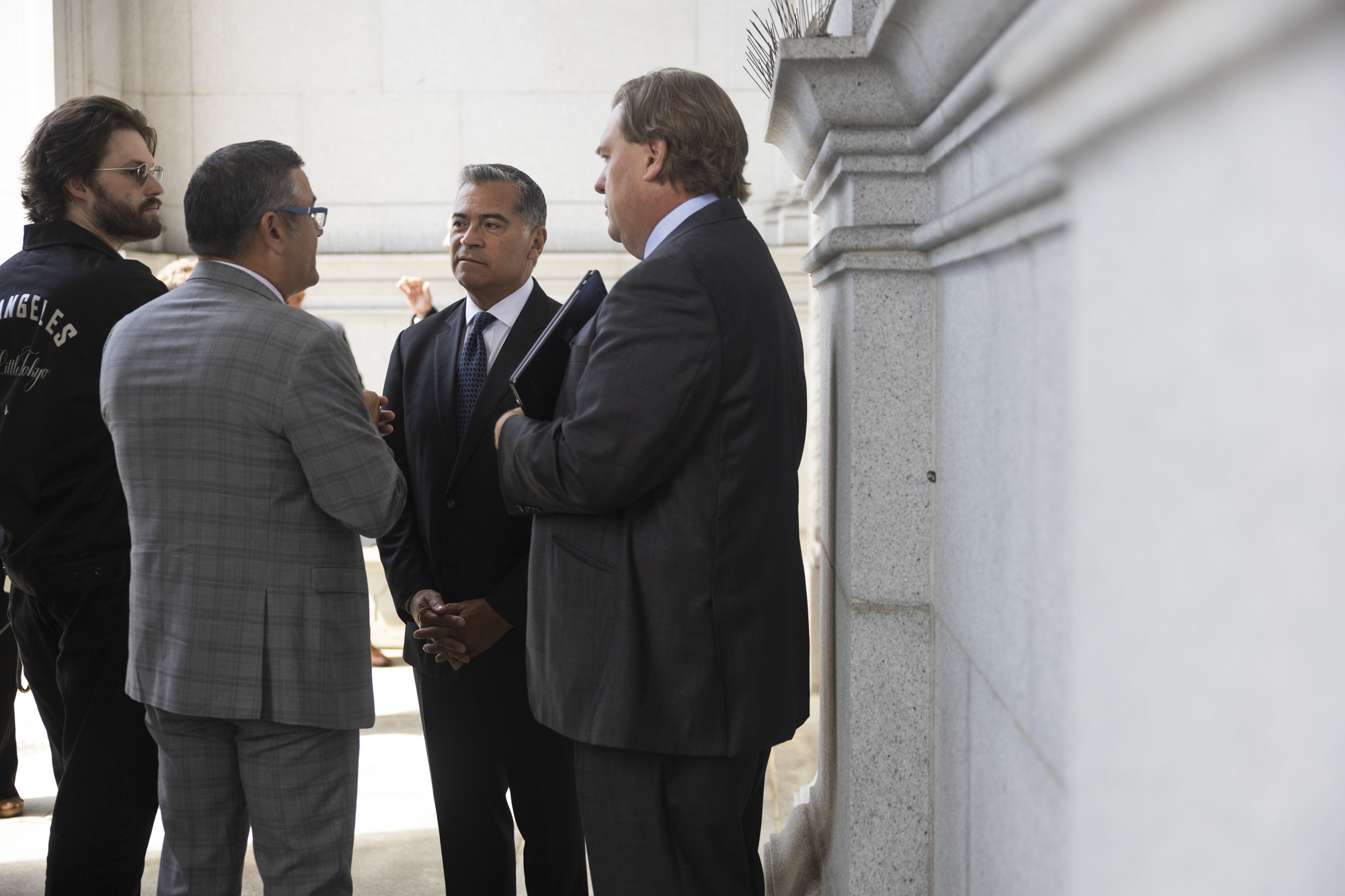 Xavier Becerra, senior adviser to the UCLA VRP and attorney on file in the case, center, speaks to Dr. Matt Baretto, faculty director at UCLA VRP, left, and Chad Dunn, legal director at UCLA VRP, right, following a press conference regarding Cervantes et al. v. Bianco, a case challenging Riverside County Sheriff Chad Bianco’s seizure of more than 650,000 ballots cast in the November special election, at the steps of the Earl Warren Building at the California Supreme Court on Aug. 24, 2026.
In April, the Supreme Court blocked Bianco’s investigation from moving forward while it considered Bonta’s challenge.
Justices questioned California Solicitor General Sam Harbourt, who said the power for Bonta to supervise the actions of county sheriffs “was intended to be expansive.”
“That to me says if he wants to drop into a particular county and say, ‘Cease this prosecution for shoplifting,’ it shall be done’ … as long as he deems it in the public interest,” Groban said. “That sounds almost unlimited.”
Hertz said that Bonta’s powers are much more curtailed — that the attorney general has an “advise and consent” relationship with local sheriffs, and can only voice his displeasure with local law enforcement actions.
“Direct supervision does not mean absolute control, and sheriffs are not employees of the attorney general,” Hertz said.