
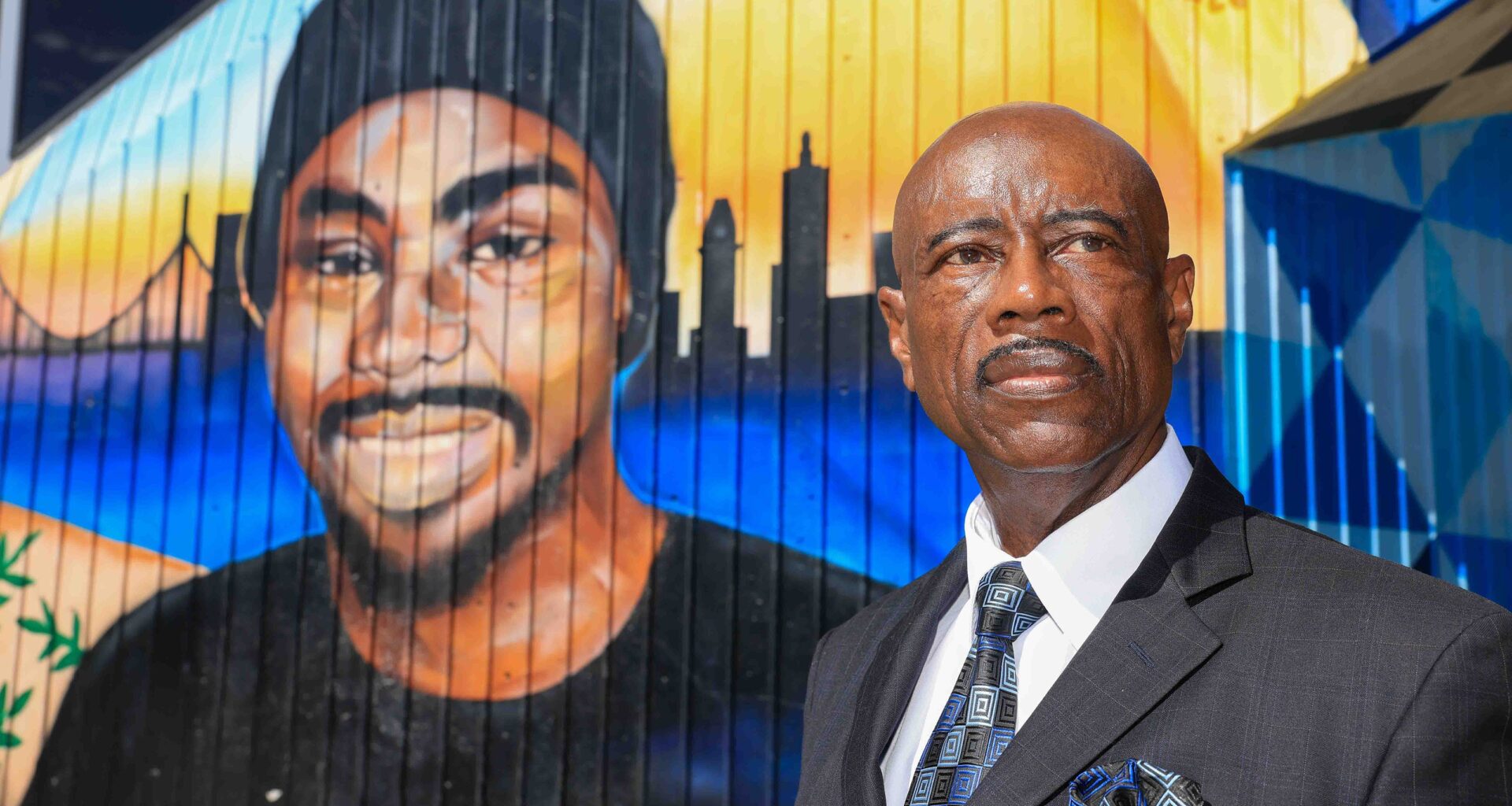
In the early morning hours of New Year’s Day 2009, Cephus Johnson texted his nephew Oscar Grant, who was waiting at BART’s Fruitvale station. Moments later, BART Police Office Johannes Mehserle shot the 22-year-old Black man in the back.
“Uncle loves you. God loves you,” Johnson’s text read that morning. “Happy New Year.”
Grant’s killing helped spur BART to create an independent system of civilian police oversight. Seventeen years later, Johnson has been appointed to the BART Police Civilian Review Board, giving him a formal role in reviewing misconduct findings, police policies and recommendations for officer discipline.
Johnson said he sees the appointment as a way to protect his grandchildren and future great-grandchildren.
“Because if I fail to stand today, it’d be their demise tomorrow,” Johnson said.
After reviewing cellphone videos, investigators hired by BART concluded that Pirone pushed Grant against a wall, struck him in the head and kneed him in the face. Later, as officers tried to handcuff Grant, Pirone and Mehserle placed him facedown on the platform, where Pirone pinned his neck with his knees. Moments later, Mehserle stood, drew his gun and shot Grant in the back.
Grant’s death became one of the first major U.S. police killings in which cellphone footage went viral, allowing the public to see the shooting for itself.
The videos fueled public outrage and days of protests in Oakland, including marches from Fruitvale station into downtown. Johnson, now widely known as “Uncle Bobby,” said his nephew’s killing drew him into activism.
“Not only were we impacted, but the community was upset because they visualized it,” Johnson said. “Seeing the video, seeing that he was laying face down, he wasn’t resisting, he wasn’t getting up to run, and then an officer shoots him in the back and you see that on video. He murdered Oscar and he should be held accountable.”
From grief to resolve, Johnson took up a new mission: He was going to make sure that what happened to his nephew would not happen again.
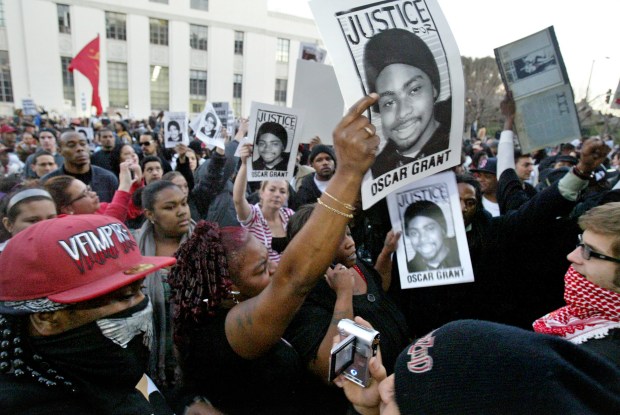 Protesters shout their message outside the Alameda County District Attorney’s office during a rally in protest of the killing of Oscar Grant III in downtown Oakland, Calif., on Wednesday, January 14, 2009. (Anda Chu/Staff)
With Grant’s mother overwhelmed by grief, Johnson became the family’s de facto spokesperson, he said. He attended every protest, memorial and event for Grant he could, defending his nephew’s legacy and demanding accountability for the officers involved in his killing.
“The community embraced us, stood with us, cried with us, went back to court with us,” Johnson said. “It was the community that gave me a sense of hope that maybe something can be done.”
Pirone was never charged in Grant’s killing despite an internal investigation that showed he used aggressive and unreasonable force, including striking Grant in the head and kneeing him. BART police fired Pirone in 2010.
Prosecutors charged Mehserle with murder, but a Los Angeles jury convicted him of involuntary manslaughter after the trial was moved out of Alameda County. A Los Angeles County judge sentenced him to two years in prison in 2010. He was released after serving 11 months.
Johnson called the conviction “history, not a victory,” saying Mehserle’s acquittal on second-degree murder and voluntary manslaughter charges meant accountability had not been achieved for his nephew.
Three days after Mehserle was sentenced, two Oakland police officers shot and killed another unarmed Black man, Derrick Jones, near Bancroft Avenue and Trask Street. Johnson visited Jones’ family as they began asking the same question he had after Grant’s death: How could they get the officers charged?
That was when Johnson realized he needed to turn protest into purpose, he said.
“It was so much bigger than Oscar,” Johnson said. “This was much more of a systemic problem than just one individual family being impacted by this violence.”
“There had to be more than just protest,” he continued. “But once that door opens up, what then?”
Johnson came to define his pursuit of justice through what he calls the “Four Ps”: protest, purpose, policy and prevention.
In 2010, he lobbied California legislators to pass Assembly Bill 1586, which created BART’s Office of the Independent Police Auditor and provided the framework for independent oversight of the transit agency’s police department.
Four years later, Johnson founded the Love Not Blood Campaign and California Families United 4 Justice, which he said have connected more than 1,500 families affected by police violence nationwide with financial and legal support.
Through those networks, Johnson advocated for a series of measures that changed police practices across California.
Assembly Bill 71 mandated statewide reporting of shootings and serious or deadly force involving officers. AB 953 required agencies to collect demographic data on police stops. AB 392 tightened California’s standard for police use of deadly force. Senate Bill 2 created a process to decertify officers for serious misconduct.
That work came full circle Aug. 13, when the BART Board of Directors unanimously selected Johnson to serve as the Civilian Review Board’s public-at-large representative.
In that role, Johnson can receive misconduct complaints, review findings and disciplinary recommendations from the independent police auditor and participate in recommending corrective action. The 11-member board also reviews police policies, procedures and training, and advises BART leadership.
After years of demanding change from outside the system, Johnson will now help shape accountability from within it.
“It’s not about me or us, or even today; it’s about what their future can look like,” Johnson said. “It’s about true, systemic change in a way that they can have real freedom, justice, and equality.”