
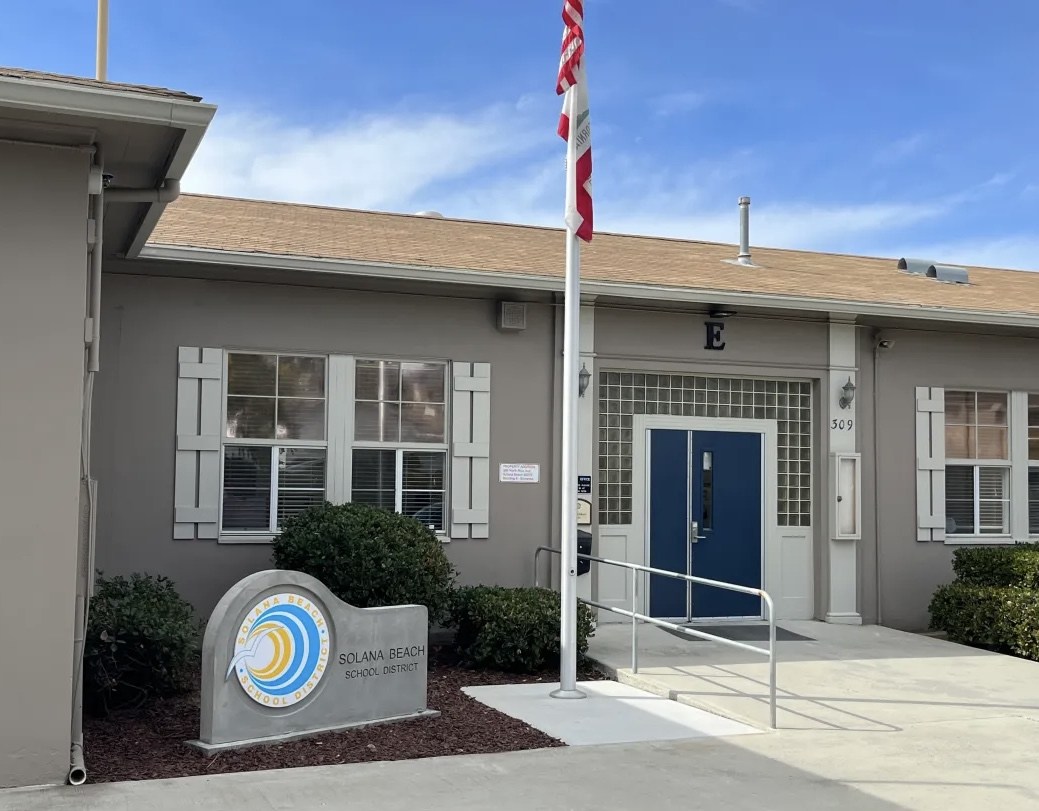
This school year, the Solana Beach School District will continue to evaluate student use of digital tools in the classroom, an ongoing conversation among school districts nationwide over the last several years with the proliferation of screens in people’s daily lives.
Over the summer, the Solana Beach School District chapter of Schools Beyond Screens delivered a petition signed by more than 300 parents asking for reform in the district’s education tech usage and limit students time on screens in the classroom. The petition called for eliminating devices for the youngest students, setting time limits by grade level and reducing the district’s 1:1 device program (iPads for grades K-6), replacing it with shared laptop carts and computer labs for grades 2-5.
Change has already come in the largest California districts. Los Angeles Unified School District banned screen time before second grade starting with the 2026 school year. By fall, LA students’ screen time will be limited to 20 minutes a day in grades 2-3 and 30 minutes per day in grades 4-5 with more restrictions going into effect for middle school and high school next year.
In June, San Diego Unified passed its screen time resolution, prohibiting video streaming and non-instructional gaming platforms on student devices. Computer carts will also be removed from transitional kindergarten classrooms.
“As parents we’ve watched technology be more integrated into education over the past decade and we have growing concerns, as do the science and education communities about excessive screen time, increasing distraction and digital dependency, the developmental appropriateness of ed tech and inappropriate content embedded in it, children’s cognitive development, and the impact of device use and gamified apps on students’ focus, social development and overall wellness,” said Annie Claplan, a Solana Santa Fe School parent in the chapter. “We believe technology can be a valuable educational tool but only when it’s used purposefully and in ways that truly support students’ learning and wellbeing.”
At the board’s Aug. 13 meeting, the board heard an update about the district’s “intentional” use of digital devices and how they are evaluating whether the tools are having a positive impact and are aligned with curriculum, looking at usage data and listening to teacher and family feedback.
“This will be a year of ongoing learning,” Associate Superintendent of Instructional Services Sabrina Lee said, “Our goal is to create new learning experiences and new ways to apply knowledge, connecting learning to real-world problems while building the communication, collaboration and adaptability skills that students need in a digital world.”
In Solana Beach, Lee said they aren’t using technology just for technology’s sake but to amplify students’ thinking. Teachers follow the framework of the SAMR Model for tech integration: SAMR stands for Substitution, Augmentation, Modification and Redefinition. They try to avoid substitution and augmentation, where tech acts as a direct substitute, like students typing an essay instead of handwriting it or using spellcheck or AI for word selection. Instead, they look to use tech to open up opportunities such as collaborative peer editing or publishing writing to a wider audience for feedback from experts beyond their classrooms.
Rather than passively consuming content on the screen, students might use tech to code, design, research or create media.
As Casey Doose, the district’s new director of instructional services and educational technology said, Solana Beach’s focus is on screen value rather than screen time.
“Our commitment is to promoting technology use that’s intentional, not a default, reward or substitution for strong instruction,” Doose said. “The measure of success is not how long a screen is being used but whether we can deepen learning, increase access or enable something instructionally meaningful.”
Doose said digital tools are only selected when it adds value. In the classroom, they are aiming for a balance of discussion, movement, hands-on learning, and face-to-face interactions.
“Technology is just one tool in a broader instructional approach,” Doose said. “We are continually refining how it’s used so it does remain intentional, manageable, age-appropriate, and aligned with student needs.”
During public comment at the meeting, parents and students shared some of the concerns they have surrounding screens. Tom Kornecook, a Solana Santa Fe parent with a PhD in neuroscience, questioned whether digital tools really help students learn or just keep them busy. He spoke about how the digital platforms promote superficial learning, create distractions and encourage skimming, clicking, task switching and quick lookups.
“This is not an anti-technology argument; it’s a pro-learning argument,” Kornecook said. “The concern is not that all technology is bad, but that schools have often mistaken digital activity for deep learning and have moved away from attention-rich, human-centered instruction.”
A few student speakers shared how they like to learn instead of looking at screens, by playing real games with friends, creating their own art, writing out math equations and getting help from teachers.
“We would rather work with real people than with devices,” said Skyline School students Lucia and Shanti.
Parent Erica Carlin also pointed out an issue with tech equity. On the district-issued iPads, students have access to the online math game Prodigy. While playing, students are given pop-ups for paid memberships ranging from $9.95 up to $19.95 a month, offering tempting perks or rewards which kids often beg for. Carlin noted that as 14% of the district’s students are socioeconomically disadvantaged, software with premium memberships should not be included in the student experience.
In their discussion, board members said they were grateful to the public for speaking out and bringing their perspectives to their attention and to the district for being in “constant state of evaluation” when it comes to the intentional use of tech.
Vice President Debra Schade, who is also president of California School Boards Association, said this has been a very big topic in education for a very long time—she has friends on the LA school board that is now enforcing the strictest screen time policies in the nation. She said that in Solana Beach, students in transitional kindergarten through first and second grade probably don’t need to be on a device, however, they do need to be learning and advancing so that they are ready for use in third grade.
Schade said she is confident that the district has the “best of the best” educators leading the process of breaking bad habits in some classrooms and getting everyone on the same page regarding the purposeful use of tech. Parents are also a key part of the process, she said.
“We are at a juncture where we know we have to do something. I’m very, very proud of the leadership and where we are now and without saying ‘no screen time’, we need to put purpose first and lead with the why and lead with the students that are going to be the bearers of their generation going forward,” Schade said. “We need to be able to put them in an education space so they are learning how to deal with this…that digital citizenship is so important.”
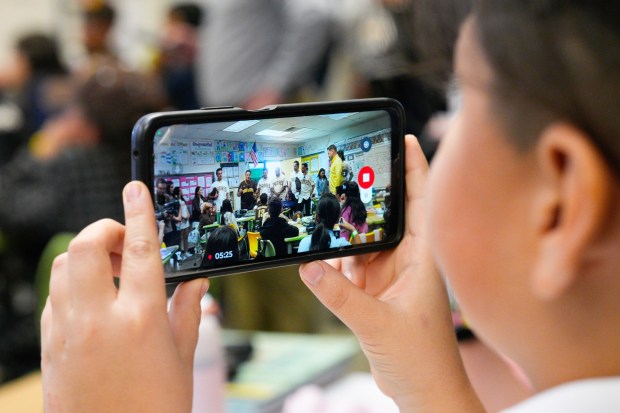 A student from a school district in San Ysidro used his smartphone to videotape the visit of a few of the Padres players to their classroom on Friday, Jan. 30, 2026, in San Diego. This school year, the Solana Beach School District will continue to evaluate student use of digital tools in the classroom, an ongoing conversation among school districts nationwide over the last several years with the proliferation of screens in people’s daily lives. (Nelvin C. Cepeda / The San Diego Union-Tribune)