
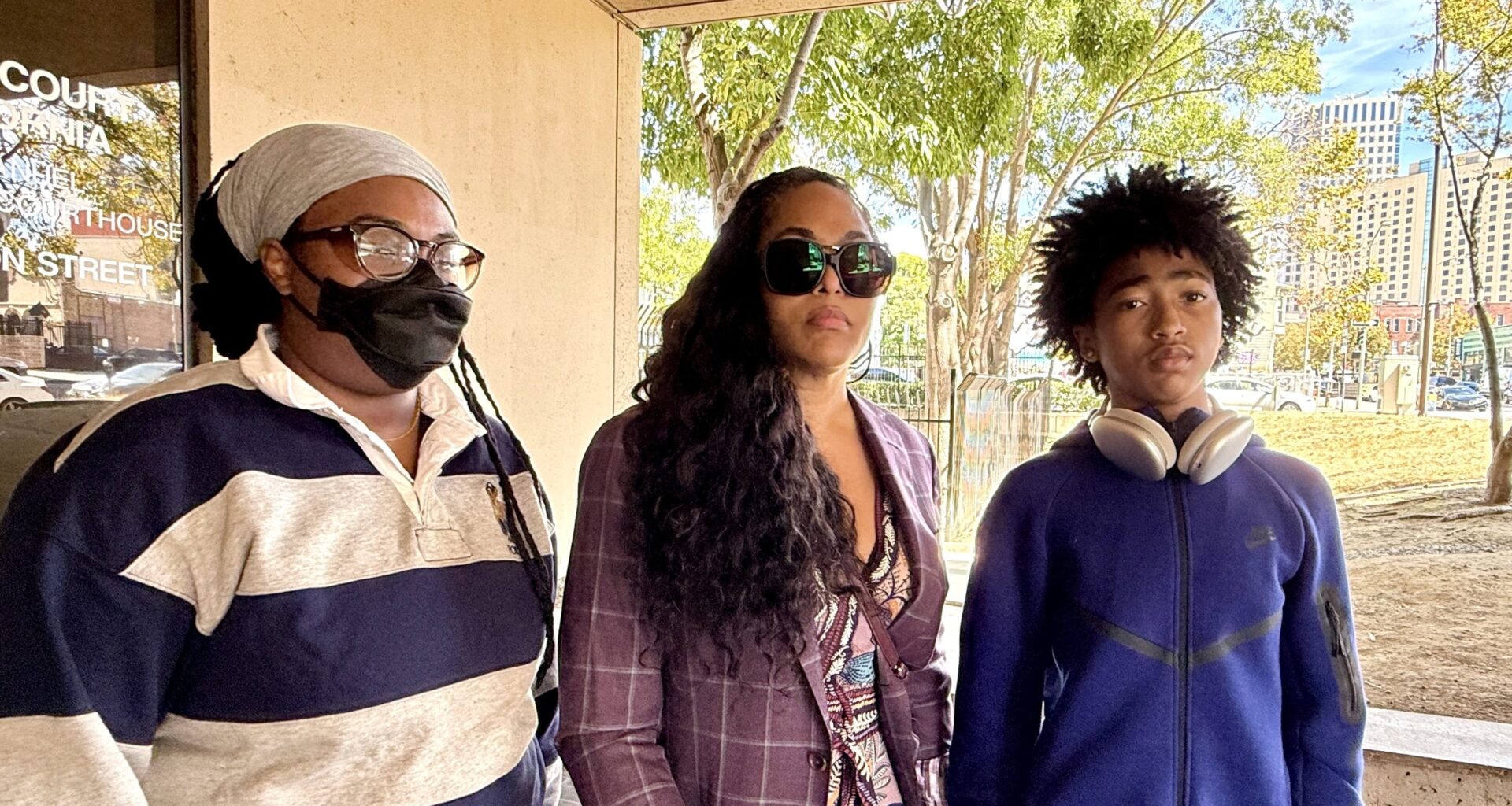
A sense of anguish pervaded the Wiley C. Manuel Courthouse in downtown Oakland this morning as Nina Woodruff, the partner of the late Marvin Boomer, the Castlemont teacher who died in a collision last year, spoke about his death for the first time in court.
Woodruff asked the presiding judge, Elisa Della Piana, not to release Eric Scott Hernandez Garcia from jail under the state’s mental health diversion law, which allows pretrial defendants to request mental health treatment in lieu of jail.
Hernandez Garcia is the Oakland resident who is accused of losing control of a car on E. 21st Street and 12th Street in May 2025 in the wake of a California Highway Patrol chase, then slamming into a fire hydrant that hit and killed Boomer and injured Woodruff. Hernandez Garcia, police said at the time, crashed the car into a tree near the couple’s home, fled on foot, and was caught nearby by CHP officers. He was 18 at the time of the crash.
“He refused to listen to police when they told him to stop multiple times,” Woodruff said. “He is a risk to society. Refuses to listen. He won’t listen to officers . Instead, he brought his problems to my doorstep.”
Woodruff said that she was broken on the inside and that her “brain is compromised thanks to Mr. Hernandez.”
A debate over mental health diversion
For most of this year, Hernandez Garcia’s lawyers have been seeking a mental health diversion for their client. The statute was amended by a new piece of legislation, AB 46, this year. Those changes, which take effect on January 1, would require defendants to have received a diagnosis of or treatment for a mental health issue within the last five years to qualify for diversion. It would also add more oversight to the program and give judges greater discretion to use public safety as a standard in evaluating requests.
Hernandez Garcia was brought into court from Santa Rita jail wearing a green jumpsuit. He looked away from Woodruff while she spoke and, at one point, looked down for several seconds. Hernandez Garcia’s family, including his sister, sat a few feet away from Woodruff; a few of them closed their eyes while listening to her speak. One older relative put her head in her chest during the statement.
Miriam Hernandez, the defendant’s sister, who lived with him in central Oakland before the tragedy, spoke about her brother’s character, saying he was a ‘humble” person who “wouldn’t hurt anyone on purpose.” She also spoke about what she described as his history of untreated mental illness.
Hernandez said the family noticed him retreating from family members in his mid-teens, and she recalled him imagining someone was speaking to him when he was in his room by himself, even saying that “someone” had asked him to harm himself.
“We would laugh about it because of our ignorance,” Hernandez said. “We would say, ‘Oh, it’s the devil,’ or, ‘It’s a spirit.’ And we did not pay attention ’cause we did not know that he could have a mental illness at such a young age. And many times, he would come over and say, ‘Someone did something to me in the room.’ We were like, ‘No one is there.’”
The Alameda County prosecutor arguing the case against Hernandez Garcia, Nora Wong, said at the hearing today that the county’s forensic psychiatrist had found issues with the findings of Dr. Rosario Carbajal, a psychiatrist who had analyzed Hernandez Garcia for the defense, and was awaiting the defense team’s reply. She did not say what mental health condition Carbajal had identified. Michael McNabb, a lawyer for Hernandez Garcia, said the defense would respond to that analysis over the next few weeks, in advance of the October 13 hearing.
Judge Della Piana said today that she would hear the final arguments on that date to help her determine whether Hernandez Garcia is eligible for the mental health diversion.
Woodruff’s daughter, Nia Moten, addressed the court about the effect that the crash had had on her mother.
Boatman said she had seen her mother endure multiple surgeries, “countless occupational and physical therapies,” and multiple mental health challenges, such as the inability to walk outside due to her new fear of speeding cars. Woodruff used a cane to get in and out of the courthouse today.
“Before the accident, my mother was sharp, an adamant walker,” Boatman said. “She would walk at minimum three miles a day, often with Dr. Boomer. She was a hard worker, putting in upwards of 50 hours a week across her many projects and colleagues, working to uplift the Oakland community. I do not minimize mental illness, nor the humanity of Mr. Hernandez-Garcia and his family, but I oppose mental health diversion because of the multiple serious injuries and death caused on that day.”
Dr. Boomer’s family, who live on the East Coast, watched the hearing today via a court video feed but did not offer their own statements. Woodruff and the family have filed separate legal cases against the city and the state.
‘I countlessly cry over it’
Several other cases in which defendants were seeking mental health diversion came before the court today. One was the case of Antowne Spruill, a 28-year-old man who was allegedly fleeing Fremont police after running a red light when he collided with a car that jumped a sidewalk and hit 39-year-old Abraham Fadel El-Zein. El-Zein’s family confronted Spruill at the court today, asking for a personal apology for the death of their loved one.
“ I go to bed every night knowing what I did, having night terrors, waking up three to five times at night a day,” Spruill said to El-Zein’s brother. “I countlessly cry over it because that’s not the type of human I am.”
The judge said that while there was a “deep unfairness” about the statute because it is “forward-looking rather than backward-looking,” she saw that Spruill had complied with his proposed treatment plan, including by submitting to substance abuse checks, taking prescribed medication, and completing a defensive driving course.
“I do want to note that diversion, for everyone here, is not a free pass; it’s an intensive, every-month check-in process for two years, and if you stop doing the treatment or if you pick up any new charge, the court can reinstate the criminal proceedings from this case,” Della Piana said.
“*” indicates required fields