
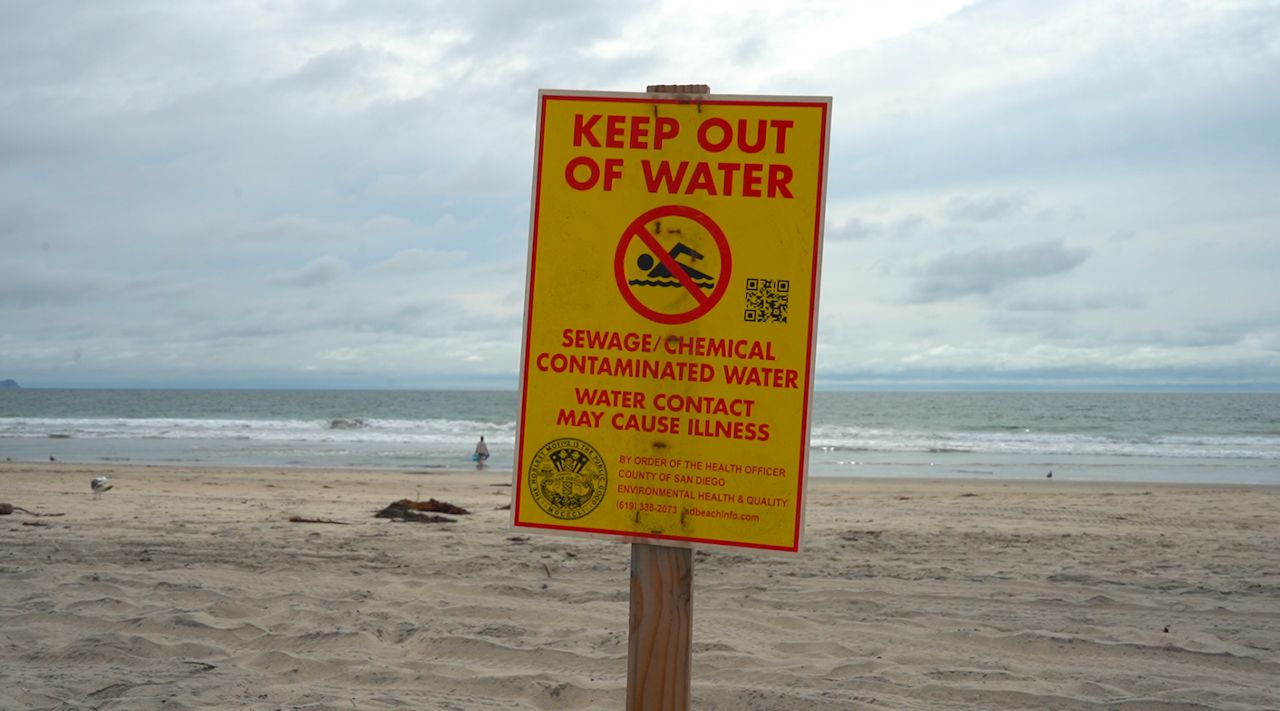
SAN DIEGO — For Billy Waller, the beach in Imperial Beach was a place where he grew up surfing, swimming and exploring.
Now, he brings his 10-year-old son to the same beach, but keeps him out of the water. Waller remembers surfing in the area as a teenager, even when the water became polluted.
“It’s been polluted pretty much the whole time,” Waller said. “Never this bad.”
The Tijuana River carries sewage and other contaminants across the U.S.- Mexico border and into the Pacific Ocean. Failures and infrastructure problems have worsened the decades-old crisis on both sides of the border.
For residents of Imperial Beach and nearby communities, the pollution isn’t limited to the ocean.
Toxic gases add another layer to the crisis
Several miles inland, near the Tijuana River Valley, contaminated water can also contribute to airborne pollution.
One area near Saturn Boulevard has been identified as a hotspot where the river’s flow can create turbulence, aerosolizing contaminants and sending them into the air.
Berry Elementary School is less than a mile from the area.
Kayla Roberts has two young sons who attend the school. She said the family can sometimes smell the pollution — and school staff take precautions when conditions are particularly bad.
On days when the smell is strong, Roberts said students may skip their normal outdoor morning lineup and go directly into their classrooms.
The school also uses air purifiers and keeps the air conditioning running, she said.
Health concerns have become a major focus of the crisis. San Diego County officials have been pushing for additional research into how exposure to pollutants is affecting people living near the river.
San Diego County Supervisor Paloma Aguirre has called the situation a public health emergency and said she wants more resources devoted to treating the pollution on the U.S. side of the border.
California puts new money toward the crisis
There has been some recent movement at the state level.
In June, Gov. Gavin Newsom announced $46 million in voter-approved Proposition 4 funding for projects addressing cross-border pollution in the Tijuana River and New River watersheds. But local officials said the money is only part of what is needed.
Aguirre has repeatedly called on the governor to declare a state of emergency over the Tijuana River crisis.
She said a state emergency declaration could help unlock additional resources and coordination.
The crisis has also become an issue in California’s gubernatorial race. Both Republican candidate Steve Hilton and Democratic candidate Xavier Becerra have pledged to declare a state of emergency if elected, according to Aguirre’s office.
Meanwhile, local leaders are looking at ways to capture and treat contaminated flows before they reach the ocean rather than relying entirely on infrastructure and cooperation across the border.
Aguirre is also backing health studies designed to better understand the long-term effects of exposure on residents.
A childhood lost
For Waller, the debate over funding and infrastructure comes back to something much simpler.
His son can’t experience the same childhood he had.
Standing on the beach, Waller watched his son build sandcastles instead of surfing in the water.
“It means a lost childhood,” he said. “My son will never get to experience all the things I did.”
For families living near the Tijuana River, the hope is that the next generation won’t have to make the same choice.