
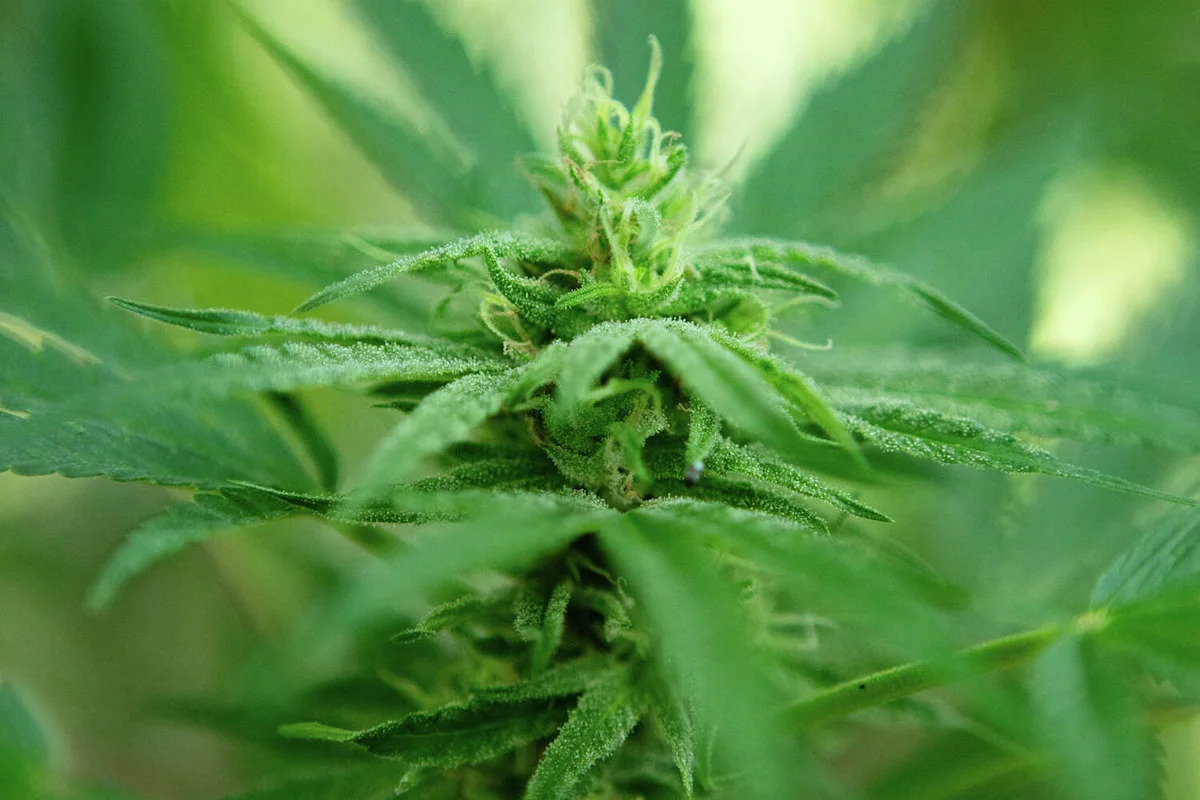
 A cannabis greenhouse in Monterey County, Calif. (Lester Black/SFGATE)
California’s leaders love to brag about the state’s legal cannabis market being the largest in the world. Even when the legal market has shown deep problems and dysfunction, leaders could say that at least California was still No. 1.
However, that no longer appears to be true.
Canada’s federal government released data last week showing that its June sales totaled $517.8 million Canadian dollars, or about $374.5 million in U.S. dollars. That’s more than the $372.4 million that California sold the same month, according to the Department of Cannabis Control, meaning California has lost its superlative status.
The two markets have some clear differences, notably that Canada is an entire country while California is a state. But both have similar populations; California has 39.5 million people while Canada has 41.4 million, and the differences have not stopped California’s leaders from making the international comparison in the past. Just last year, Gov. Gavin Newsom mentioned that California’s pot market is the biggest in the world in at least six different news releases.
 The exterior of Airfield Supply Co., a cannabis dispensary, advertises its selection in a storefront window in Redwood City, Calif., on Jan. 7, 2026. (Douglas Zimmerman/SFGATE)
The leaderboard flip comes as the two markets take decidedly different paths. Canada is posting record cannabis revenue as the country opens up new legal stores, shuts down the illicit market and expands into exporting cannabis to European countries like Germany.
California is moving in the opposite direction. Legal sales have cratered since they peaked in 2021, driven by both lackluster retail performance and an ongoing drop in prices, which means even when more products are sold, overall revenue can decrease. The state has also seen a contraction in retail access, with declining retail stores as the majority of the state’s counties ban retail cannabis. The illicit market has continued to proliferate, and California is unable to legally export cannabis internationally or even across state lines.
Hirsh Jain, a cannabis consultant based in Los Angeles and longtime observer of the state’s system, said Canada passing California should be a wake-up call for leaders to open up retail access and lower regulatory barriers.
 Cured cannabis waits to be packaged into individual containers at a cannabis facility in Monterey County. (Lester Black/SFGATE)
“California was supposed to become the global model for cannabis legalization. Instead, it has become what Lieutenant Governor [candidate] Fiona Ma aptly describes as ‘a complete failure.’ California had every advantage imaginable,” Hirsh said in an email to SFGATE, referencing Ma’s remarks last month. “Yet poor policymaking has turned what should have been the world’s premier legal cannabis market into a cautionary tale.”
Story Continues
This isn’t the first time California’s position as the biggest market in the world has come into question. In March 2024, Michigan sold more overall product units, defined as any packaged cannabis good, than California did although the overall product value was lower. Michigan continues to sell more products than California, according to data firm Headset. Although that distinction has not stopped Newsom from continuing to call California the world’s biggest market.
Most Read
| Ex-child actor claims she was repeatedly raped during Disney filming
Sports | 49ers owner Jed York filed for divorce months before arrest
News | Husband of Central Coast teacher who died sues pool contractor
Parks |
French tourist dies in Death Valley after car breaks down
Read our stories ad-free on the new SFGATE app.
Gov. Gavin Newsom’s office declined to comment on the Canadian market and referred SFGATE to the DCC. Jordan Traverso, a spokesperson for the DCC, said the June sales data from Canada was not a fair comparison.
“California has no peer when it comes to the size and complexity of its legal cannabis market,” Traverso said. “We remain focused on the work of strengthening the legal market, expanding access to licensed businesses, and continuing to address the illicit market. We’ll continue to follow the data and let the numbers, rather than a single-month comparison, tell the story.”
Traverso did not respond to an SFGATE follow-up question asking how California’s market is peerless in size and complexity when two other markets are selling either more products or more overall sales.
 FILE: A cannabis plant grows at a legal marijuana farm in Mendocino County in 2024. (Lester Black/SFGATE)
California’s cannabis industry has long said that a lack of retail stores in California – especially in the 53% of cities and counties that outright ban cannabis businesses – is hampering legal sales and allowing the illicit market to thrive. The DCC has estimated that California’s market is still exporting $9.9 billion dollars worth of cannabis out of the state, while only $1 billion was sold to the legal market in 2024.
Retail access is one of the clearest differences between Canada and California. California currently has 3.7 retail stores or delivery services per 100,000 people, while Canada had double that amount with 7.9 stores per 100,000 people in December 2025, the most recent official data available.
 Employees at a legal cannabis farm in Monterey County, which has faced a severe decline in cannabis farming. (Lester Black/SFGATE)
California’s overall sales could pass Canada’s in the following months, as this is just one month of data showing the Golden State falling behind, but Hirsh said it should still make California’s leaders consider new policy proposals.
“So even if California moves back ahead in another month, I don’t think Sacramento should dismiss this as a statistical fluke,” Hirsh said in an email. “Canada has been moving in the right direction, while California has spent the last five years moving in the wrong one. Absent policy reform, this will continue.”
The success of California’s cannabis market could come to haunt Newsom, as he is expected to run for president in 2028. Newsom led the charge to legalize cannabis during his time as lieutenant governor and then oversaw the majority of the rollout of the legal market, appointing his close ally Nicole Elliott to run the newly formed DCC in 2021. He seemed to expect the focus to be on him, even a decade ago, telling Billboard magazine that the market’s success would be on him.
 Young cannabis plants grow at a large scale cannabis cultivation facility in Monterey County. (Lester Black/SFGATE)
“Put it this way: Everything that goes wrong, you’re looking at the poster child,” Newsom said in 2017. “Everything goes right, nobody will be looking toward me. They’ll be saying they were always onboard, and they would’ve done it better.”
More Cannabis Coverage
– One of California’s most expensive licenses is now basically worthless
– How weed drinks became the only winner of California’s legal weed market
– UC San Francisco study uncovers troubling new cannabis health risk
– The man behind California’s brand-new $15M weed ranch
– ‘This is freaking crazy!’: The rise and fall of a San Francisco party that changed the world
– Full SFGATE cannabis coverage
This article originally published at Canada surpasses California as largest cannabis market in the world.