
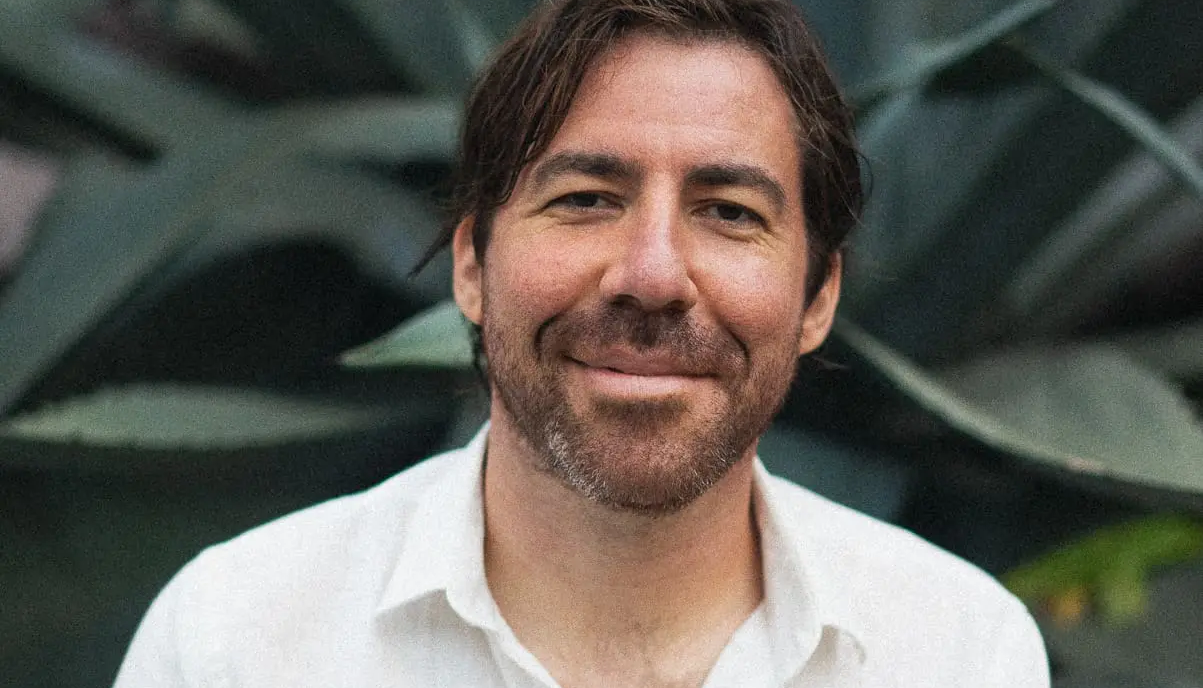
In this first-person narrative, incoming English transfer student Michael Battisto reflects on growing up discouraged from reading, cooking for top chefs at Chez Panisse and the thrill of studying his craft at Berkeley.
In first grade, I was lucky enough to discover books. I really feel like they saved my life.
I grew up in a working-class family in Chicago, and I spent most of my life in situations where it didn’t feel safe to say I was a poet. My dad struggled with bipolar disorder and alcoholism and was in and out of prison. He was proud to have never finished a book in his life. It was like, “Do you have book smarts or street smarts?” Because book smarts didn’t get you anything, he thought.
 Michael grew up in Chicago in a household he describes as anti-intellectual. After he learned to read in first grade, he couldn’t stop. He soon started walking to the library after school without his mother knowing, spending hours there discovering new books.
Courtesy of Michael Battisto
Once I learned to read, I didn’t stop. I just read and read and read. My home was the worst place in the world, but my room was my little haven. One of my favorite books was Fantastic Mr. Fox by Roald Dahl — it was weird, funny and a little bit scary.
After school, I’d walk to the library without my mother knowing and spend hours there. My family was very religious, and as a child I was kind of a Bible freak. I’d check out different versions, spread them across my floor and compare them. It’s not like I could understand everything in the King James version at age 8, but its language felt luxurious, full of peaks and valleys I’d never encountered before.
Then, when I was 15, I was institutionalized. I thought I was crazy for many reasons — the primary one being how often I was told I was crazy. Another was that I found both men and women beautiful. The bars on the inside of the hospital windows made it impossible to open them, so I didn’t see any sunlight while I was there. It was hell for me. The place I had been put in was worse than the place I thought to escape by ending my life.
The only book I had with me was Leaves of Grass by the 19th-century poet Walt Whitman. That’s what saved me. The way he strings together adjectives with all these commas, it’s as though he’s trying to go really deep into every single thing he’s encountering. It was a beautiful thing to realize that everything’s connected and that, through writing, we are all talking to each other across time.
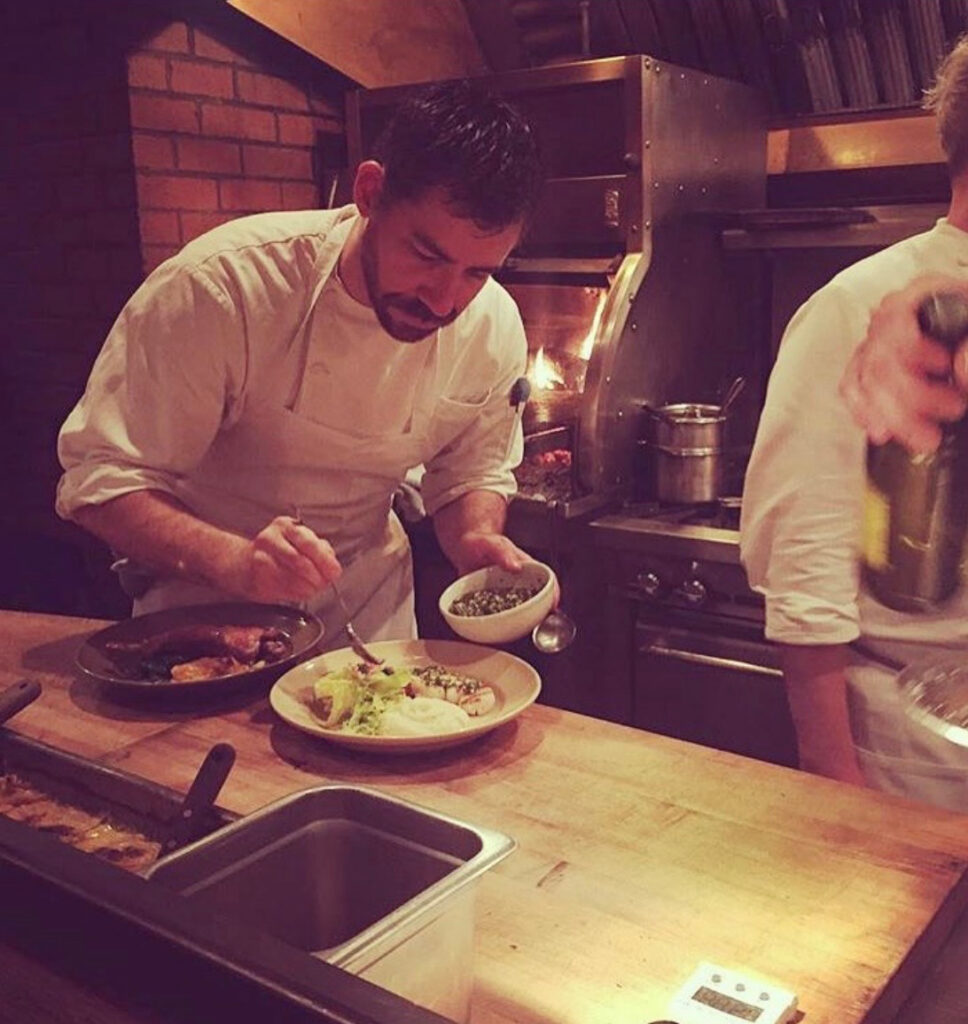 Battisto discovered his love for cooking after moving to Wyoming to work as a dishwasher. He began working for better and better restaurants, eventually becoming a lead cook at Chez Panisse in 2015, pictured here. “When I saw a dish on a page, the idea became a kind of matrix in my mind, and I could bring all the elements together,” he says. “It’s almost like writing a poem.”
Courtesy of Michael Battisto
When I got out a few weeks later, I had a profound moment when I knew: I am a poet. There was no longer a difference for me between writing poetry and living.
After years of working overnight warehouse shifts, I moved to Grand Teton National Park in Wyoming to take a dishwasher position at a restaurant. That’s when I discovered cooking. It was creative, challenging and something I could believe in. While my co-workers went out to the bars after work, I went home and read cookbooks.
I spent the next few years traveling to different cities, trying to work in better and better restaurants. Eventually, I was working for acclaimed chefs who were winning James Beard Awards. In 2015, I started at Berkeley’s Chez Panisse and soon became a lead cook. All the while, I was writing whenever I could. But I never showed my work to anyone; I’ve had partners and best friends who never knew I was a poet.
When Chez Panisse temporarily closed during the pandemic, I redirected the energy I’d given to cooking into writing. For about a year, I wrote 12 hours a day, every single day, because I didn’t know when I’d have that time again.
I began submitting my poems to journals; I’ve since published more than 170 of them and received nominations for Best of the Net and a Touchstone Award. I often explore themes like food and housing insecurity, intergenerational trauma and urban history.
Freedom of expression is incredibly important to me. That’s why I decided to come to Berkeley after transferring from Berkeley City College. As a Jack Kent Cooke Scholar, I plan to major in English and minor in creative writing or rhetoric. I got into a poetry workshop this semester with Geoffrey O’Brien, which I’m really looking forward to.
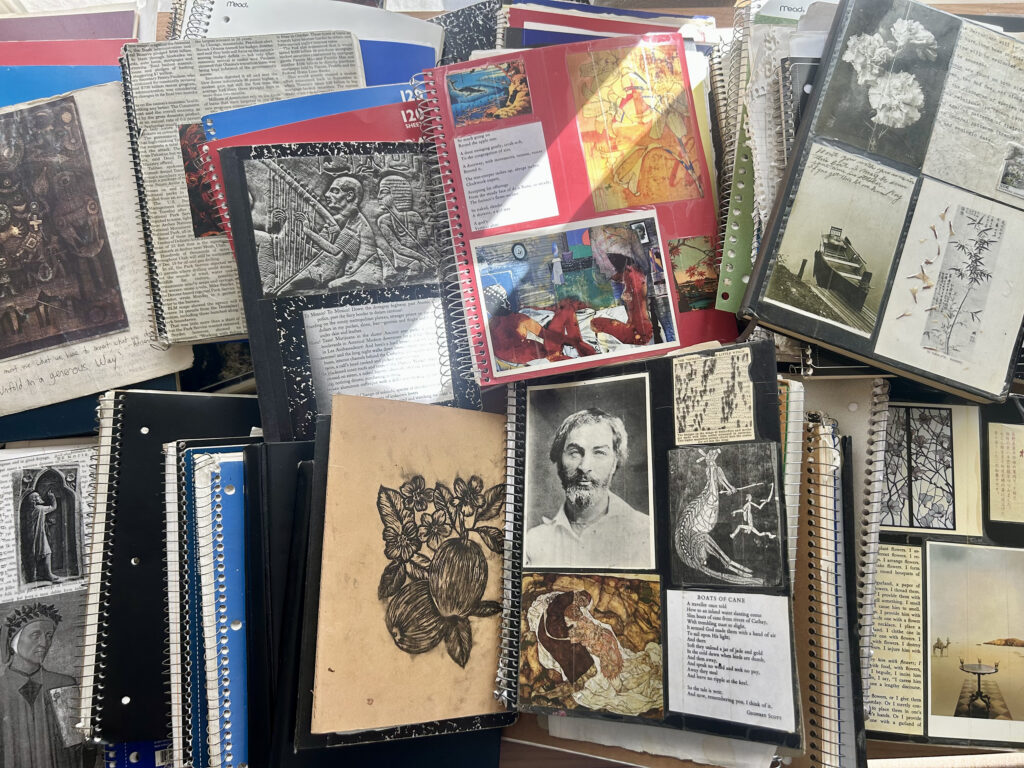 Throughout his life, Battisto has written in his journal whenever he has a spare moment — poetry, essays and short stories — without telling anyone for much of that time. He often explores themes around food and housing insecurity, intergenerational trauma and urban history. His journal collection, shown here, has grown to 57 volumes.
Michael Battisto
Berkeley’s English department is one of the most preeminent in the world. It’s not just about interpreting a text, but considering the circumstances in which it was written: What social pressures shaped the writer as they composed it? What does a relationship in the text reveal about gender? Just the idea of being at Berkeley around people who are here to learn, to think, to analyze these things — it’s heaven.
After I earn my B.A., I’d like to pursue an MFA in poetry and then a Ph.D. overseas, perhaps in the U.K. I want to build an ecosystem that supports my work as a writer. I already run a Substack newsletter and have been teaching poetry-writing workshops. One day, I’d love to be a poetry professor. I’m thrilled by teaching. Because I struggled so much to find knowledge on my own, being able to share it with someone else is incredibly rewarding.
Some writers feel like everything’s already been written, but I am constantly inspired by how much there still is to write about.
Read poetry and other writing by Michael Battisto on his website and his Substack newsletter, Continuum.
To learn more about Battisto and his journey to Berkeley, read his essay, “What It Took.”