
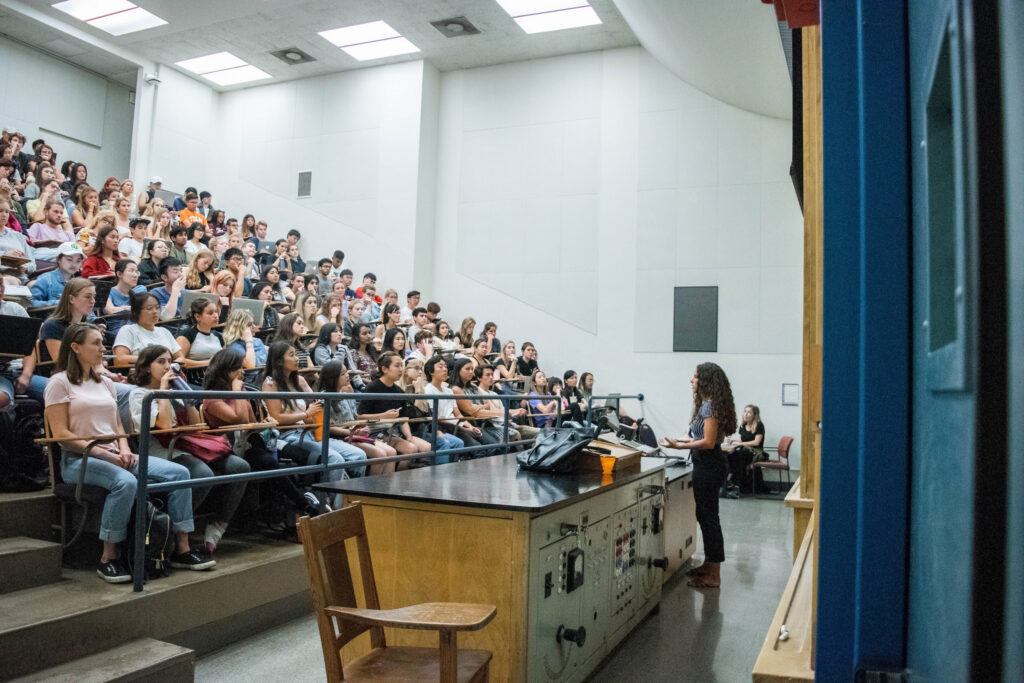
This week, UC Berkeley students will settle into lecture halls and around seminar tables for their first classes of fall semester. While some courses will be longstanding prerequisites, others will be brand new, designed to equip students for a rapidly changing world and to think deeply about it. Some students will dive into the past, reading 14th-century Chinese horror stories, while others will think about the future by engaging with the work of Octavia Butler or programming autonomous robots. They’ll craft slick-looking slides for an assignment to pitch a startup concept, discuss a Nobel Prize-winning labor economist’s work and grapple with ethical questions. Read on to learn more about some of the newest academic offerings for Golden Bears:
Afrofuturism in Music
Afrofuturism is a perspective that blends the Black American experience with speculation about future or alternate realities. Taught by composer Matthew Taylor, this class in the music department will ask students to closely listen to and analyze songs from artists like Janelle Monáe, OutKast, Sly & the Family Stone and Prince. They’ll consider visions of the future that date back to the Great Depression, like Skip James’ “Hard Time Killing Floor Blues,” as well as very recent Afrofuturism, like the Kendrick Lamar soundtrack for the blockbuster film Black Panther. Jimi Hendrix’s distorted national anthem performance at Woodstock will also make an appearance, as will literary works, including an interview with Octavia Butler, the grand dame of science fiction.
Modern Applications of Plant Biotechnology
This Plant and Microbial Biology course takes the long view — 10,000 years long. Professors Becky Bart and Patrick Shih will help students understand the science behind the earliest examples of crop domestication in Southwest Asia; come December, they will have arrived at the cutting edge of modern agricultural technology. In between, they’ll learn how scientists figured out how to create disease-resistant crops, hear guest lectures from local biotech startup founders and consider the ethics of these technological advances. As a final challenge, students will be asked to create a group pitch for a product or company that uses the plant biology they’ve been learning about.
Preparing for Community Engaged Research
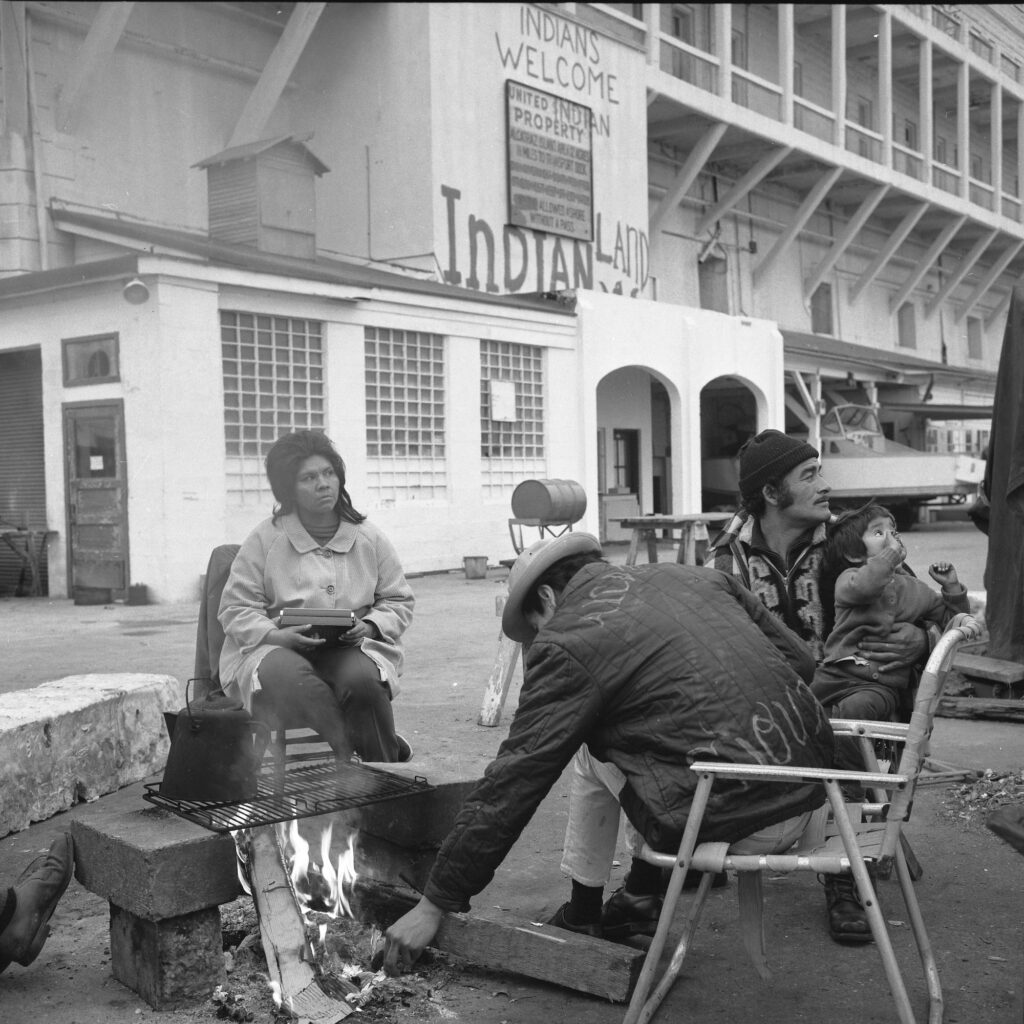 A photograph from the Native American occupation of Alcatraz in 1969. Berkeley students were involved in the activist group, Indians of All Tribes, that organized the occupation.
Cal Montney/UCLA Library Special Collections
“Academic research done at universities can support broader communities beyond them,” writes geography lecturer Chase Hobbs-Morgan at the start of his syllabus. His class aims to give Golden Bears the foundation to do community-engaged research: scholarship conducted in collaboration with, rather than on, the communities involved. In Hobbs-Morgan’s class, students will have the chance to get out of the classroom and into the Bay Area. One set of assignments involves attending and reflecting on two public events hosted by local organizations, and a walking tour of Alcatraz is listed as a potential field trip to accompany a module on Native American activism and the Indigenous occupation of the island from 1969 to 1971.
The East Asian Ghost Story
Kevin Shadel’s class might be best for those unafraid of the dark. It looks at the literary genre known as the “strange tale” or chuánqí, which originated in 14th-century China, and traces how these spooky stories evolved and contributed to the horror genre as we know it today. Students will read centuries-old tales from China, Korea and Japan and encounter nightmare fodder like rokurokubi — humanoid creatures whose heads either detach or float on long, super-stretched necks — and a shapeshifting serpent woman. Enrollees will get to moonlight as podcasters, since assignments include recorded reflections on the readings, and will turn in their own original ghost stories for a final project. The course counts toward the new Korean language and culture major, along with other majors in the East Asian Languages and Cultures department.
 This woodprint, created by Utagawa Kuniyoshi around 1844, shows a Japanese mythological creature, a gashadokuro, being summoned by a princess.
Public domain
Climate-Positive Ventures: Turning Environmental Challenges into Market Opportunities
Entrepreneurial types from all sorts of majors will learn by doing in this project-based College of Engineering class, which throws them into the role of startup founders. All semester, they’ll work in teams to conceptualize a business that would address an environmental problem. Groups will be coached by Bay Area-based climate entrepreneur Nathan Sedlander. Coursework will involve conducting interviews to find untapped opportunities, rigorously vetting ideas and building a “vibe-coded” prototype. Finally, they’ll pitch instructors and industry experts, and the winning team will move on to the Collider Cup (the Sutardja Center for Entrepreneurship and Technology’s version of Shark Tank). Students will also get to act as venture capitalists and learn how to evaluate their peers’ business proposals.
Us and Them: The Psychology of Prejudice Through Fiction and Science
This psychology course takes a split-screen view to understand prejudice. Each week, participants will watch a film or TV episode and also read fiction that depicts prejudice in action, including the movie Get Out, an episode of Black Mirror and short stories by acclaimed authors like Ursula K. Le Guin and Flannery O’Connor. At the same time, they’ll review academic studies in social and personality psychology to understand what science tells us about prejudice — and what it cannot fully capture. Ultimately, Professor Rodolfo Mendoza-Denton writes, “You will practice using your heart and your head together to understand the complexity of the human condition.”
Data and the Body
This fully waitlisted seminar, taught by new faculty member Kate Metcalf, may feel relevant to anyone who’s owned an Oura ring, Garmin watch or Fitbit. For three hours each Monday, the class will rigorously consider the history and implications of data about the body, including how early medicine and epidemiology shaped modern information practices and how data and psychology have been used to produce consumer profiles and influence behavior. As a graduate-level course in the School of Information, it’s intended to give students practice digesting and discussing complex academic texts — and give them the full context of modern applications, like consumer genetics, facial recognition and self-optimization.
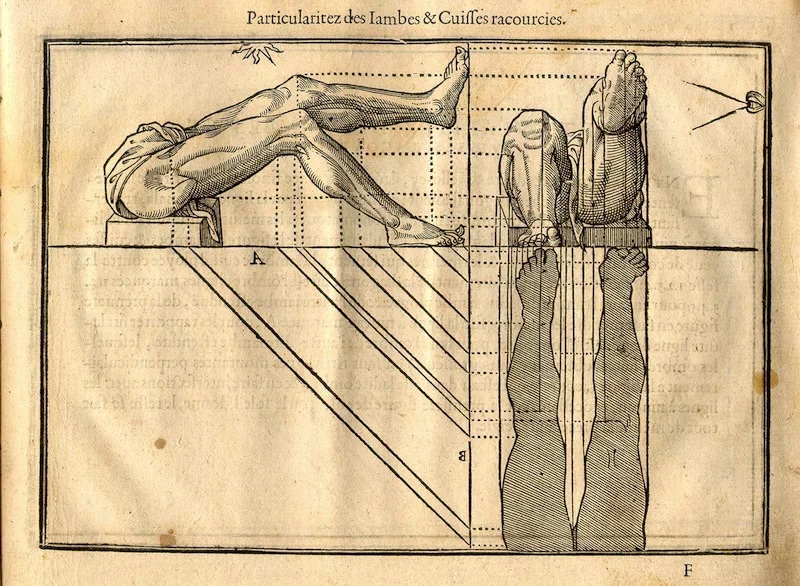 An example of early data-gathering about the body: engravings from a 1608 French book, Livre de Pourtraiture, illustrating human anatomy for artists.
Jean Leclerc/Public domain
Probabilistic and Learning-Based Navigation for Physical AI
How does a driverless car or a robot know where it is in space? This course, in the Department of Electrical Engineering and Computer Sciences, delves into the complex AI-enabled calculations that aim to answer that question. One challenge students will explore involves combining data from camera feeds with input from other sensors, like accelerometers. They’ll also tackle how robots navigate an unknown space while simultaneously updating a “map” of it. Three hours of lab time a week will help students test out their programming on real and simulated robots. Instructor Giuseppe Loianno leads the Agile Robotics and Perception Lab, which is centered on this rapidly evolving field.
The Economics of Gender and Discrimination
The existence of gendered wage and employment gaps is well known, but Nina Buchmann’s economics course will comb through the various factors — not just outright employer discrimination but behavior, gender norms, household responsibilities and others — that contribute to the famous 85 cents to a dollar statistic. The syllabus of this graduate-level course includes papers by Harvard economist Claudia Goldin, who won a Nobel Prize in 2023 for her work on this topic. Other readings cover gender differences in being asked to do unwanted, low-reward tasks and how property-division divorce laws impact women’s employment. The material spans the globe, too, examining attitudes about women’s employment in Saudi Arabia as well as how cash transfers have reduced intimate partner violence in Kenya and Ecuador.