
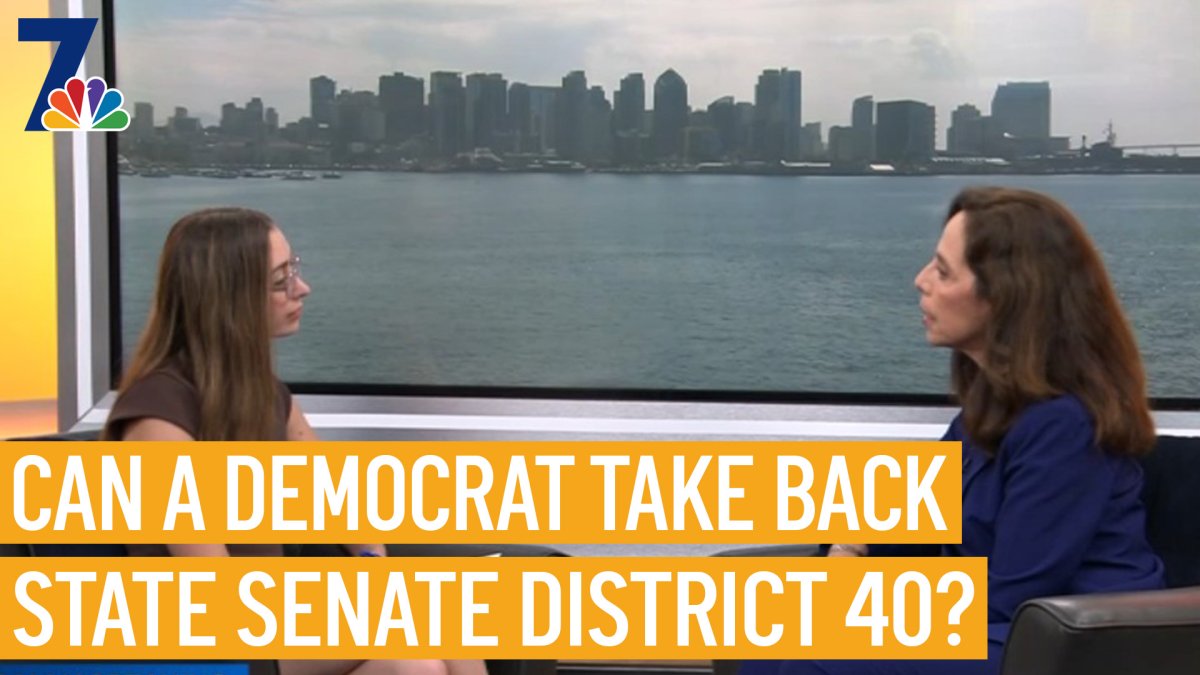
Former San Diego City Attorney Mara Elliott is running to replace Brian Jones, the Senate Minority Leader who is terming out. If she is elected, she’d bolster the Democrats’ supermajority in Sacramento. She joined NBC 7 Political Reporter Joey Safchik on Politically Speaking this week.
A transcript of the conversation is below.
Transcript:
Safchik: There’s a trifecta of races that could cause a seismic shift in San Diego’s political profile. Some voters in areas like San Marcos will weigh in on Congressional District 48, County Supervisor District five, and State Senate District 40, all highly competitive. Currently held by a Republican but liable to flip blue. Former San Diego City Attorney Mara Elliott is the Democrat running in state Senate 40 and joins us now. Thank you so much for being here.
Elliott: Thank you for having me.
Safchik: Why are you the person for this job?
Elliott: Well, I’ve been doing similar work for the last 30 plus years, and I really have a solid background as a municipal law attorney. I’ve worked with the county, with the city of San Diego as a city attorney for eight years, with transit authorities, with school districts up and down the state of California. I think the operational aspect often gets lost among lawmakers. Nobody’s ever had the experience I would bring to the table and everything we’re talking about right now that really impacts people has to do with how government runs. And I have I’m known for being able to find loopholes to really address them, to create programs that really make people’s lives better on a day to day basis. And as city attorney, first of all, it’s an elected position so accountable to the voters. It’s a watchdog job. But it’s not just the general counsel for the City of San Diego, but also the city’s prosecutor. And people in district 40 are concerned about public safety. They want someone who has proven credentials that they’re going to keep the public safe. I have a record of protecting domestic violence victims, gun violence victims, addressing elder abuse, child abuse. That’s really important to this district. But what they’re also looking for is experience. They want someone who’s been there before, knows how to solve things, and really can get in there and make a difference in their lives.
Safchik: You know, it’s interesting hearing you say that because I feel like in this day and age, we’ve grown accustomed to people who are familiar faces, maybe big media personalities running for public office. And you’re talking about these operational things on your resume that may, on paper, sound kind of dry, but it sounds like you think your tenure in City Hall and your experience with that is exactly why voters should pick you.
Elliott: I’m glad that you honed in on that. I think that that really sets me apart from my opposition on this. So often we enact laws or we do something at City Hall and we want it to get done, but there’s a disconnect. So you have your big press conference and we talk about how things are going to be terrific, but then the implementation is not there. I know how to implement, and I did that within my own office. So as city attorney, I was able to not only prosecute domestic violence, but run what’s called a Family Justice Center because we were concerned that if somebody is being abused, the propensity of returning to your abuser is very, very high because they’re often dependent on them. They’ve got children. Maybe they are immigrants and they’re being threatened with their status. I wanted to make sure that we close the loop. We don’t want to see people coming back in with an even worse story than we’ve already encountered. So I took over the Family Justice Center, rebranded At Your Safe Place, and it provides wraparound services for a victim of domestic violence. And now we’ve expanded it to human trafficking because the correlation is undeniable. Where they can go to one place and they get assistance getting a restraining order or clothing or food access or shelter, psychological care, forensic examinations, you name it, because we don’t want to see them fall back into victimhood. So that’s what I’m talking about. It’s not just the dream. It’s, you know, lots of people have big ideas, but I think where the public is so frustrated is okay. That was a great idea. Now what? And it’s also the accountability part of the job that I had. Because when you’re directly accountable to taxpayers, we are protecting their money. So if we’re asking them to make an investment in us and that way we deliver. And if we can’t deliver, they shouldn’t invest in us. So that was really important to me to be able to say, okay, here’s what you got for your money.
Safchik: On the other side of this coin, San Diego City Hall doesn’t have a sterling reputation right now.
Elliott: Yes.
Safchik: Are you worried that any of the city’s faux pas, even those after your tenure there, will haunt this campaign? Because that’s what people associate you with.
Elliott: Well, politics are politics. I have a lengthy career, a lot of successes. I’m known nationwide for the work that I’ve done to protect people. And when I was reelected in 2020, and remember, we were going through Covid and people were not necessarily happy with government. I won with two thirds of the vote, so I ended on a good note. I think the public appreciated that I was independent, that I was accountable to them, that I took their investment through their tax dollars very, very seriously and wanted to make sure that that came to fruition. So, for instance, when I was city attorney, we sold that stadium and that was beloved. We sold it to San Diego State University, the state of California. That was a very difficult transaction, but it resulted in no litigation. We issued almost 20 public reports informing the public of, here’s your investment, here’s how we’re handling it, here’s how we’re going to keep you from being embroiled in litigation after a deal closes. And who wants that? If we sell a house, we never want to hear from the person about it again. It’s no different than that type of transaction. So I was able to show that, yeah, every government agency has some problems, but sometimes we elect people who can actually get in there and fix them.
Safchik: A Republican has long held this seat. Democrats now have a razor thin edge in this district. What makes you think that it’s flippable?
Elliott: Well, so I don’t see it as a flippable seat. If you look at the history of Senate 40, it was long held by Democrats that after redistricting in 2020, Brian Jones came in and he was the right guy at the right time for that district back in 2022. So he actually broke a trend that went back decades while it had been held by Democrats. So I don’t see this as a Democrat or Republican issue. It’s who is going to make your life better. And I would love to see the public get away from looking at an hour or two afternoon and saying, okay, I align with that. That means everything’s going to go my way. We agree on everything. We should not be elected to office if we cannot deliver because our job is to make people’s lives better, and the public should be asking themselves, what kind of portfolio does this candidate have? Do they have a proven record of delivering? What have they done to make my life better? If we can’t answer those questions to their satisfaction, we’re not the right candidate for them. So it’s not a Democrat or Republican issue in my mind. It’s not flipping a seat. It’s finding the candidate that can really serve this community, a community where I proudly raise my children. I mean, there’s a lot of very interesting issues. I align with this community, our District 40 community, whether it’s law enforcement or I am married to a PhD chemist. He’s a researcher. He does cancer work. We are a hub of science in district 40. It’s also tech heavy. It’s pharma heavy. These are great jobs. We want to keep those jobs there. But also some of us want our kids to come home after they finish college so that we can play with grandkids at some point. Those are the things that are really important. It’s what people talk about when they get home. At the end of the day, whether they hit a pothole and it ruined their tire or they couldn’t go to the park because it wasn’t open. I mean, those are the types of things that can really drive people crazy. So who is the candidate, has the experience and knows how to get things done to make people’s lives better?
Safchik: Yeah. How would you still be a voice for the Republicans in this district?
Elliott: Well, as city attorney, I served every district. And so we have nine districts in the city of San Diego. The issues are profoundly different. Whether it’s San Ysidro versus La Jolla versus Scripps Ranch, where I live. So you really have to get to know your population. And I was in the public a lot hearing from people about what’s working and not working, what can we do better for you? And also explaining what I was doing because nobody knows what the city attorney does. So you want to make sure that they understand why it’s an important position and how it’s making your job better.
Safchik: And I think you can make the same case for your state senator.
Elliott: Yes. And it’s going to be, you know, hiring the right staff. You do spend a lot of time in Sacramento, but you get Thursday to Sunday to be with your constituents. And I want anybody to invite me to their meetings so I can learn about the real issues. The best ideas I’ve had have not been my own. It’s been from sitting around a table and talking to a chamber or a Rotary Club or gun violence prevention group, or whatever it may be, and saying, you know, there’s something we can do about that.
Safchik: If you have the chance to fix one thing about district 40, what is it?
Elliott: That is a really tough question, because I feel like the issues around us in general in the country are exploding. It’s affordability. And that’s you’ll hear a lot of people running for office say, well, I’m going to fix affordability. But how? You know, I want to get beyond the grandiose statements, the social media posts of outrage and get down to, what are we going to do for you? Well, I have some ideas that I think are really good. We’ve all hired lawyers, and we know lawyers can make suggestions, and the client doesn’t have to follow the lawyer’s suggestions. So I’ve got some stuff I’d like to dust off on the shelves that I think could really make a difference.
Safchik: Give me an example.
Elliott: Well, manufactured housing. We’re talking about that a lot. Condominiums are really a place where a lot of us started. That was the first home my husband and I ever bought. A dilapidated condominium where now do it yourselfers.
Safchik: How much development do you support in this district?
Elliott: I support as much as is safely possible, and I want to say it has to be safe, because we’re starting to encroach into areas where wildfires are prevalent. Now, I live in Scripps Ranch. We’ve had two devastating wildfires, so that’s top of mind in that regard. But finding affordable housing solutions, and I think there’s some that have been untested that I’ve seen as a lawyer that I would like to say, let’s give it a shot. And I’m known here in San Diego for saying, let’s give it a shot. If we fail, we fail. But at least we’re tackling something that’s really important to our community, not necessarily the way most politicians approach their job, but, you know, go big or go home.
Safchik: Democrats have a supermajority in Sacramento like we’ve talked about. California is extremely expensive. Why should voters trust that? Strengthening that supermajority by electing you would ultimately make their lives cheaper?
Elliott: Well, I think that they need to look at it through a local lens, because you may have a lot of Democrats that reflects the state of California. That’s just where we are right now. But every one of those Democrats needs to understand their district, or they’re not going to get reelected, because I see elected officials sort of like a stock. You put your money into it, and if it doesn’t give you any gains. And why are you going to continue to invest in it? You’re going to sell it off. Now that’s the same with us. So if you have a senator or an Assembly member who’s a Democrat and they’re serving your district, but they’re really not serving your district, that person is going to lose their seat. So my job is to really understand the district, help address the pressing needs. And there are so many, and then doing something about that and letting the community know what I’m doing, 12 years can go by in the blink of an eye. I saw that with my eight years as city attorney. So I’m hitting this position with the urgency it deserves. And I’ve got ideas I’ve already started drafting and working on, because I just want to get something done.
Safchik: How much responsibility do you think Sacramento has in creating headwinds for the Trump administration?
Elliott: Oh, I think it’s got extreme responsibility. And I’ll just say I worked with our attorney general, Bonta, and his job is to protect Californians. And he’s been able to do that because the state has invested in his office. I would have to go and look at the numbers. But he’s been able to claw back a lot of the resources that we as a state lost to the Trump administration. He’s also been able to stand up for our immigrant population or others whose rights have been trampled upon, and that’s really important. The legislature itself can also do educational laws that can do guidance. They can incentivize development. They can invest in our educational system. Those are all going to be important right now because California is not getting the resources that it really needs to effectively protect Californians. So it just makes the job of the legislature so much harder because you’re making up for money that you don’t have, that you should have gotten.
Safchik: Your campaign has received the support to the tune of tens of thousands of dollars of labor unions. Would you be beholden, then, to their interests if elected?
Elliott: That’s always a good question. Any time we take money, you got to ask yourself that. But I have a reputation, and I think the public has witnessed that of not being beholden to anybody but the person or the group of people that I serve as the city attorney. That was the city of San Diego, and I often was the one standing up saying, I cannot support this on behalf of our city. For these reasons, I don’t intend to change who I am and do I respect our labor workforce? Of course I do. They’re the ones that make businesses successful. They should be treated with dignity. They should be working in safe and healthy environments. They should be paid what they are worth. Am I going to stand for that? Of course I am. But there’s a balance we don’t want to, so put labor out of balance that businesses go under. So I think that any time you’re looking at making change or even voting on something, you’re trying to figure out, where are the compromises? Does this really work for my community?
Safchik: You told the Union Tribune that you support prop 40, the so-called billionaire tax. Why?
Elliott: I don’t recall saying that to the UT.
Safchik: I think this was back in May. You responded to a series of questions from them. They asked if you would.
Elliott: Yeah. I have to say I have reassessed whether I feel strongly about that because I think initially it sounded good. You know, get us through this very tight economy, help us with that one time bump. But I don’t think that that’s necessarily a good way to go forward. So I’m reassessing whether I still would vote for that.
Safchik: You’re not sure where you stand yet?
Elliott: I am standing probably against it. I think that we need to look at something that is a more comprehensive approach to a very difficult problem.
Safchik: You also told the UT in that interview that you oppose the voter ID measure. Do you stand firm in that position?
Elliott: Absolutely I do. It’s a solution with no problem that needs to be solved. There is nothing that indicates that we have election fraud in the state of California, and independent organizations have reviewed that to see if that’s the case. The responsibilities that are part of this proposition would require millions and millions of dollars on the state’s behalf, money that we don’t have. We’re already trying to figure out where we should be making budget cuts. So I think it’s an insane approach to a problem that does not exist. We have perfectly good precautions to make sure that we are not having election fraud, and the state is on top of it. I just don’t see any reason to support that.
Safchik: Back in 2019, you made an effort as the city attorney working with the legislature to reduce the public’s ability to get their hands on government documents and records that ultimately didn’t come to fruition. Right. In this political climate, how do you justify any effort to limit transparency?
Elliott: Well, I disagree with how you’re phrasing that. So what the bill was intended to do is there is something called the Public Records Act. And anybody can access government records. They can put a request in. There is a population that will sue for even the most minor mistake. And as city attorney again, remember my goal and my responsibility was to protect the public. So we were seeing a lot of these lawsuits where an attorney actually had the document that they put the request in for, and then said, here’s a document. You failed to produce it. The city of San Diego, like many municipalities, is huge. It takes a long time to find documents. So I don’t think that it’s necessarily nefarious if something doesn’t get found. What the Public Record Act lacks, and we have it with open meeting laws, is what’s called meet and confer. Tell us what you want so that we can try to address your need. And that’s a fair thing. So I try to insert a meet and confer requirement in. That should not dissuade anybody from asking for a record. That should actually make us get that record for them sooner, because you can use one term and I can use something else. And we’re talking different languages and we just don’t necessarily know what’s being asked. So that was the intent. It did not go where it needed to go. I think it’s a shame it didn’t because I think it.
Safchik: Would you try that again?
Elliott: Probably not. I’m not going to do that. The reaction was harsh. I own some of that. And the reason is, and I learned this as a new politician, when you’re doing something that can be taken by stakeholders as a seismic shift to sit down with the stakeholders and talk to them about it. I did not do that. I didn’t explain what I was trying to achieve. And when you don’t explain what you’re trying to achieve, people put words in your mouth. So that was actually a great teachable moment for a new politician. I didn’t do that again. So, for instance, with gun violence restraining orders, I met with the San Diego County gun owners because I learned and I said, this is what I’m going to do. If you ever feel that I am crossing the line, that I am, you know, not following the law, you call me. And they never called me during that entire duration. That’s the difference in approach. So that’s what I should have done.
Safchik: I know that curbing gun violence was a huge platform for you during your time as city attorney. What would you bring to the state legislature that you learned during that experience?
Elliott: Well, it’s again, actual operational experience. So we started a program within a year of taking office. There is what’s called a gun violence restraining order. It is an intervention for a crisis, and it can be reported from a spouse or an employer or anybody that somebody has got access to a gun, or they have a gun and they’re a danger to themselves or to someone else. So you can get an order for up to five years to remove that gun from that person so they can, you know, deal with whatever is causing the irresponsibility. And we intervened about 1500 times. And in the seven years I had the program, and that was really important. Those are lives saved. We can’t quantify it, but it’s a really important program. But we also trained law enforcement agencies throughout the state of California. So over 500 I understand the nuts and bolts. I know where there’s room to make it even more protective of citizens. This is not something where it’s being forced on people. It’s a tool. If somebody needs to use it. One thing that’s important is just reminding people, educating them that there are options available when they’re facing gun violence, domestic violence, human trafficking, whatever it may be, because we get so wrapped up in our daily lives that we forget you can actually call the police department and they’ll do something about it. So I think PSA’s are extremely important. It does. It’s not a huge investment of money, but when I was the attorney, I went on the news quite a bit just to remind people this is out there and call us if you have a situation. We’d be happy to help.
Safchik: I do want to circle back to the billionaire tax for a minute.
Elliott: Sure.
Safchik: The Democratic Party is split on this, right? The California Democrats have endorsed it. Newsom and Becerra both oppose it. What other ideas do you have as stopgap measures, especially as this is intended to help support health care while facing these federal funding cuts?
Elliott: That is a really terrific question, because I think that that’s the intent of this. This bill is to get that money to us to try to get through, to patch things through, because we have these pressing needs. I have a background in budget and auditing. I’m not an auditor, but I have worked with government agencies for 25 years, primarily through auditing. I actually enjoy going through budgets and trying to figure out if there’s anything left to cut. I always feel like if we’re going to ask people to pay more when things are so difficult, we better have a good reason for doing that. And I would want to go through I want to be on the budget committee and figure out, do we really need to be doing things this way? You know, that’s something I’m known for in my industry, is really being able to reverse engineer a process and figure out if there are steps that can be cut, can it be cheaper, or do we have to do this? Do we have to do that because we have to find some money? Now that’s not going to get us everything we need, but I think it’s a good start.
Safchik: What have you heard that has forced you to reevaluate your opinion on this?
Elliott: Well, I started to think about whether that’s good governance to do a one time infusion of cash, because at first it sounded great. I think, you know, we all get scared. I’m worried about my neighbors. I’m worried about the elderly people not having access to health care or medications or whatever they may need. But I’ve also seen in my experience that sometimes an infusion leads to not being responsible for future actions. So I’ll just use, for instance, Covid money. And this happened for some municipalities throughout the state where they got this infusion of money through Covid, and they created programs that requested or required ongoing financial commitments. I could see that happening with something like this. That’s actually what scared me away from it.
Safchik: A lot is being asked of voters who live in this political hotspot, or voting in all three of these competitive races. We know they’re going to be inundated, right? Right. Mailers and advertisements. What is your message to them? They’re bearing this pretty heavy burden.
Elliott: Well, that’s exactly right. I understand that you are facing a burden. I’ve got my own story to tell. I’ve got two kids in college right now. I have a husband who works for the state. Yes. So we watch dollars just like everybody else does. And I’m taking a little hiatus, so I can run. So we definitely get the problems. I think what people really want to hear are real solutions. What are you going to do to make our lives better? Really? At the end of the day, that’s what people care about. That’s why they engage in politics. So pinpointing this is what I’m going to do to make your life better. And if you agree with what I am proposing, I am your candidate. And if my opposition is the person who has better solutions, they should vote for that person. So I think that our job is to make a pitch where interviewing with the public and we’re trying to convince the public that we are here because we’re going to make your lives better. And that’s exactly what they are hiring us to do. It is a responsibility I do not take lightly.
Safchik: Your opposition has the backing of Reform California?
Elliott: Yes.
Safchik: You have the backing of the Democratic Party. How would that impact the lives of Californians depending on who is elected and the support behind them?
Elliott: That is a great question. I think that you should always look at endorsers to figure out what the values are of the people who are running. And I would encourage the public to look into both of us and figure that out. The position I am taking is centrist. I care about everybody. I’m not fighting for one particular cause. I’m not fighting for one particular religion or anything. I think that that’s exactly what people are looking for right now, is someone who is going to see the human being and fight for that human being, not someone who’s going to take care of a very small sliver of district 40. Just stay true to an ideology.
Safchik: Mara Elliot, thank you so much for being here.
Elliott: Of course. Thank you for having me.