
To Alonzo Carter, the message from the Oakland hilltop was clear: You can’t touch this.
That went for all of Coach John Beam’s rivals looking to wrestle Oakland Athletic League football supremacy from Skyline High throughout most of the 1990s. McClymonds was a basketball school in those days with dwindling enrollment, but then Carter, a West Oakland kid who’d made good as a dancer with MC Hammer, got the school’s top coaching job and put the public-school league on notice with a gusto that might have made Hammer himself blush. Carter cultivated a look with his orange-and-black fatigues and combat boots. He rode his motorcycle right onto the field. And he talked trash with rival coaches, especially his friend Delton Edwards, the coach at Oakland Tech.
Then, in a dynasty-changing 2001 Oakland Athletic League championship game, known as the Silver Bowl, Carter backed up his talk.
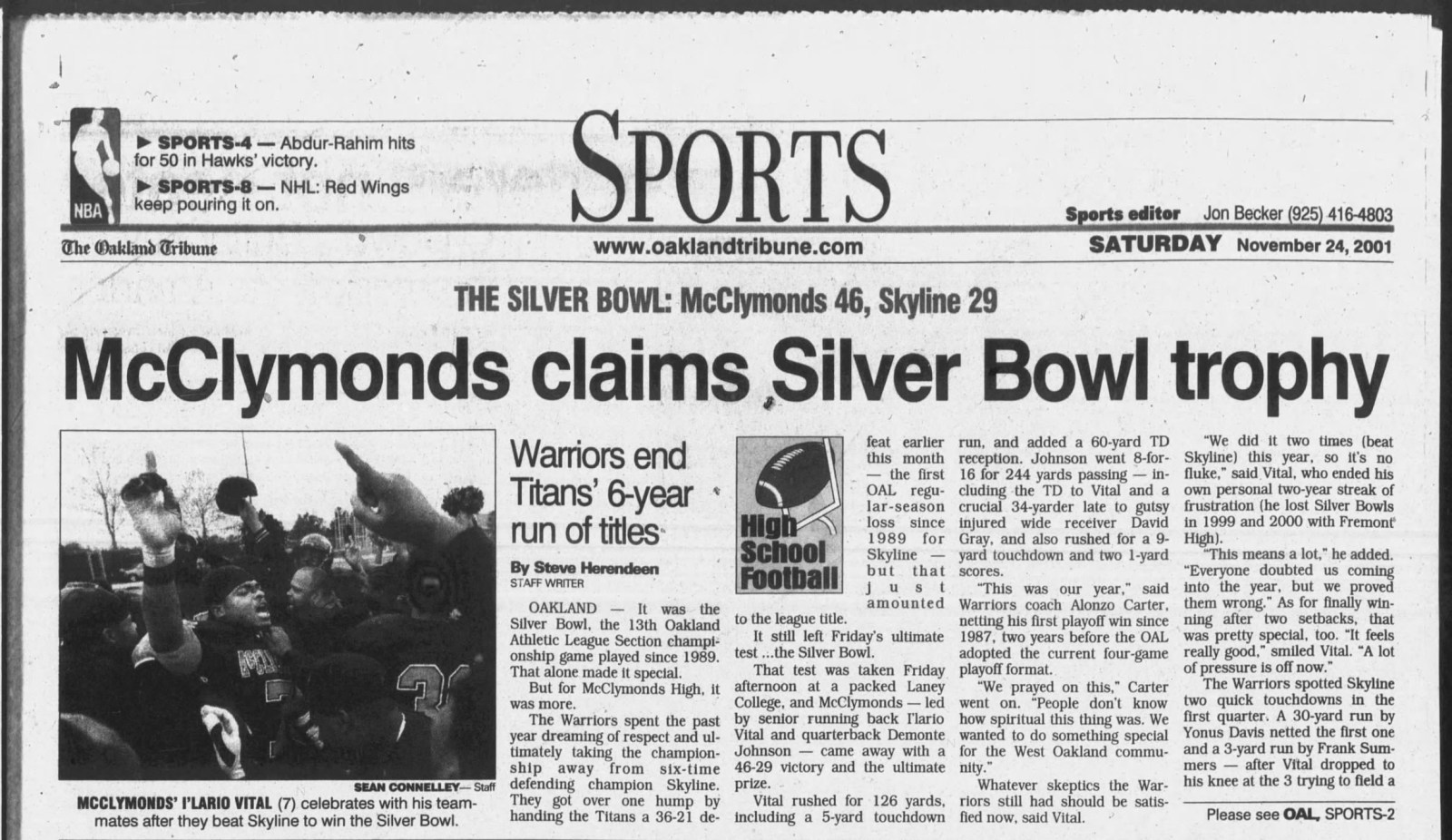 When McClymonds High’s football team toppled perennial league champions Skyline High, it made headlines. Credit: Newspapers.com
A quarter century after cementing his Oakland legacy, the kid raised in the Westwood Gardens projects is taking on his biggest role yet. Carter, 57, will lead Sacramento State into its first season in the Division I Football Bowl Subdivision, the top level of college football.
The Hornets have spent three decades in the lower Division I tier, the Football Championship Subdivision, mostly playing out of the national spotlight. Now, stiff-arming a trend among California universities that have been cutting football to meet budget shortfalls, Sacramento State is banking on the billion-dollar sport for television revenue while attempting to finance a stadium upgrade.
The Hornets open at Eastern Michigan on August 29. Their first home matchup will be against Mississippi Valley on Sept. 5.
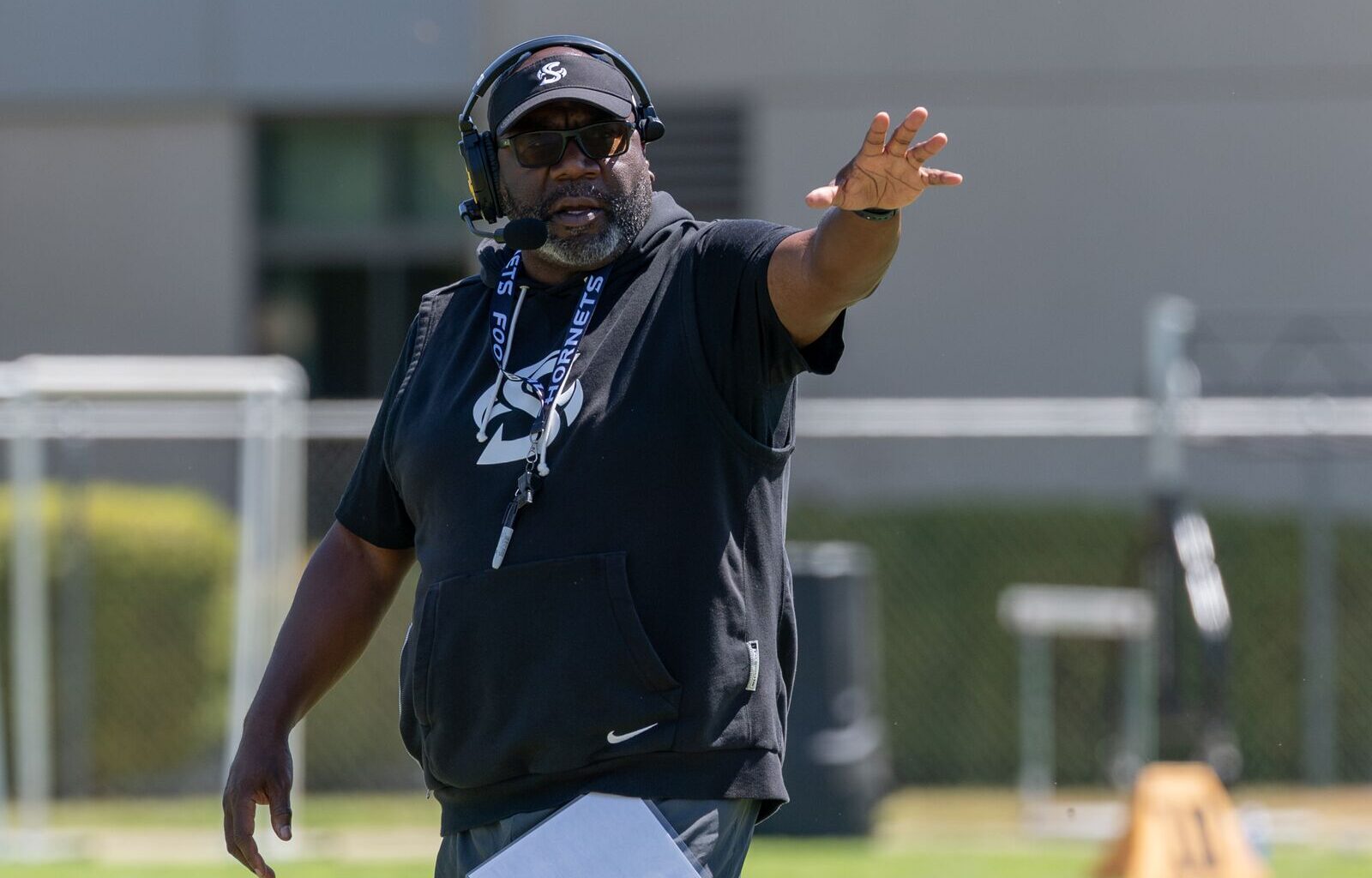
 Sacramento State head coach Alonzo Carter talks with his team during practice Tuesday, Aug. 18, 2026, at Sacramento State in Sacramento, California. Credit: Sara Nevis for The Oaklandside
A West Oakland kid
Carter, a standout cornerback at McClymonds in the mid-1980s, returned to the school as a track coach while touring part-time with MC Hammer in the early 1990s. He sold his drop-top Corvette, a gift from Hammer, to pay for new warmups. When Carter became head football coach, he tapped Hammer, a McClymonds alum, to pay for uniforms. Now, at Sacramento State, Carter is backed up by a staff of some 40 coaches, analysts and trainers.
After 15 seasons, Carter left McClymonds in 2007 for Berkeley High where he dominated the powerful North Coast Section. He went on to coach at Contra Costa College in 2010 and, after finishing his degree in African American studies at Cal State East Bay, took a Division I running backs coaching position at San Jose State in 2016. The past two seasons, he has been assistant head coach at University of Arizona.
Though Carter now saves the side-to-side Hammer shuffle that defined an era of Oakland hip-hop for “special occasions,” his dancing past and football future are linked. It was one of MC Hammer’s security guards, Lloyd Johnson, then a JV football coach at Fremont High, who inspired Carter’s return to the game.
Most Oakland Athletic League coaches, like Carter and Johnson, were homegrown. The public-school league had long been dominated by the five flatland schools — McClymonds, Oakland Tech, Fremont, Oakland High and Castlemont — where the majority of the city’s elite athletes grew up. McClymonds in West Oakland, the center of Oakland’s Black population boom after World War II, became known by the 1960s as The School of Champions by producing legendary athletes such as NBA player Bill Russell, MLB player Frank Robinson and Olympic gold-medalist sprinter Jim Hines.
 Carter, left, runs with his players during practice Aug. 18, 2026, at Sacramento State. Credit: Sara Nevis for The Oaklandside
 Carter works out with his Division I players. Credit: Sara Nevis for The Oaklandside
It took Skyline High, which opened in 1961 in the Oakland hills, decades to catch up in athletics. Coach Beam, a transplant from San Diego, used a tough-love approach to change the football culture. It paid off in Division I scholarships for dozens of his players. The sight of his short, red, school-issued shorts and trademark mustache enraged flatlanders who suddenly, in the 1990s, found themselves playing for second. Now some of Oakland’s top athletes bussed into the hills each morning. When Skyline football visited rivals, they were met with chants of “F— Skyline! F— Skyline! B—!” Games on the hilltop often ended in brawls. Skyline almost always won on the scoreboard, though.
Beam finished his football coaching career at Laney College, where he won a national title in 2019 before gaining worldwide fame through the Netflix documentary “Last Chance U” and becoming the school’s athletic director. Last November, Beam was murdered at age 66 at the Laney College athletics offices. (Cedric Irving Jr., a former Laney student, faces murder charges.)
Carter was named head coach at Sacramento State just a month later.
“Coach Beam was the standard,” Carter said by phone in early August between coaching meetings at Sacramento State. “If you wanted to win you had to beat Skyline, and you had to beat them on the hill, which was really difficult. We had a lot of respect for each other.”
Carter scheduled tough preseason opponents to prepare for the matchups against Skyline — even though other coaches laughed when the team went winless for those stretches. “His plan was, I can go 0-5,” explained Dion Evans, a former McClymonds assistant coach under Carter. “My kids will be better, have played tougher competition and by time we get to OAL it will be easy.” The strategy became a blueprint in the flatlands for rebuilding a program and culture.
 Carter after practice at Sacramento State, Aug. 18, 2026. Credit: Sara Nevis for The Oaklandside
If there was anyone Carter enjoyed beating more than Skyline, it was the neighboring school.
McClymonds in West Oakland and Oakland Tech in North Oakland, separated by just two miles, share more than a sports rivalry. As West Oakland’s iconic Black business district was fractured by freeways and gentrification starting in the 1950s, families moved to east and north, and some of their kids began to attend the rival school. Aaron Pointer was a football star in the 1950s at McClymonds. His daughters, who went on to form the famed R&B group the Pointer Sisters, attended Tech. Baseball star Curt Flood, who later paved the way for modern sports free agency, transferred from McClymonds to Oakland Tech in the middle of his high school career in the 1950s.
The showdown between the two schools’ football teams, the OAL finale, was dubbed The Ghetto Bowl in the late 1990s, with a garbage can trophy that Carter claimed Edwards, the Tech coach, never returned — or “lost”? — after McClymonds beat Tech in one season.
“Edwards chose to poke the bear,” Carter laughed about his friend, who died in 2021. “Being boisterous and loud, having someone whose voice was bigger than mine was fun.”
Carter and Edwards would shout, “Meet me at the 50!” across the field before going for drinks after, he said. “We had a friendship bigger than football.”
Heading into the 2000 game, Carter told the Oakland Tribune that if McClymonds lost to Tech, he would forfeit his playoff spot. McClymonds won, but then lost to Fremont in the OAL semifinals. Skyline then triumphed over Fremont to win its sixth consecutive Silver Bowl.
“It was passion, sometimes misdirected,” Carter, who goes by Coach Zo, said of his early, bombastic style. “I wanted to see people be successful and show these men that, despite the obstacles, they can be the next Bill Russell. Who can be that? Who can chase that?”
“There’s a huge trophy case at McClymonds and we used to stare at that thing,” he said. “It’s easy to teach tradition when it’s right there in front of you.”
Longtime Castlemont football coach Amin Denny, Carter said, taught him to be selfless. It was thanks to his example that Carter started inviting rival coaches to his West Oakland home each weekend to watch film, discuss the league and cut recruiting videos using his dual-deck VCR. Eugene Denard said that back when he was head football coach at Fremont High in the 2000s, Carter helped him get his star running back, Anthony Petty, a scholarship to Saint Mary’s College.
“It was a bonding time,” Denard said. “To join that fraternity was great. The camaraderie. Zo and Delton [Edwards] showed me how to put together highlights and what to ask recruiters. Today’s coaching fraternity is more cut-throat. Nobody wants to share information.”
 Carter, in red, at the 2001 Silver Bowl.
 McClymonds celebrates a touchdown.
 Skyline High coach John Beam.
In 2001 came the transfer that changed OAL football.
A few years before Marshawn Lynch was running through helpless OAL defenders in the early 2000s, it was the Vital brothers who were the talk of the town. L’lario and younger brother Genado followed Mario and Jino to Fremont High. The four brothers had dominated Oakland Babe Ruth Baseball and were now terrorizing high school football, but lost to Skyline in the 1999 and 2000 Silver Bowls. The following season, L’lario and Genado jumped to Carter’s rising program at McClymonds High.
In the 2001 Silver Bowl at Laney College, L’lario rushed for 100 yards and scored two touchdowns as McClymonds upset Skyline for the city title.
“It’s like a fairy tale,” Carter told the Tribune.
A commitment to Oakland talent
Today, McClymonds is still dominating OAL football, while Skyline has struggled since Beam’s departure and is coming off a winless 2025 season. Meanwhile Evans, who assisted Carter at McClymonds, has joined Denard’s coaching staff at Fremont. The longtime coaches, hoping to rebuild their program as Carter once did across town, trekked to Sacramento this spring for Carter’s coaching clinic.
“Alonzo shows the community where you can go if you concentrate, laser-focused on what you can become,” Evans said.
He also said he sees Carter’s ascent as an opportunity for Oakland athletes. “I’m rooting for him and excited for him,” he said. “If he’s able to assemble the staff he needs, he has proven at all levels he can get the kids he needs. It gives every kid from Oakland a legitimate opportunity to go D1. Alonzo Carter will ensure if you’re an Oakland kid playing at a high level, and have the grades, you will get a fair look.”
 Alonzo Carter with his friend Dion Evans. After assisting Carter at McClymonds, Evans went on to be athletic director at Madison Park Academy, head football coach at South San Francisco High, and head track coach at Oakland’s Fremont High. Credit: Courtesy Dion Evans
Carter estimates he has sent more than 100 players to Division I colleges in his 20-plus years coaching high school and junior college. “Some of the pitfalls in the streets are tough,” he told The Oaklandside. “You want to have those success stories.” He now hopes the East Bay’s best athletes will come to Sacramento, since the Hornets are the only West Coast team in the Mid-American Conference.
One of Carter’s first recruits was Oakland native Ellijah Washington, a transfer wide receiver from Oregon State who as a high school player helped his father, Coach Ed Washington, transform the football program at Castlemont. He recruited two more Oakland natives, Jahlil Lindsey and Carleton Perrilliat, who were teammates at Richmond’s Salesian Prep, as freshmen. Lamar Ellis, a running back at Oakland’s Bishop O’Dowd High, has, according to a post on X, committed to play for Sacramento State.
“Alonzo gives hope to real coaches,” Evans said. “Not everyone coaching are coaches. But for the guys building programs and developing talent, Alonzo is a guy you look up to.”
 Carter calls to the team during practice, Aug. 18, 2026, at Sacramento State. Credit: Sara Nevis for The Oaklandside
It’s been a decade since Carter was last a head coach, at Contra Costa College, and two since he commanded the sidelines at McClymonds in those fatigues and combat boots. His viral fame in 2017 from performing the iconic MC Hammer dance to “U Can’t Tough This” during a San Jose State practice — which landed Carter and the team an interview with Ellen DeGeneres — has long since subsided. But Carter’s confidence in his ability to recruit talent, a weapon that once shook up the OAL power structure, hasn’t wavered.
“Y’all in trouble,” he warned Sacramento State’s rivals during an introductory press conference in November. “The ones you think you’re going to get, well, you’re not going to get them anymore.”
Sounds like old times.
“*” indicates required fields