

Forever chemicals went unchecked for decades and now water regulators and chemical companies across the country are grappling with the fallout.
One chemical manufacturing company, 3M, was ordered to pay out between $10.5 to $12.5 billion to roughly 12,000 public water utilities across the country. The utilities filed a class action lawsuit over groundwater contamination, which 3M will be paying through 2037.
In 2022, the city of Sacramento filed their part in the lawsuit against the chemical manufacturer for the contamination of Sacramento’s groundwater. In 2023, they secured a $10.4 million settlement.
“[Sacramento’s] Water Resources have been contaminated by PFAS compounds approaching and exceeding California’s notification and/or response levels,” the lawsuit reads. That legal complaint was filed on November 1, 2022 in federal court, alongside a class of other water suppliers throughout the country that have been affected by PFAS.
Eleven wells were identified as wells contaminated with PFAS, which stands for per- and polyfluoroalkyl substances, by the City of Sacramento in the 2022 lawsuit. Drinking water data analyzed by CapRadio from the State Water Resources Control Board’s Division of Drinking Water shows that at one time water sampled from one well was over four times the EPA’s current maximum contamination level for safe drinking water.
The wells were not deactivated until 2024, the same year the EPA established legally enforceable levels for PFAS in drinking water. When the EPA established this maximum contaminant level, water suppliers were given until 2029 to comply with the standard, and earlier this year, that deadline was extended to 2031.
Data collected by the State Water Resources Control Board are sampled by the city, sent to certified laboratories for testing, and the results are reported back to the state and to the city. One well, identified in the State Water Resources Control Board data as Well 139, was tested 23 times from 2019 through 2021, with each sample ranging from 200% to 400% of the maximum contamination level for PFAS that goes into effect in 2031. That well has since been deactivated, according to the city.
The city was not able to immediately provide dates for when each well was deactivated.
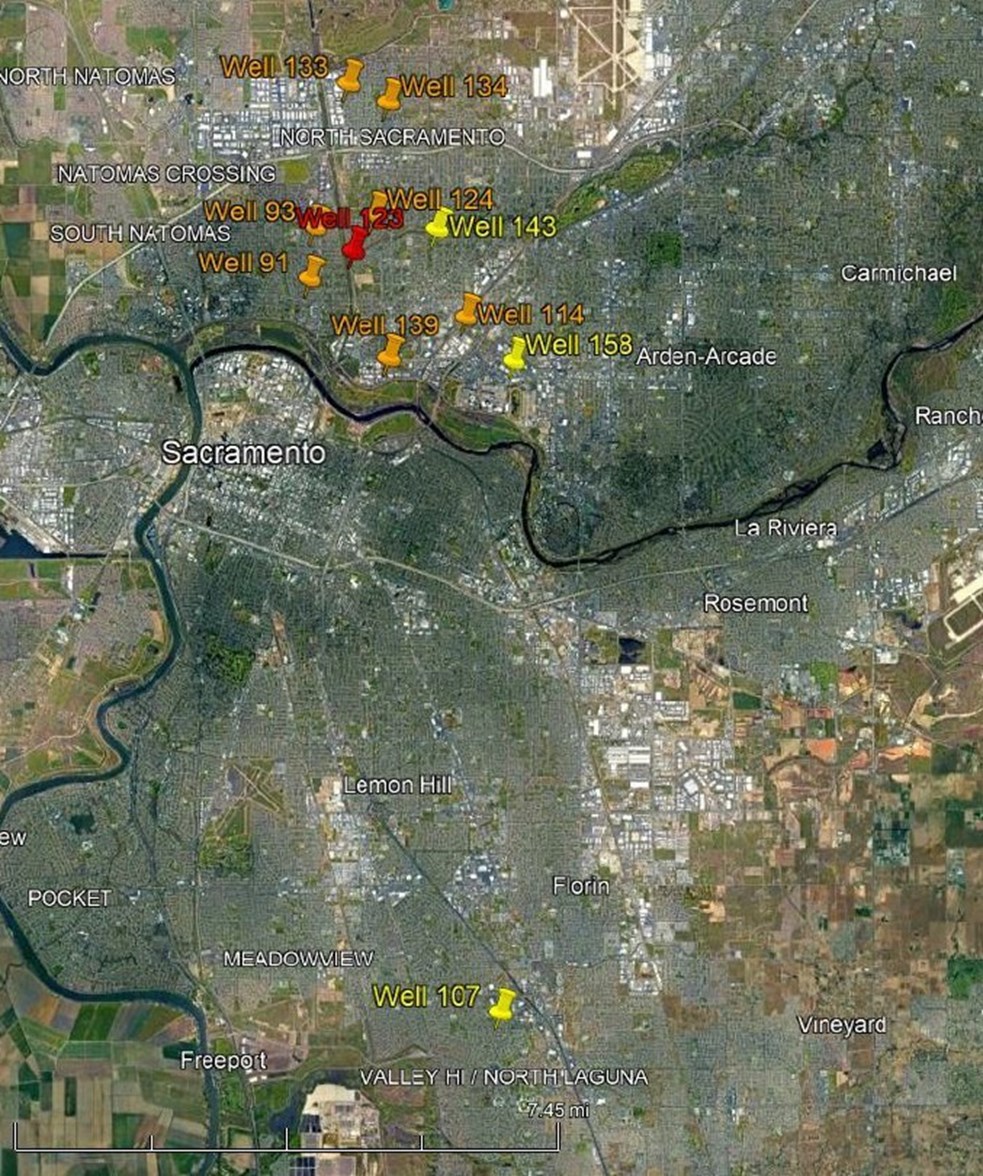 A map of the wells contaminated with PFAS identified in a 2022 lawsuit the city of Sacramento filed against chemical manufacturers.
How did the city respond?
Dalia Fadl, the Director of Utilities for the City of Sacramento, said that at the time the lawsuit was filed, the health effects of PFAS were not fully understood, and at what levels they were considered a health risk, but they were identified as something to watch out for.
“Proactively, before the lawsuit was even a thing, we started looking at collecting samples for PFAS only because by that time it was already kind of an emerging contaminant,” Fadl said.
The contaminated wells were not immediately shut off because they hadn’t surpassed notification levels at that time, or levels set by the state where they needed to start addressing the problem. When the city of Sacramento filed the lawsuit, state regulators were just beginning to issue orders around PFAS, with the first orders for testing being issued in October 2022. According to Fadl, the regulations that the city has to comply with are constantly in flux.
“You could have some trace amounts of some of these contaminants, and that would still be okay from a regulatory standpoint with PFAS,” Fadl said. “There was no number telling us, ‘Oh, if you have this much PFAS in the water, that’s a bad thing.’”
Also, the testing process for PFAS has evolved in recent years.
“The lab process for it is super complicated, [and] was not consistent,” Fadl said. “I don’t know that there’s a final [answer] on the testing method for California.”
The lawsuit filed in 2022 said that settlement funds would be used to address the PFAS contamination problem. According to Fadl, the city is using the money to account for wells taken offline for PFAS contamination.
“The funding allows us to go look for a new well site, be able to study it, drill the well, install all the treatment that comes with it and things like that,” Fadl said.
The city was not able to comment on the number of Sacramento residents who may have been exposed to PFAS through its tap water, or whether people living closer to a contaminated area were more likely to be affected.
“Historically, about 20% of the water comes from groundwater wells,” Fadl said. “We don’t necessarily have a certain area that would get water from a treatment plant, versus one area that would get water from a groundwater well.”
Settlements were calculated via a formula laid out in the suit which took into account the max levels of PFAS detected by the water supplier and the flow rate of each individual contaminated water source.
“The city did submit all the required data that we had available at the time, and then they crunch it into some formula,” Fadl said. “That basically gets determined by the attorneys in the settlement and then literally we just get notified that here is the city’s share and then we receive that share.”
Every year, the City of Sacramento publishes a Consumer Confidence Report, where levels of contamination are recorded to ensure compliance with state and federal requirements. In 2024, PFAS were listed on the report, but they were excluded in the 2025 report.
Fadl said that the exclusion of exact levels of PFAS in the City of Sacramento’s 2025 Consumer Confidence Report means that there were none detected in the testing conducted for the report.
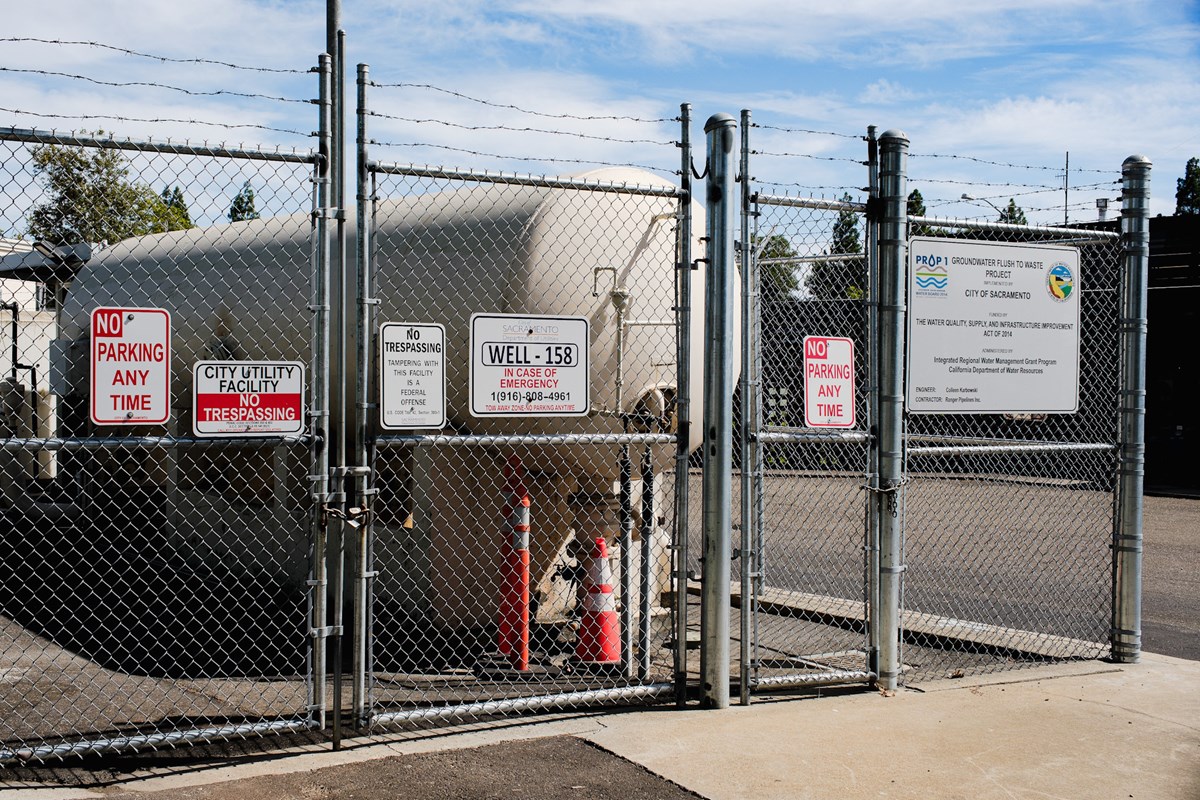 Sacramento’s groundwater Well 158 was one of the wells identified in the city’s lawsuit against checmical company 3M over “forever chemicals” contaminating groundwater. It’s next to Sacramento Fire Department Station 19 on Challenge Way.Ruth Finch/CapRadio
What are PFAS?
In the mid-20th century, chemists developed organic compounds that combined carbon and fluorine, in a way that hadn’t been done before. The chemicals, called per- and polyfluoroalkyl substances, or PFAS, were found to be incredibly resistant to water, stains and grease.
They were used to make things like non-stick cookware, water-resistant clothing and remarkably effective firefighting foams, often used in fighting jet fuel fires. These foams were incredibly popular for use on Air Force bases, and were used in drills, fighting fires from the early 1960s and into the early 2000s.
The two most commonly used types of PFAS were PFOS, or perfluorooctane sulfonate, and PFOA, perfluorooctanoic acid.
Scott Bartell, a professor of environmental and occupational health at UC Irvine has been studying the effects of PFAS for over 20 years.
“A lot of these military bases and airports ran drills routinely, sometimes two or three times a week,” Bartell said. “Test spraying it and making sure all the systems were working. Then, everything got washed out in the dirt and … into the water column.”
They were phased out from production in 2001, however, when it became clear that when people were exposed to these chemicals they increased the risk of a laundry list of health threats, including increased risks of certain cancers, increased cholesterol and interference with hormones.
These chemicals also break down incredibly slowly, can build up in the body, and are often referred to as “forever chemicals.”
These chemicals are also in Sacramento’s groundwater, and were used at military bases, like the now defunct Mather Air Force Base, which has since started to treat the groundwater that’s been contaminated, as well as on civilian airports and fire stations around Sacramento for decades.
How harmful are ‘forever chemicals’?
PFAS can be harmful in incredibly small quantities, according to former product development chemist and mechanical engineer Daniel Rudy. Rudy runs a website called Town Water Check, where he analyzes reported water data from the EPA and, in California’s case, the State Water Resources Control Board to give municipalities a grade that reflects the quality of their tap water. He said that these PFAS are often measured in parts per trillion.
“One drop in 20 Olympic sized swimming pools is the amount that you need of PFAS… the EPA says that’s the maximum you should have,” Rudy said. “They really want you to have nothing.”
He gave Sacramento’s tap water a ‘C’ grade because of the PFAS contamination reported by the EPA and the State Water Boards, however it was not publicized at the time he gave the grade that many wells contaminated with PFAS were shut down.
Other surrounding cities like Berkeley, Chico and Santa Rosa scored grades in the A range. He said that Sacramento’s ‘C’ grade was a combination of a few factors, including higher than average byproducts of chlorine disinfection.
“You have a fair amount of recorded PFOA, PFOS in the system, and you have a fair amount of disinfection products, but they’re not catastrophically bad,” Rudy said. “They basically accumulated to the point where they produced a C along with some other very minor issues which everybody else has.”
Bartell, the UC Irvine professor said that a side effect of PFOA and PFOS in the water is a reduction in antibodies, which can affect immune health. He said that while the EPA has a Maximum Contamination Level, essentially the amount of these chemicals that can be in the water before water providers are penalized, that level takes into account the realistic ability to remove these chemicals from the body.
The Maximum Contamination Level Goal, or MCLG, is the amount that the EPA says will not produce a harmful effect on the body.
“There’s more than one study suggesting that there’s no sort of threshold for dose response at which, below this number, you’re safe,” Bartell said. “You start to see those antibody effects at very, very low concentrations, which is one of the reasons why the goal the EPA has set for PFOA and PFOS is actually zero.”
UC Davis environmental engineering professor Thomas Young said that he wouldn’t be alarmed by the levels shown in Sacramento’s water supply.
“I think that level is a level which is appropriate to take action and perform further investigation, but it wouldn’t personally make me unwilling to drink that water supply,” Young said. “I certainly wouldn’t be concerned that I had already consumed it.”
Bartell said that PFAS can be removed by most water filters found in stores.
“PFOA and PFOS actually are removed by just Brita filters or other granular activated carbon filters that you can buy at Target, Walmart, or Amazon,” Bartell said.
Bartell said that people experiencing poverty are more likely to experience negative effects from water contamination.
“People with lower socioeconomic status are drinking more tap water,” Bartell said. “Wealthier people drink more bottled water or other treated water.”
However, according to Bartell, below a certain level, water isn’t the main source of PFOA and PFOS that people are exposed to.
“It really takes like double digits, and probably more than 20 or 30 parts per trillion to get to the point where PFAS in water would be actually the main way you’re getting it into your body,” Bartell said. “Food is going to be your predominant source if you’re down in the single digits.”
The highest contamination level recorded by the California Water Boards in Sacramento’s groundwater was 17 parts per trillion.
Bartell said that the same property that allows PFAS to accumulate in people’s bodies allows them to accumulate in food. He said that a source of food PFAS contamination can be with treated sewage sludge, or “biosolids” that’s often used as fertilizer on farms.
“They’re in every wastewater treatment sample that you can take and they’re just part of that wastewater stream and the sludge kind of condenses them,” Bartell said. “If you’re spreading it on farms as fertilizer, then that’s just making it easier for … the plants to take up and kind of keep it in the food chain.”
According to the Sacramento Area Sewer District’s website, their facility processes about 12,000 dry tons of biosolids a year.