
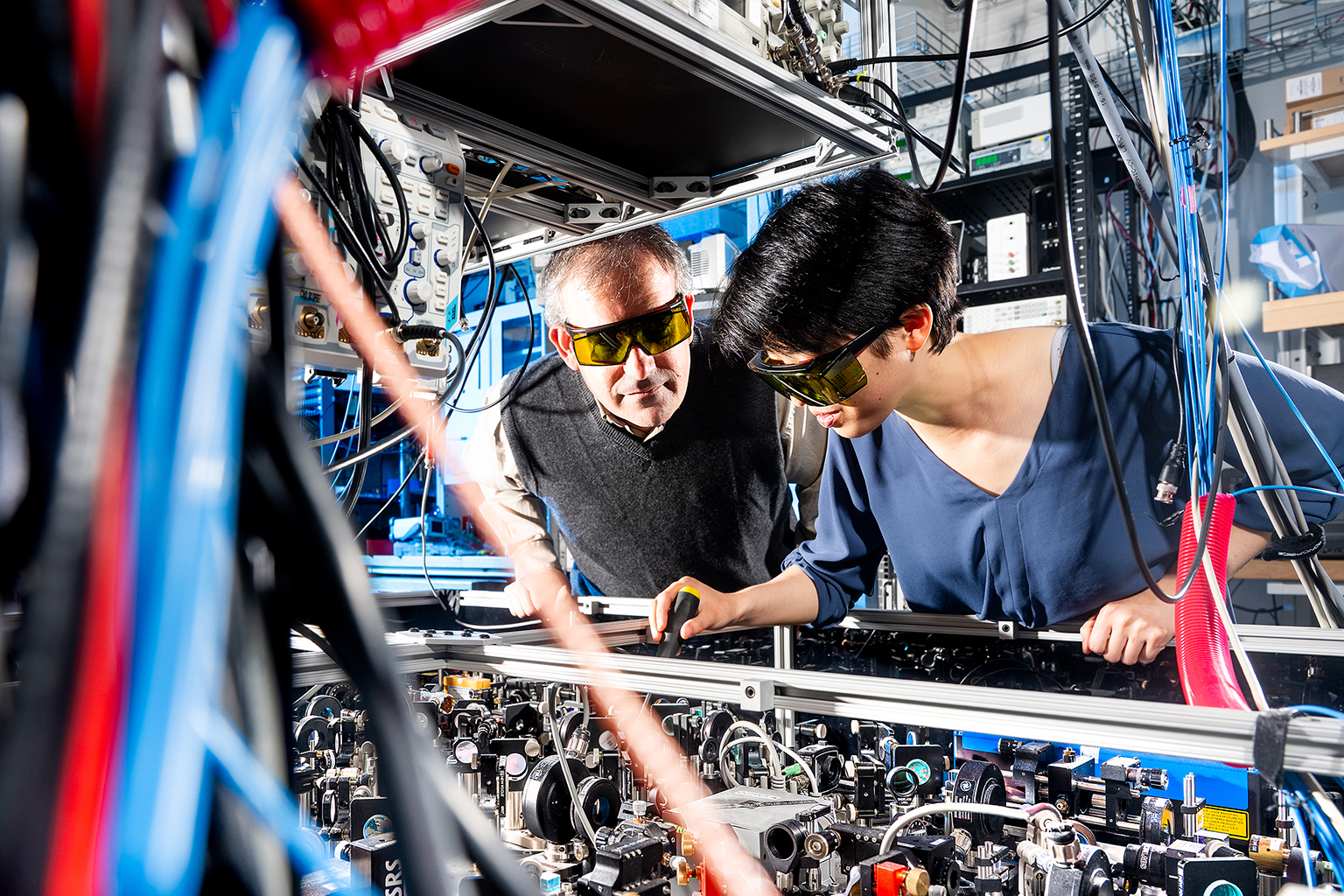
“The renewal and expansion of the NSF CIQC is a momentous event for the field of quantum science and for the quantum ecosystem in the state of California,” said Shimon Kolkowitz, the Herst Chair in Physics at UC Berkeley. “UC Berkeley’s position as a world leader in quantum research over the past century, as exemplified today by the NSF CIQC, was a large part of what drew me to relocate my research group here three years ago, and I am thrilled to now be joining NSF CIQC 2.0 as both a funded researcher and a member of the leadership team. This center enables and enhances large-scale academic collaboration on basic quantum research at a pivotal moment for the field.”
By linking leading quantum research teams and educational initiatives across the state of California, the NSF CIQC serves as the backbone of an integrated, statewide ecosystem. UC Berkeley, UCLA, UC Santa Barbara, Stanford University, and the California Institute of Technology are core research partners.
The renewal of the NSF CIQC will feature several new initiatives. California State University San Marcos and Cal State East Bay will anchor plans to establish system-wide degree programs in quantum information science, and the Computer History Museum and Berkeley Oral History Center will document the history of quantum computing in real time as it unfolds.
NSF’s re-investment will act as a force multiplier for other federal, state, and university commitments to quantum research:
Last year, concurrent with the inaugural convening of the Quantum California Initiative, UC Berkeley opened the Roger Herst Quantum Nexus to nucleate a coordinated quantum ecosystem in the Bay Area.
Lawrence Berkeley National Laboratory leads the Quantum Systems Accelerator, a National Quantum Information Science Research Center backed by the U.S. Department of Energy with strong university participation.
California passed legislation in 2025 to stimulate the state’s quantum economy, with Governor Gavin Newsom signing the bill at a UC Berkeley event.
These moves recognize the growing energy around quantum and build on the long history of exceptional quantum research in California. Notably, the 2025 Nobel Prize in Physics was awarded to UC Berkeley Professor Emeritus John Clarke, together with his former postdoctoral fellow Michel Devoret and graduate student John Martinis (both now on the UC Santa Barbara faculty), for quantum tunneling experiments that lay the groundwork for today’s superconducting quantum computers. A modern-day version of that technology in the form of a UC Berkeley-produced superconducting quantum processing unit was even included in California’s contributions to a time capsule buried in honor of the nation’s 250th birthday.
“NSF’s commitment to quantum information science is a testament to the field’s world-changing possibilities and the inherent value of basic research,” said Claire Cramer, the executive director of Berkeley Quantum and executive director of the NSF CIQC. “The future of the quantum industry is being decided right now, and we are prepared to lead. We are excited to be able to continue the frontier research that will keep US industry in the global lead while welcoming an expanded cohort of scientists and engineers to our institute.”