
Veronica Benitez was fed up.
Born and raised on 18th Street in the Mission, the 29-year-old had stopped walking her dog or going out at night in recent years as activity from the sex trade worsened outside her front door. Fighting, shouting and loud music disrupted her parents’ sleep at night, she said.
But Benitez said she reached a breaking point after an incident this summer when a sex worker pepper-sprayed a neighbor while he recorded loud late-night activity.
Benitez and her husband and parents moved out of their longtime San Francisco home Saturday to get away from the chaos.
“It’s just very gross conditions now,” Benitez said. “It’s not worth staying.”
A stretch of Capp and Shotwell streets in the heart of the Mission have been a prostitution hot spot for decades, but a few years ago, residents said the issue had spiraled out of control. The city responded with traffic posts and barriers, warning letters sent to so-called johns based on their license plates, and more recently, police enforcement of a new state law that targets people loitering to buy sex.
But residents say the measures have failed to stop the sex trade or address deeper concerns about human trafficking, instead simply pushing the activity several blocks down the street. The migration highlights the challenge that San Francisco and other Bay Area cities face in trying to deal with seemingly intractable issues like sex work, the open-air drug market and homelessness.
Multiple sex workers, who spoke to the Chronicle on the condition of anonymity or declined to give their full names out of safety concerns, said the traffic barriers and the police have done little to interfere with their business.
“The barriers don’t stop nothing,” Soleil said while walking up 18th toward Folsom Street in tall sparkly heels and a furry white coat on Saturday night. “We’ll just go down the next corner.”
The city installed traffic posts on Capp Street between 18th and 22nd streets in 2023 and added concrete barriers on Shotwell Street between 19th and 21st the following year. The closures created dead-ends to prevent those looking to buy sex from cruising the residential streets where sex workers lined up at night.

A barricade blocks a stretch of Shotwell Street in San Francisco. Some neighbors are pleased with the barricades, but others say the problem has simply moved several blocks down Shotwell. (Camille Cohen/For the S.F. Chronicle)
The concrete barriers on Shotwell provided almost instant relief from the noise, trash and related violence, residents who live on those blocks said. Issues stemming from prostitution had previously disrupted their sleep and kept families trapped indoors at night.
“They put these things in, and it’s like there was a before, and there was an after,” said Marc Babsin, a Mission resident of nearly three decades. “It’s like we’ve taken back our street.”
Sex work has not entirely disappeared from the neighborhood, Babsin said, “but it’s more diffuse and there’s less of it – it’s not like the intensity and the density of what was going on before those were put in.”
But families living near 18th Street say the same issues that caused previous uproars among residents, including a lawsuit against the city that has since been dismissed, have now migrated to their doorsteps. They have sent letters and showed up at meetings imploring the city to address the displacement of sex work to their blocks, increase police patrols and consider extending the barriers further down Shotwell. An aide to Supervisor Jackie Fielder, who represents the Mission, did not respond to inquiries for this story.
One resident, who did not want her name used due to safety concerns, said she passes sex workers every morning while walking her kids to school and often finds used condoms in front of her home. She calls the non-emergency police line most nights but gets little reaction.
“I would like it off our block,” she said. “I don’t want to live like this.”
Not everyone finds the intervention necessary. Katie Miles, who is raising her daughter in the home on Shotwell where she grew up, said occasional sex work on her street had never impacted her family.
“Worrying about sex work on one block because of a small group of neighbors who don’t like it is not a good use of city resources,” said Miles.
San Francisco police say changes in state law have made it more difficult to deal with sex work because officers can no longer arrest sex workers for simply loitering. In a 2022 bill authored by state Sen. Scott Wiener, the state decriminalized loitering with the intent to commit prostitution, an effort to prevent discriminatory arrests of women based on their appearance.
A new state law went into effect on Jan. 1 to target sex buyers, making it a misdemeanor to loiter with the intention of purchasing sex, with fines of $1,000. Prosecutors can use evidence such as a person circling the block repeatedly, beckoning to pedestrians or making unauthorized stops along a known prostitution track to bring charges against violators.
San Francisco police have made 16 arrests under the new law so far and more than 130 arrests for alleged prostitution since January 2025 in the Mission, said Evan Sernoffsky, a department spokesperson. He said cases often result in citations.
But Sernoffsky said the 2023 law means cases now require more resource-intensive strategies such as surveillance, plainclothes officers and undercover work. Sernoffsky said police conduct sting operations in San Francisco every week, but declined to provide details.
Police offer resources to people they believe may be victims of human trafficking and try to go after their traffickers, Sernoffsky said. But it can be difficult to gain witness and victim cooperation.
“Anytime we can gather evidence and build a case against somebody who’s trafficking folks, we will aggressively investigate and make an arrest when possible,” Sernoffsky said.

The transparent shoes of Soleil, a sex worker, are lit by passing headlights on Shotwell Street in San Francisco. Soleil said the barriers don’t stop the sex trade in the area. (Camille Cohen/For the S.F. Chronicle)
Police have also tried to deter sex buyers by sending letters to the registered owners of vehicles seen soliciting sex near the Shotwell corridor, advising them that prostitution is illegal. But the department has sent just 65 letters, including fewer than 10 since last August.
“We air on the side of caution when it comes to sending one of those letters to ensure we don’t accidentally send it to the wrong person,” Sernoffsky said.
In June, the city approved an 18-month extension of the street closures on Capp and Shotwell streets, but San Francisco Municipal Transportation Agency staff acknowledged at a recent meeting that the agency had not yet studied the effectiveness of the program or its impact on nearby blocks. Repair and maintenance will cost $39,000 through next October.
“This is not a data-driven decision right now. We don’t have any data to really support if this is actually working,” SFMTA board member Stephanie Cajina said at the meeting. She voted to extend the program on the condition that the agency report back on its outcomes.
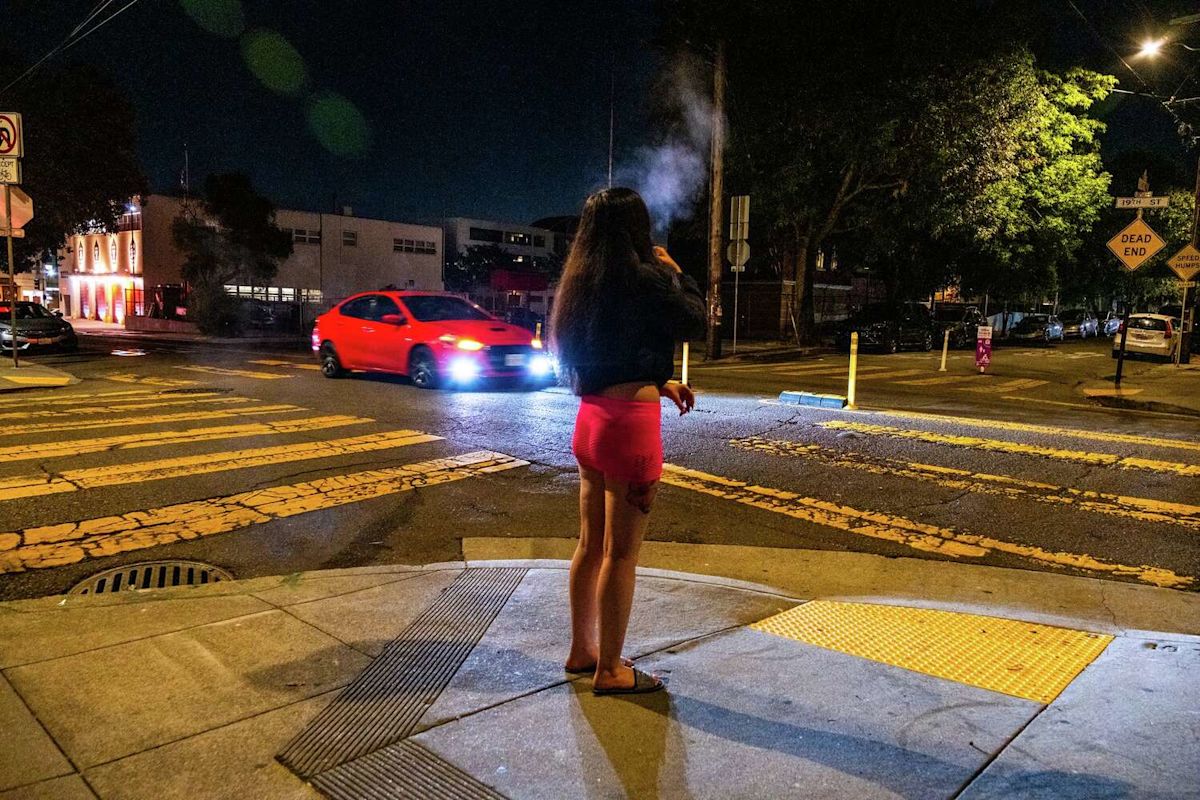
Late Saturday night, about half a dozen sex workers stood alone or in pairs on Shotwell near 18th and 19th streets while a steady stream of drivers slowed to a crawl and rolled down their windows.
Wearing a black puffer jacket and tight pink skirt, a 25-year-old woman from Sacramento named Rena stood on one corner rolling a blunt and sipping a Capri Sun pouch. She said she has encountered some hostility from residents, but acknowledged that she feels bad and tries to avoid working near children.
“I would be pissed if I lived here, too,” Rena said.
Soleil said police officers sometimes come by with a loud speaker to disperse people, but she ducks her head and moves to another corner.
“Us girls out here, we have a quota we have to make,” she said.
Meanwhile, by Saturday night, the Benitez family had already packed up and moved away, trading their city apartment for a clean, peaceful small town outside the Bay Area.
“If we had a choice, we wouldn’t want to,” Benitez said about moving. “But there’s just no solution at the moment.”
Subscribe
There’s more to San Francisco with the Chronicle. Subscribe today for just 25¢.
This article originally published at Mission residents plead for help with sex work: ‘I don’t want to live like this’.