
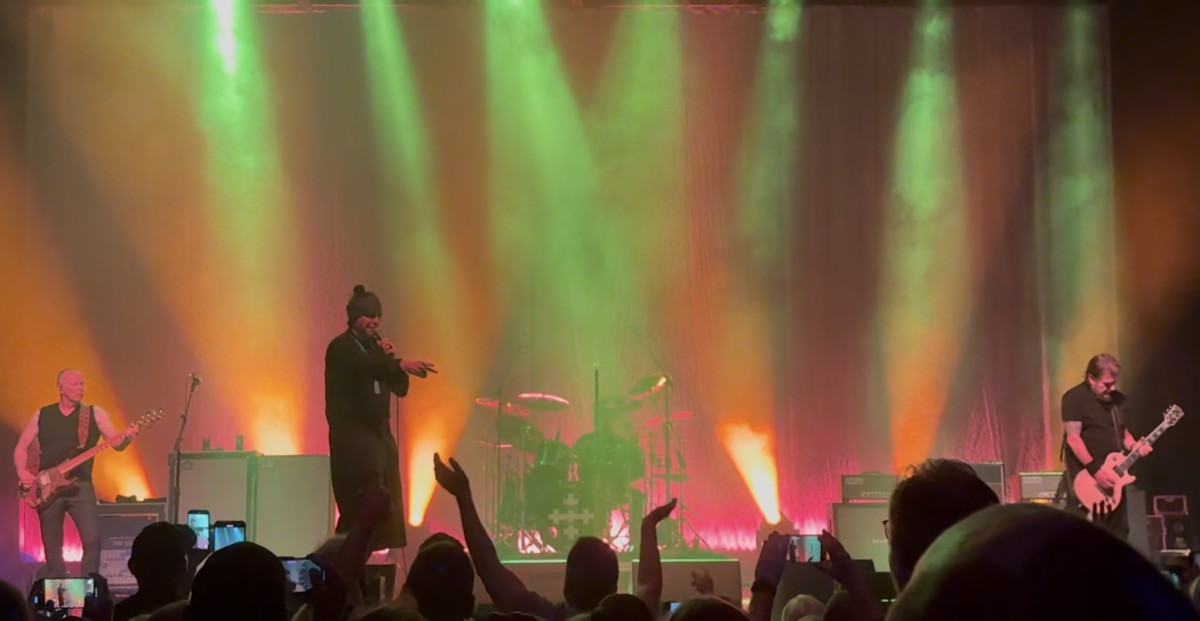
 Ian Astbury and The Cult perform in Del Mar. (Photo by Donovan Roche/Times of San Diego)
Ian Astbury wasn’t feeling the love.
Or so it seemed on Oct. 29 when the alt-rock icon performed as the frontman of The Cult and its earlier incarnation, Death Cult, at The Sound in Del Mar.
Throughout the night, Astbury repeatedly questioned the audience’s energy. “Are you guys in this?” he asked twice early in the set, later chiding fans for not showing enough enthusiasm for the songs or the band’s performance.
The singer’s frustration may have been influenced by the previous week’s announcement that the band is taking a hiatus from touring for the foreseeable future. With San Diego the penultimate stop on their North American Paradise Now 8525 tour, perhaps he expected a more electric send-off.
 Ian Astbury at The Sound. (Photo by Donovan Roche/Times of San Diego)
Celebrating more than four decades of music, the set list spotlighted both eras of the band’s evolution — as the post-punk/gothic rock outfit Death Cult (from 1983 to 1984) and, thereafter, as the English hard rock powerhouse The Cult. Instead of blending old and new, Astbury, longtime guitarist Billy Duffy, bassist Charlie Jones, and drummer John Tempesta split the show into two distinct sets.
The night began with the foursome shrouded behind a thin white scrim as the tribal pulse of “Ghost Dance” filled the room. Silhouetted and spinning, tambourine in hand, Astbury danced through the song inspired by the teachings of Paiute spiritual leader Wovoka.
When the curtain dropped, Death Cult tore through eight songs in a half hour. Astbury’s voice was commanding and resolute, particularly on “Gods Zoo” and “Horse Nation,” both from their 1983 debut EP. The set also included four tracks from their next album, Dreamtime, recorded under the new name The Cult, including “83rd Dream,” “Butterflies” and the rousing closer “Spiritwalker.”
Though Astbury never explicitly referenced the break from touring, he alluded to it several times. At the end of the first set, for instance, he invited everyone to the following night’s show at Shrine Auditorium, saying, “The last time to see Death Cult is tomorrow in L.A.”
Following a brief intermission, The Cult reemerged with “Wildflower,” from the Rick Rubin-produced Electric. Propelled by Duffy’s searing riffs, the opener drew a collective roar from the crowd. The ensuing 12-song set featured deep cuts like “The Witch” and “Lucifer” alongside concert staples including “Rain” and “Edie (Ciao Baby).” While the former charged the audience with its full-throttle attack, the latter, known for its slow build, sounded slightly off in timing.
After “Edie,” Astbury stood at the front of the stage and gave the audience a blank stare. “I’m waiting for you guys,” he said. As people began clapping more, he added, “Please…!” and waved them on for more applause.
Wearing a wide headband, black kimono-style jacket, and Hakama pants, Astbury looked part rock shaman, part martial arts master. He moved with ritualistic precision, assuming ready stances, waving his arms, and shuffling his feet. At times, he’d spin his tambourine into the air, catching it or kicking backward, and occasionally he’d form prayer hands in appreciation of applause.
But more often than not, he called out the crowd’s lack of response. At one point, he scolded, “You guys need to get into this…come on!” And during “Fire Woman” — when Astbury was perhaps his most animated, swinging the mic around, hopping atop the stage monitor, and interjecting “Ole, Ole, Ole!” — he halted mid-song to solicit a stronger reaction: “Well, that’s pathetic. Try again.”
To a certain degree, Astbury’s constant reproach marred an otherwise tight and dynamic 90-minute show. Duffy, one of rock’s most underrated guitarists, unleashed blazing licks throughout, while Astbury’s muscular baritone fueled each song forward.
The night ended on a high note, though, with “Love Removal Machine” and the encore “She Sells Sanctuary,” arguably one of the greatest hard rock songs of all time. Across both sets, the material effectively honored the band’s legacy with a mix of mysticism and swagger (though “Sweet Soul Sister,” a fan favorite from the platinum Sonic Temple, was conspicuously absent).
Following introductions, each band member exited one by one, leaving just Astbury. Kneeling before the crowd, he offered a solemn prayer, but one couldn’t help but wonder if it also carried a silent plea for tomorrow’s finale to really go off.
Donovan Roche is a regular music and culture contributor to Times of San Diego.
READ NEXT