
The Emeryville City Council held three meetings in July, covering a range of noteworthy items. The July 7 meeting that we previously covered is posted here.
July 21, 2026 Emeryville City Council Meeting Recap
The July 21 Emeryville City Council meeting stretched over four hours with several consequential items on the agenda, headlined by the Council’s first study session on Sutter Health’s proposed medical campus.
The meeting opened with emotional appeals from city employees over ongoing contract negotiations, advanced a business license tax measure to the November ballot, and concluded with a discussion over more than $1 million in additional costs for the city’s Sustainable Streetscapes project.
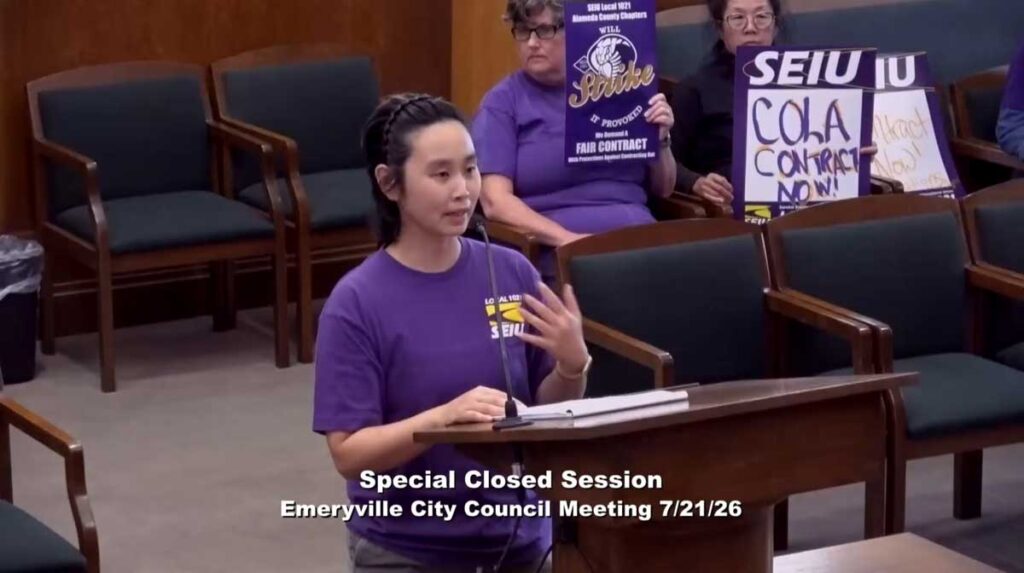 City employees represented by SEIU held signs calling for a more substantive cost-of-living adjustment and warning of a potential strike.
City Employees Press Council on Higher COLA [6:31]
Before entering closed session, members of the city’s SEIU bargaining unit used public comment to urge the Council to offer a cost-of-living adjustment that keeps pace with inflation.
Associate Planner Alyssa Chung, who serves as SEIU chapter president, argued that employees were not seeking raises but simply protection against losing purchasing power.
Several employees contrasted the city’s contract offer with previously approved salary adjustments for executive leadership, arguing that frontline employees deserve equal treatment.
“We’re not asking to get ahead,” Finance employee Monica Centeno told the Council. “We’re just asking not to fall behind.”
After hearing from five employees, the Council recessed into closed session for labor negotiations.
STUDY SESSION: Sutter Health Presents Revised Medical Campus [56:09]
The evening’s primary agenda item was a study session on Sutter Health’s proposed medical campus, which would replace Alta Bates Hospital in Berkeley with a new regional hospital in Emeryville.
Prior to the start of the meeting, Councilmember David Mourra announced his recusal, citing a potential conflict of interest related to his wife working for a division of Sutter. “I’m currently working with the City Attorney’s Office to open an inquiry with the FPPC to ensure that there is no material conflict of interest,” he noted before leaving the dais.
Planning Manager Miroo Desai provided an overview of Sutter’s proposal, emphasizing that no land-use decisions have been made and that the project remains in the early stages of environmental review.
Sutter’s current proposal includes:
A 15-story hospital rising approximately 330 feet.
Approximately 785,000 square feet.
Up to 325 patient beds.
Women’s and infant services relocated from Berkeley.
Medical office space and structured parking.
A future mixed-use building that could accommodate medical offices or workforce housing.
Desai outlined the lengthy approval process ahead, including preparation of an Environmental Impact Report, additional study sessions, Planning Commission hearings and eventual City Council action. The next step is a public scoping session at the Planning Commission’s August 27 meeting, where residents and agencies can weigh in on what the EIR should study. Following the scoping period, the city will prepare a Draft EIR for public review.
Sutter Team Makes Pitch to Community [1:06:32]
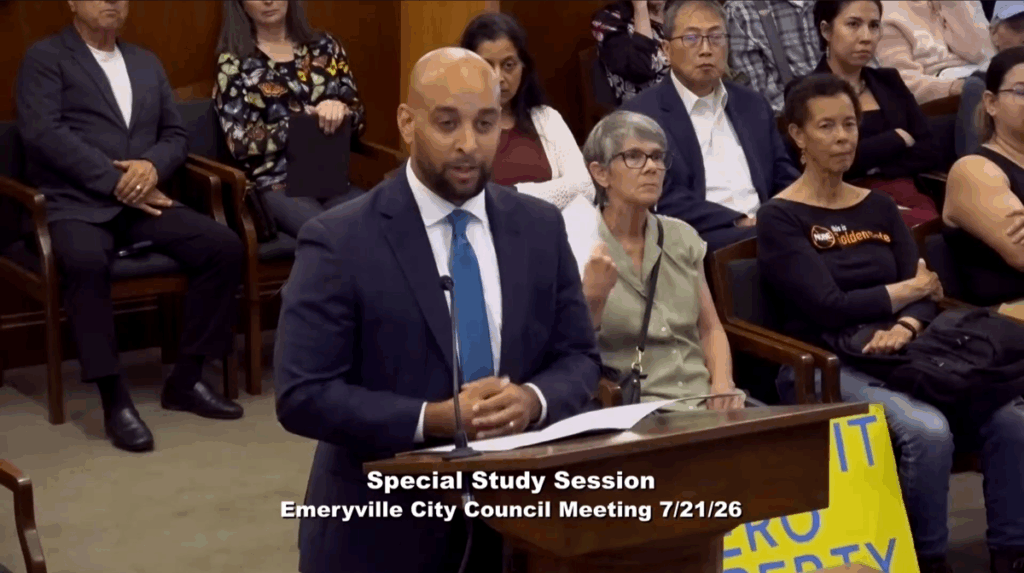 Sutter Alta Bates CEO Trevor Brand led things off for his team.
Sutter Alta Bates CEO Trevor Brand kicked off the project team’s presentation, noting that the project remains in its early stages. “We have a lot of listening, a lot of learning to do,” he said.
Brand then turned the presentation over to Todd Kohli with SmithGroup, who provided an overview of the project’s open space plans, drawing on the site’s history and its connection to Temescal Creek and the Ohlone people.
“Emeryville was a place of confluence where Bay, Creek, Marsh, and people came together, and the legacy of that connection continues to define the city today.”
Responding to community pushback over locating a shuttle stop along the Horton bike boulevard, Kohli detailed a revised proposal that would move the stop to Hollis Green and expand the park at the foot of the South Bayfront Bridge. The plans also envision a café and food trucks to help activate the spaces.
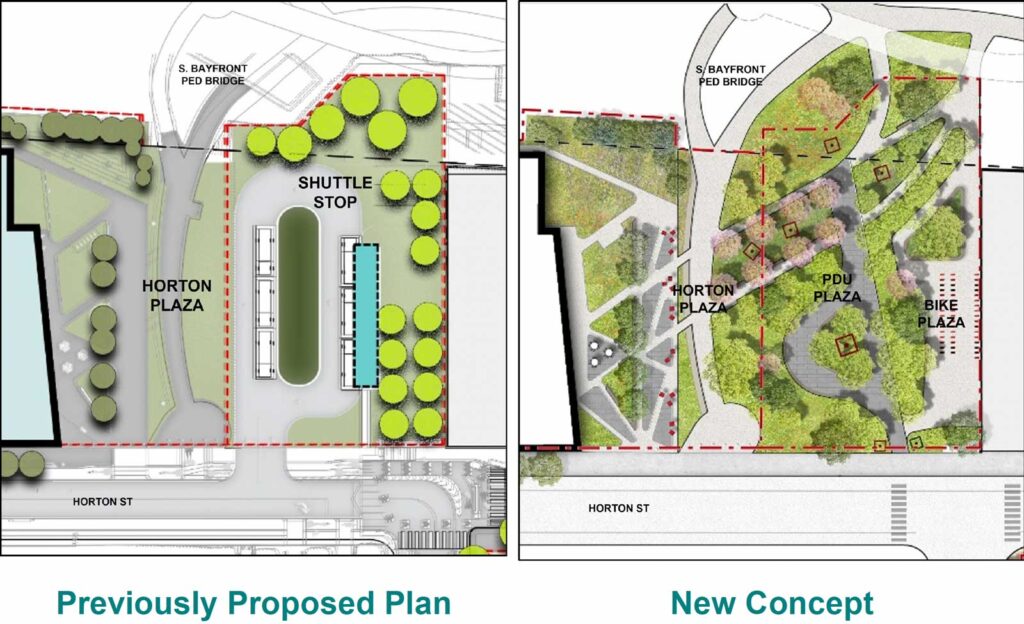
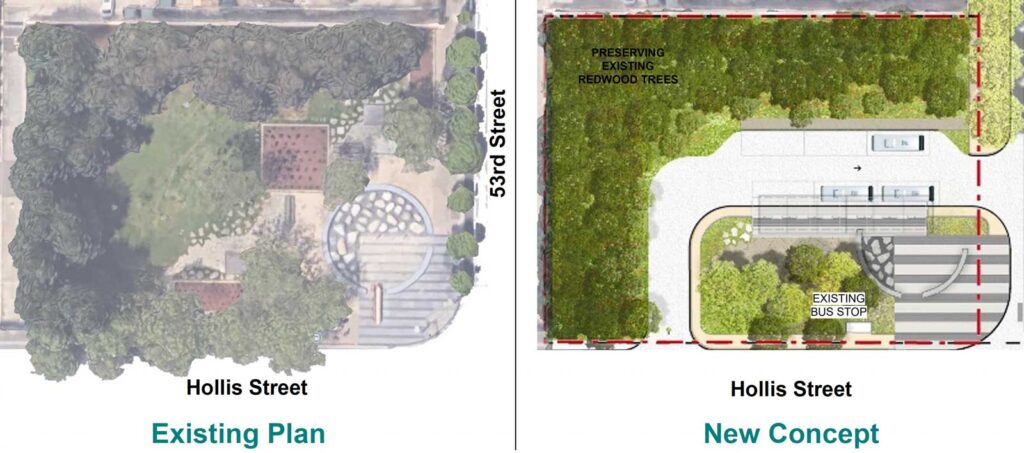
Revisions to the current plan included moving the shuttle stop from Horton to Hollis Street.
Next, Tricia Dudala with Hexagon Transportation Consultants outlined the traffic circulation challenges posed by the existing Horton Street and 53rd Street traffic diverter. Sutter’s preliminary traffic modeling found that the diverter would need to be removed to address congestion from vehicles exiting the Horton Street parking garage under full buildout.
But Sutter has received strong community support for retaining the diverter because of its traffic-calming benefits. The project team is now evaluating alternatives that would either retain it in its current location or move it farther north, beyond Stanford Avenue. Any changes will be presented at future community meetings.
 Emeryville Mayor Sukhdeep Kaur.
Council Seeks Clarity on Sutter’s Impacts [1:43:00]
Before turning the meeting over to the Council, Desai briefly outlined the project’s nearly six-year hospital construction timeline and required General Plan and PUD amendments. The city’s forthcoming EIR will examine transportation, noise, air quality and other impacts, including at least 79 intersections.
Vice Mayor Matthew Solomon said transportation improvements presented by Sutter remain preliminary and will be refined through the EIR process. Councilmember Courtney Welch asked about the timeline for the city’s fiscal impact analysis, while Councilmember Kalimah Priforce pressed Sutter on accountability for its community benefits and called for an established channel for ongoing communication with the community.
Mayor Sukhdeep Kaur focused on the project’s land-use and community impacts, asking staff for a comprehensive General Plan consistency analysis and Sutter about its flexibility to reduce the proposed height and massing and provide community benefits. She also asked whether alternative designs would remain available if the EIR identifies significant impacts; Desai confirmed that the Draft EIR will include an alternatives analysis.
Residents Raise Traffic, Fiscal and Neighborhood Concerns [2:02:23]
Public comment dominated the study session, with more than 20 residents and community members speaking for roughly 45 minutes. Most expressed opposition to or significant concerns about the proposal, with many identifying traffic and safety impacts on 53rd Street and surrounding neighborhoods as their primary concern.
Several speakers questioned how the city could accommodate the estimated 20,000 additional daily vehicle trips without undermining its investments in walking, bicycling and transit. Residents along 53rd Street, including parents with children attending nearby schools and childcare centers, warned that increased traffic could compromise pedestrian and bicycle safety. Others raised concerns about emergency vehicle access, helicopter noise, construction impacts, the project’s scale and its potential effects on neighboring Oakland communities.
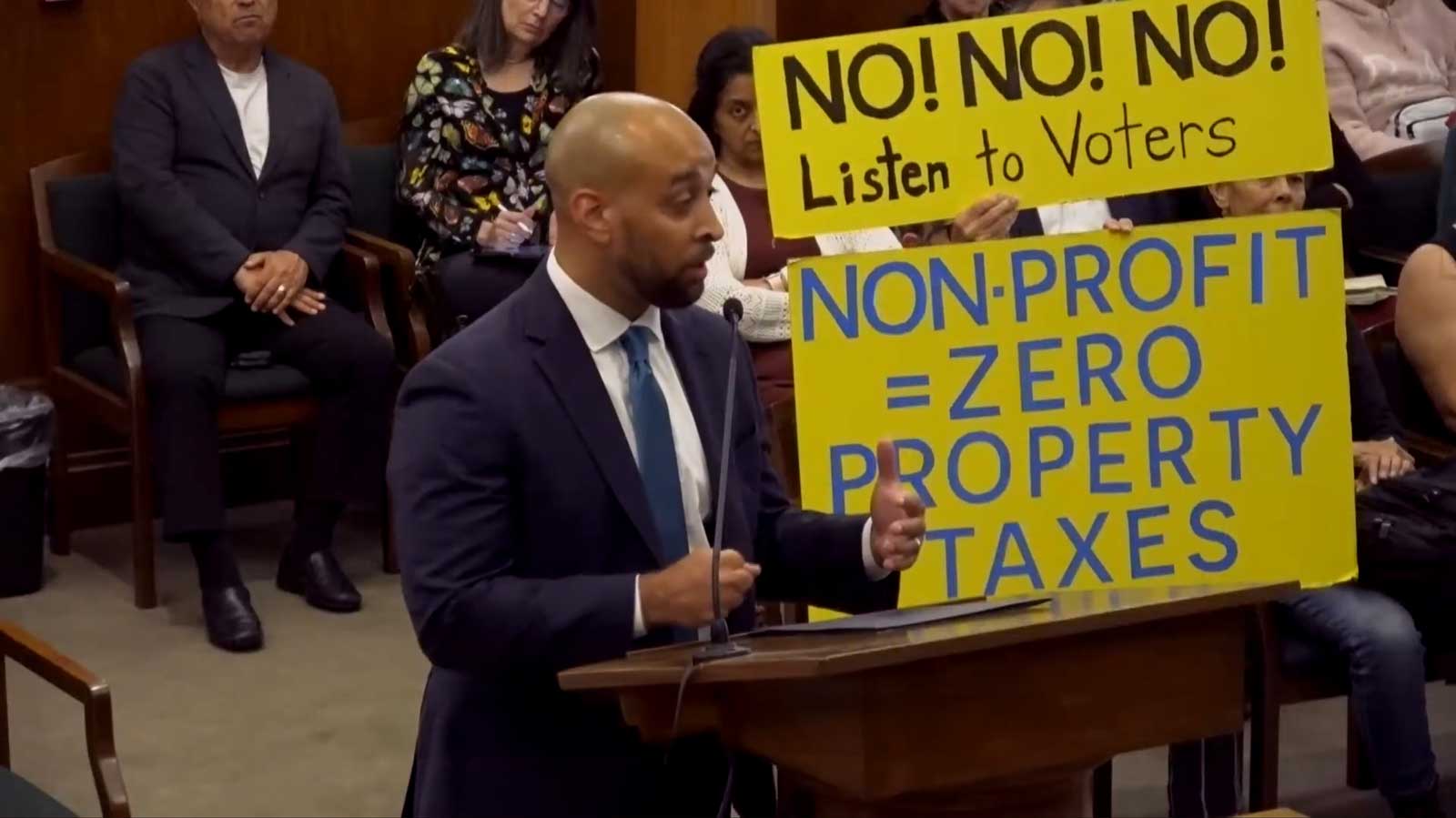
 Brandon Soublet, who we later learned was running for a City Council seat, was a frequent speaker during public comment, weighing in on several issues before the Council.
The project’s fiscal impact was another recurring concern. Former Councilmember Scott Donahue and others pointed out that Sutter’s nonprofit status would exempt the hospital from property and business taxes, while the city faces growing budget deficits. Several speakers urged the Council to consider whether the hospital would generate sufficient community benefits to offset the loss of potential tax revenue.
Others challenged Sutter’s contention that Emeryville is the best location for a regional hospital, arguing that the proposed campus is too large for the site and incompatible with the city’s General Plan and existing street network.
The testimony wasn’t uniformly opposed. A representative of the Alameda County Building and Construction Trades Council said Sutter had begun discussions with the trades and expressed optimism that continued dialogue could produce a strong community benefits agreement with a significant labor component.
Following public comment, Councilmembers called for further analysis of transportation, fiscal impacts, community benefits, safe routes to school and Complete Streets considerations before the project advances. Mayor Kaur stressed that the Council had not taken a position on the project.
Regular Council Meeting [3:21:18]
After a five-minute intermission, the regular Council meeting got underway shortly after 9 p.m., with Councilmember Mourra returning to the dais. By then, most of the public had left the chambers, with only a handful of attendees remaining.
Emery Bay resident and Council candidate Brandon Soublet again addressed the Council during public comment, calling the Sutter project an “existential choice” for Emeryville.
“We can decide if we want to continue to be a bike- and pedestrian-friendly, transit-oriented city, or we can become a hospital town,” he cautioned.
 City of Emeryville City Finance Director Sharon Friedrichsen.
Business License Tax Measure Headed to November Ballot [3:28:16]
After approving the consent calendar and a 3% increase in the parcel tax to help fund the Emery Go-Round, the Council reviewed a proposal to place a measure on the November ballot that would “modernize” Emeryville’s business license tax structure. The city’s business license tax rates have remained unchanged for 42 years.
Finance Director Sharon Friedrichsen provided a snapshot of the city’s finances, highlighting a growing gap between projected revenues and expenses. Expenditures are projected to exceed $60 million by 2028-29, with a nearly $13 million structural deficit forecast for the 2029-30 budget cycle.
If approved by voters, the measure would:
Replace the city’s current flat-rate structure with six business classifications.
Increase annual business tax revenue to an estimated $12.4 million.
Raise the small-business threshold from $25,000 to $100,000 in gross receipts.
Increase the maximum annual business tax cap to $800,000.
Require independent oversight of tax revenues.
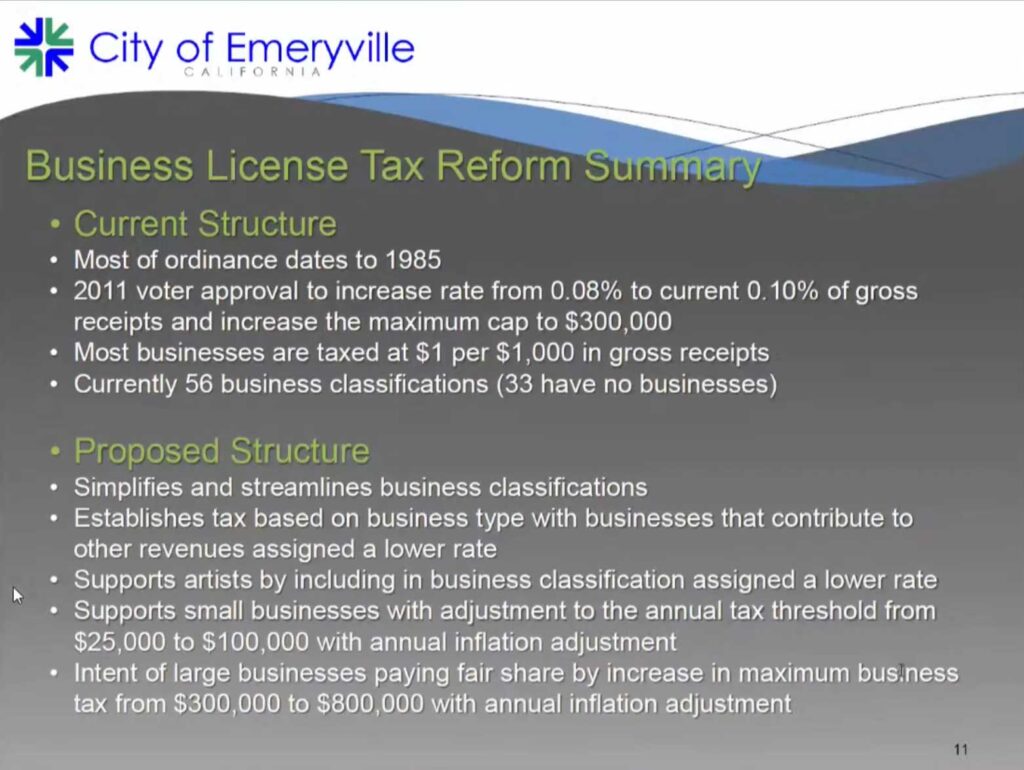
Councilmember David Mourra noted that even if the measure passes, Emeryville would still face a significant structural deficit, though the additional revenue would roughly cut projected deficits in half. He also questioned why the city opted for an $800,000 cap when neighboring Berkeley has no cap.
Mayor Sukhdeep Kaur asked how many small businesses would benefit from raising the threshold to $100,000. Staff did not have that figure readily available.
Two members of the public offered separate suggestions. One proposed an exemption for very small home-based businesses and micro-entrepreneurs to encourage new business formation, while another suggested expanding the business tax to include hospitals.
After discussion, the Council unanimously approved placing the measure on the November 3 ballot. Passage will require a simple majority of voters, with the new tax rates taking effect in 2027 if approved.
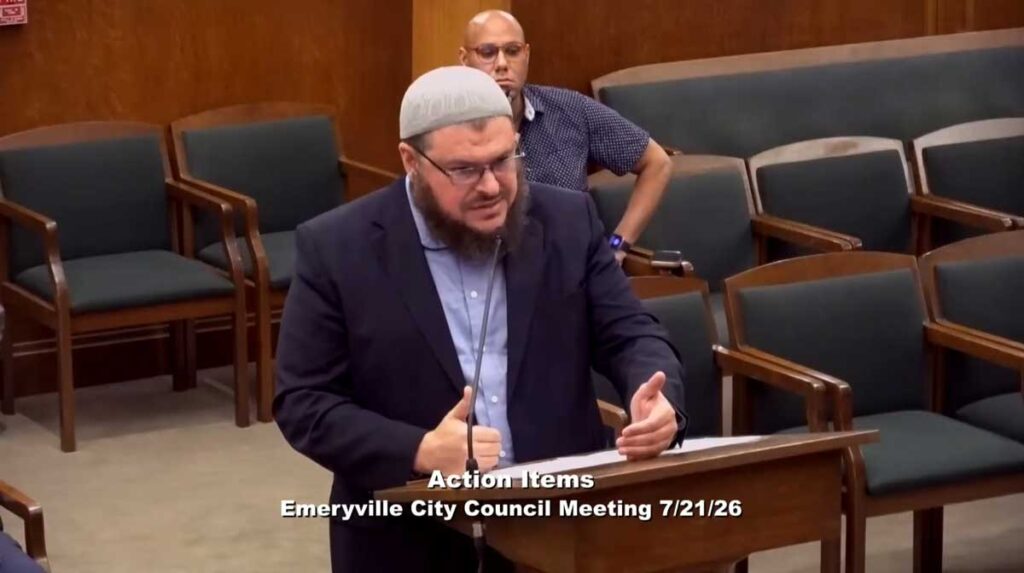 Emeryville Public Works Director Mohamed Alaoui explained the cost overruns.
Streetscape Project Closed Out After $1.1 Million Cost Increase [4:01:55]
Council unanimously approved a $1.13 million contract amendment with Bay Cities Paving & Grading to complete the city’s 2024 Sustainable Streetscapes Project, bringing the total construction cost to approximately $10.96 million.
Public Works Director Mohamed Alaoui described the project as the largest Complete Streets investment in Emeryville’s history, including roadway reconstruction, protected bicycle lanes, ADA improvements, transit boarding islands, sidewalks, bus stop lighting, bike racks and traffic-calming improvements across multiple neighborhoods.
Alaoui attributed the additional costs to unforeseen conditions, including unmapped underground utilities, state-mandated green infrastructure requirements, a sinkhole beneath 53rd Street, PG&E and EBMUD coordination issues, tree-root conflicts and poor subsurface soil conditions.
Several councilmembers praised the project’s accomplishments while expressing concern that the Council was not notified sooner as costs increased.
Mayor Sukhdeep Kaur called for earlier reporting when project costs exceed authorized spending levels, emphasizing the importance of fiscal transparency as the city asks voters to approve new revenue measures.
Public Works staff acknowledged that earlier communication would have been beneficial and said new internal tracking dashboards and quarterly reporting procedures are being implemented to improve oversight.
The contract amendment was ultimately approved unanimously.
Future Agenda Items / Meeting Adjournment [4:47:26]
After two unsuccessful attempts by Councilmember Priforce to add agenda items, the more than four-hour meeting concluded at 10:04 p.m.
View the complete agenda for this meeting on emeryville.org.
July 28, 2026 Emeryville City Council Meeting Recap
The Emeryville City Council met for a special meeting July 28, 2026, with Mayor Sukhdeep Kaur presiding. Councilmember David Mourra participated remotely, while Councilmember Kalimah Priforce was absent.
The Council essentially handled two administrative and funding matters—formalizing the Police Management Association contract and authorizing an Emery Go-Round funding application.
After some brief clarifications, the items were unanimously approved, and the meeting was adjourned after about eight minutes.
View the complete agenda for this meeting on emeryville.org.
Related
You have Successfully Subscribed!