
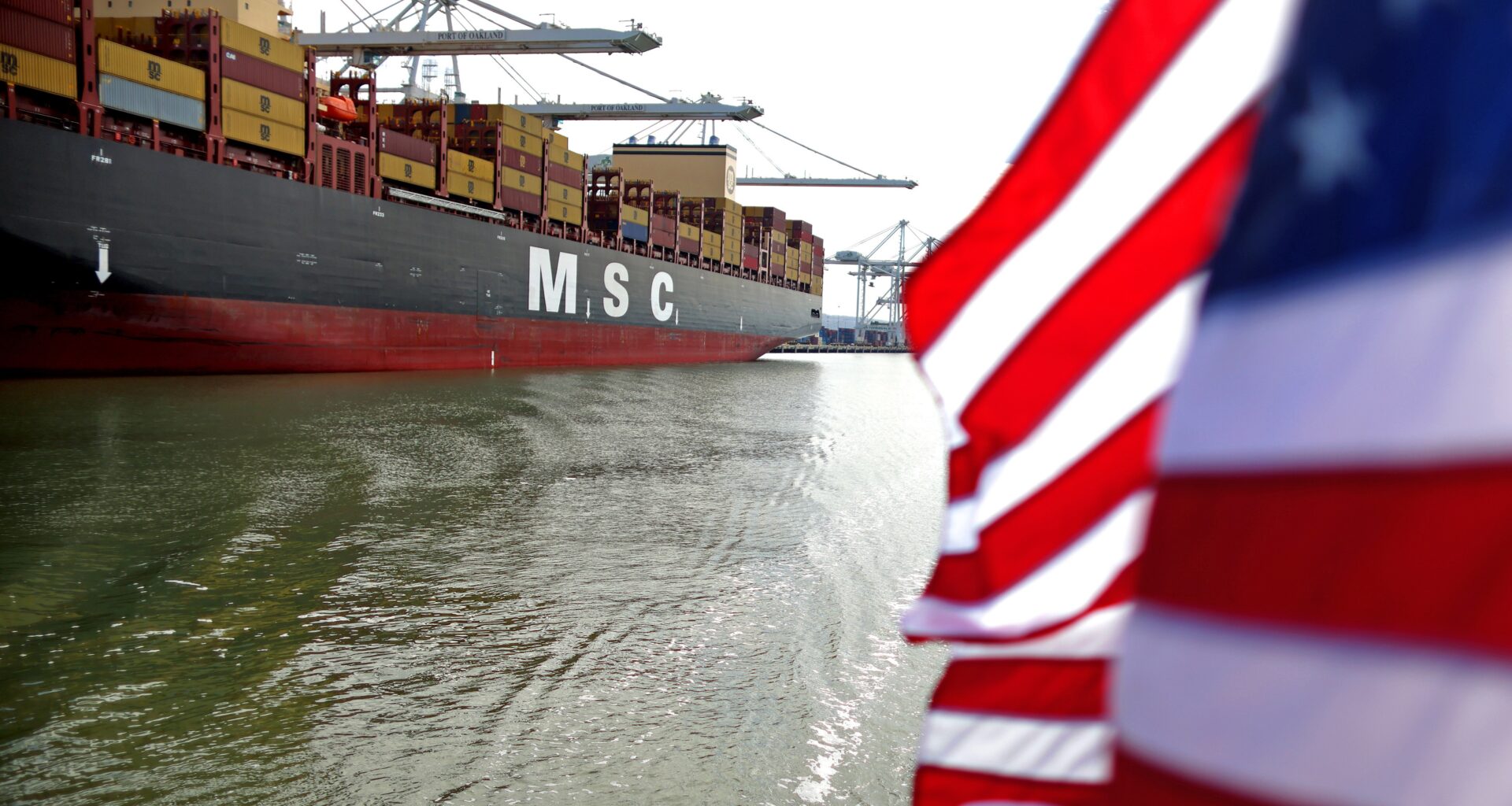
Port of Oakland officials and the U.S. Army Corps of Engineers signed a $640 million design agreement Thursday for a project that will allow modern, ultra-large container ships to maneuver safely and with more frequency out of the port.
When completed in 2030, the U.S. Army Corps project will widen the estuary between Oakland and Alameda and expand both the inner and outer harbor turning basins used by large ships to turn around. Local leaders said that expansion was key to modernizing the port’s infrastructure, maintaining its competitiveness against West Coast ports and will protect jobs at the key trade hub.
As modern trade ships grow larger to increase efficiency when transporting goods, the Port of Oakland’s turning basins have become small in comparison.
New container ships can be as long as 1,200 feet — longer than the tallest building in California, the Wilshire Grand Center in Los Angeles, which stands at 1,100 feet. The estuary’s widest point, meanwhile, is approximately 1,500 feet.
When these modern ships rotate in the turning basin – the nautical equivalent of a three-point turn – there is often less than 150 feet of clearance between each side of the estuary, according to the Port of Oakland. When factoring in the effects of wind and currents, the opportunities to reverse a ship’s orientation may only occur once a day, said Justin Taschek, senior maritime project administrator at the Port of Oakland.
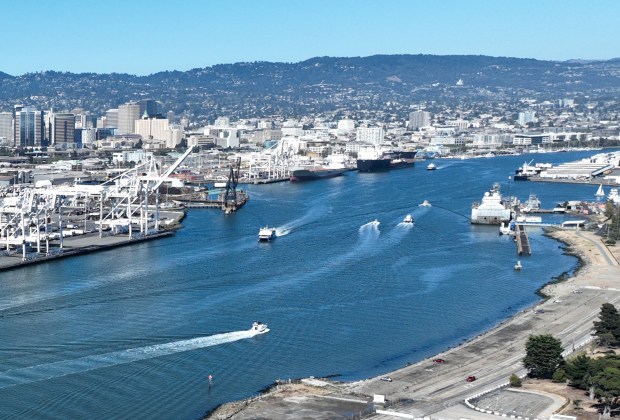 A drone view of the Port of Oakland Inner Harbor Turning Basin seen from Alameda, Calif., on Wednesday, July 15, 2026. The U.S. Army Corps of Engineers signed a landmark $640 million design agreement to widen the estuary between Oakland and Alameda to enable modern, ultra-large container ships to maneuver safely and more frequently out of the Port of Oakland. (Jane Tyska/Bay Area News Group)
The increased width of the estuary, Taschek said, will give the Port of Oakland more flexibility to maneuver large ships into San Francisco Bay multiple times per day and reduce disruptions to ferry operations.
“Infrastructure is not just concrete. It is not just steel. And it is not just a dredged channel. It’s the engine of opportunity,” said Maj. Gen. Jason Kelly, deputy commanding general for civil and emergency operations with the U.S. Army Corps of Engineers. “By signing this design agreement, we officially move this project out of the study phase and turn it into reality.”
With actual construction slated to start in 2028, the project will dredge just under 5 acres of the north Alameda shoreline to add 334 feet to the width of the inner harbor turning basin in the estuary. Dredged mud and soil will be relocated to the Montezuma Wetlands in Solano County to restore over 200 acres of habitat.
The project serves as a long-term investment to help the Port of Oakland remain competitive with other West Coast ports in Los Angeles, Long Beach and Seattle.
“The Turning Basin Widening Project will not just sustain these jobs and keep Oakland competitive, it will strengthen Oakland’s position as a green innovation hub, provide community benefits to West Oakland and to our community, and help the Port transition to zero-emissions operations,” Oakland Mayor Barbara Lee said Thursday during the signing aboard the USS Potomac.
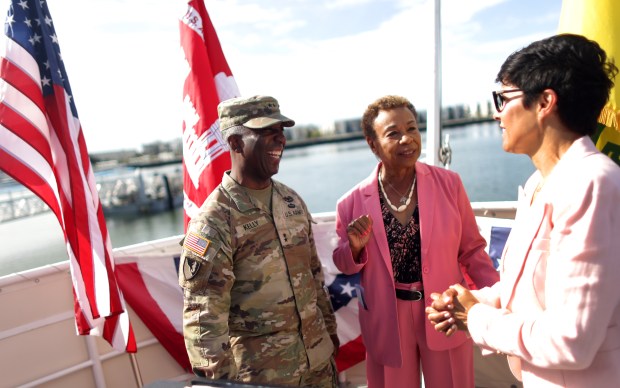 Major General Jason Kelly of the U.S. Army Corps of Engineers, left, talks with Mayor Barbara Lee, center, and Port of Oakland President Stephanie Dominguez Walton on Thursday, Aug. 27, 2026 in Oakland, Calif. The Port of Oakland, and the Army Corps of Engineers have signed a design agreement that formally launches a $640 million infrastructure project to modernize the Port’s turning basins. (Aric Crabb/Bay Area News Group)
District 12 Rep. Lateefah Simon emphasized that modernizing the estuary was essential. Every shipping container that comes through the port creates jobs for warehouse workers, mechanics, merchant mariners, truck drivers and community members across the East Bay, Simon said.
At $640 million, the project is set to be the largest Army Corps effort in the Bay Area while under construction. San Francisco District Commander Lt. Col. Virginia Brickner said she was eager to finish the paperwork and get the actual work started.
“I look forward to breaking ground — is it really ground?” Brickner said. “I look forward to scooping mud.”
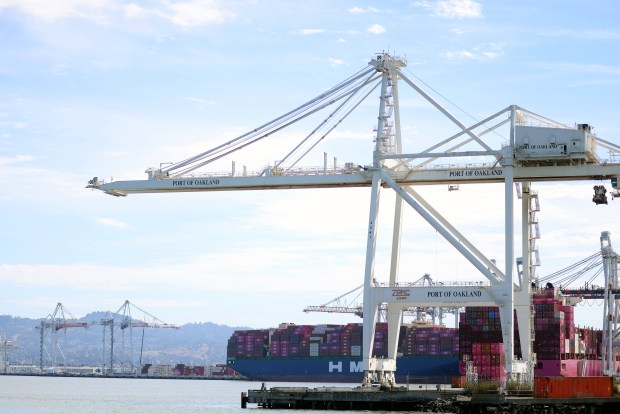 In a view looking east the outer harbor turning basin can be seen along the Port of Oakland on Thursday, Aug. 27, 2026 in Oakland, Calif. The Port of Oakland, and the Army Corps of Engineers have signed a design agreement that formally launches a $640 million infrastructure project to modernize the Port’s turning basins. (Aric Crabb/Bay Area News Group)
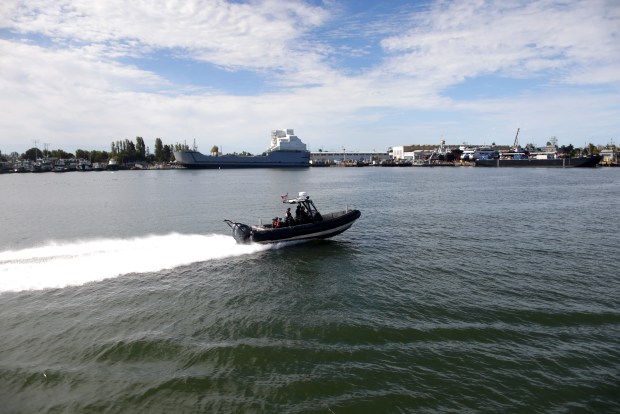 In a view looking west towards Alameda boat passes the inner harbor turning basin along the Port of Oakland on Thursday, Aug. 27, 2026 in Oakland, Calif. The Port of Oakland, and the Army Corps of Engineers have signed a design agreement that formally launches a $640 million infrastructure project to modernize the Port’s turning basins. (Aric Crabb/Bay Area News Group)