
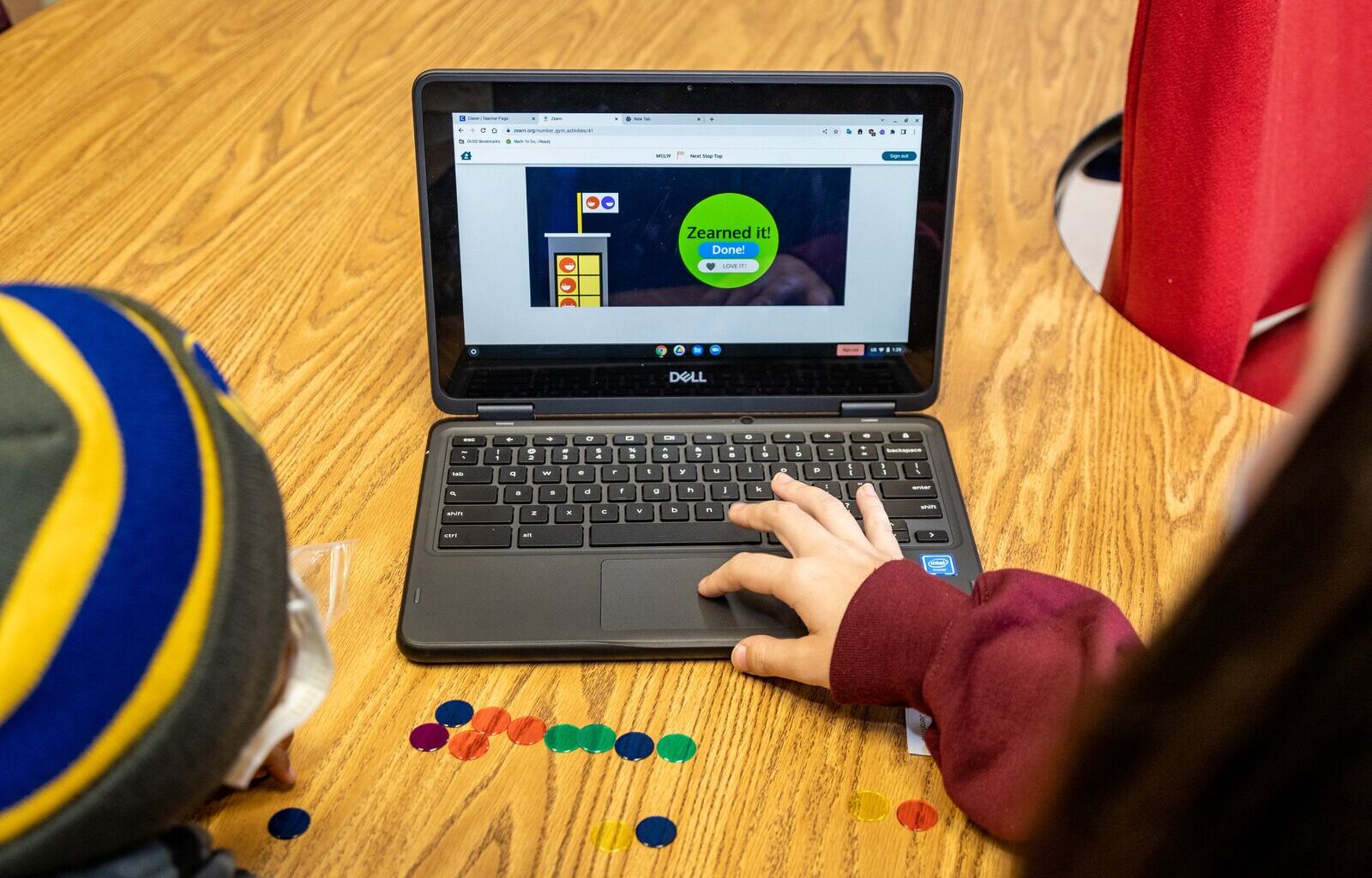
At Wednesday’s Oakland Unified School District board meeting, directors tackled the contentious question of student screen time, taking up a resolution that would prohibit students from using Chromebooks or personal laptops outside of instructional time. The resolution would also prevent the district from adopting software or programs that rely on game-like reward systems, direct the superintendent to create guidelines for the next school year laying out what is appropriate screen time for students, and provide professional development to principals.
For now, their decision is to take a beat. The board said it needs time to address questions of equity and to bring in student perspectives.
District 1 Director Rachel Latta introduced the resolution and advocated for it as a natural follow-up to the district’s new cellphone ban, which requires students to lock away their phones for the duration of the school day.
“If we as a district believe that students should not have access to their phone during the school day so that they can be engaged in school and academics, and that whatever screen time we provide is around academic learning, my belief is that we should not be allowing students to access devices for recreational purposes,” Latta said last night.
The conversation comes as a growing number of school districts and states are taking a closer look at how exposure to technology, screens, and social media can harm students’ mental health and cognitive development. This week, Meta, the company that owns Facebook and Instagram, settled a multibillion dollar lawsuit with California and more than two dozen other states that claimed the company’s products negatively impacted the mental health of children and teens, in a case heard in an Oakland federal courtroom. And Oakland assemblymembers Mia Bonta and Buffy Wicks have co-sponsored legislation this session that would prohibit social media apps from exposing users younger than 16 to addictive features.
Oakland school board directors expressed concern that the resolution as written could have any unintended consequences.
District 7 Director Clifford Thompson, an elementary school teacher in West Contra Costa Unified, suggested the guidelines might limit teachers’ options in the classroom.
“When we talk about game-like reward systems, that is a pedagogical strategy used by many educators in the classroom,” he said. “When we’re trying to teach a particular skill, many times it is predicated on something that looks like a game, but it’s an educational strategy to facilitate the students’ learning of a particular concept.”
Director Patrice Berry, who represents District 5, recommended that district staff consult with students in developing the guidelines and proposed removing the ban on recreational use to encourage district officials to consider more carefully how such as prohibition would be carried out.
“That may be the end outcome, but it’s ahead of the process, and I think integrity of process is probably important,” Berry said.
Concerns about a too-strict laptop ban
The resolution was developed in collaboration with parent and teacher representatives of Schools Beyond Screens, an organization founded in Los Angeles that advocates for responsible technology use in the classroom. Oakland was the first city beyond Los Angeles to have a Schools Beyond Screens group, Dian Le, an OUSD parent, told The Oaklandside.
The group is now inviting educators to work with them on developing evidence-based training to offer school leaders about responsible device use, Le told The Oaklandside.
“It’s easy to say blanket ban, tech is bad, so no screens,” she said. “We should know when not to use tech, but are there specific instances where it does make sense, and why? I do recognize there are specific instances where tech would be useful. I don’t want to throw the baby out with the bathwater.”
Director Mike Hutchinson, who represents District 4, also warned against blanket ban, saying it could be inequitable.
“If it was just the first clause that called for the superintendent to do this work and report back, no problem,” he said. “But to say you’re going to go into our schools tomorrow and we’re going to cut off access to our students in these other times — that’s a real equity issue. What about our students that the only point they can access a Chromebook and the internet is in these recreational times at school?”
The board sent the resolution to its teaching and learning committee to be refined further, and to allow the district’s student governing body, the All-City Council Student Union, to weigh in. The board’s two student directors, who are members of All-City Council, questioned how teachers would enforce a blanket ban on recreational device use and how that free time would be filled instead.
They also reflected on the first few weeks of the district’s cellphone ban. Student director Amina Tongun, a senior at Oakland Technical High School, said she’s noticed more socializing between students and higher engagement in class, but she also said that students felt blindsided and left out of conversations around how the ban would be carried out.
Implementation and enforcement have left some gaps, such as long waits to get the Yondr-brand pouches unlocked at the end of the school day due to an insufficient number of magnets, said Andrew Bloch, a first-year student at Oakland High.
“There are plenty of ways around this policy, like not locking the Yondr pouch, putting a different phone in it, or putting a burner phone in it,” Bloch said. “We even heard a story from Fremont [High School] where a student put a block of cheese in their Yondr pouch. There are plenty of ways around it and administration doesn’t have the manpower to fully implement this for every single student.”
“*” indicates required fields