
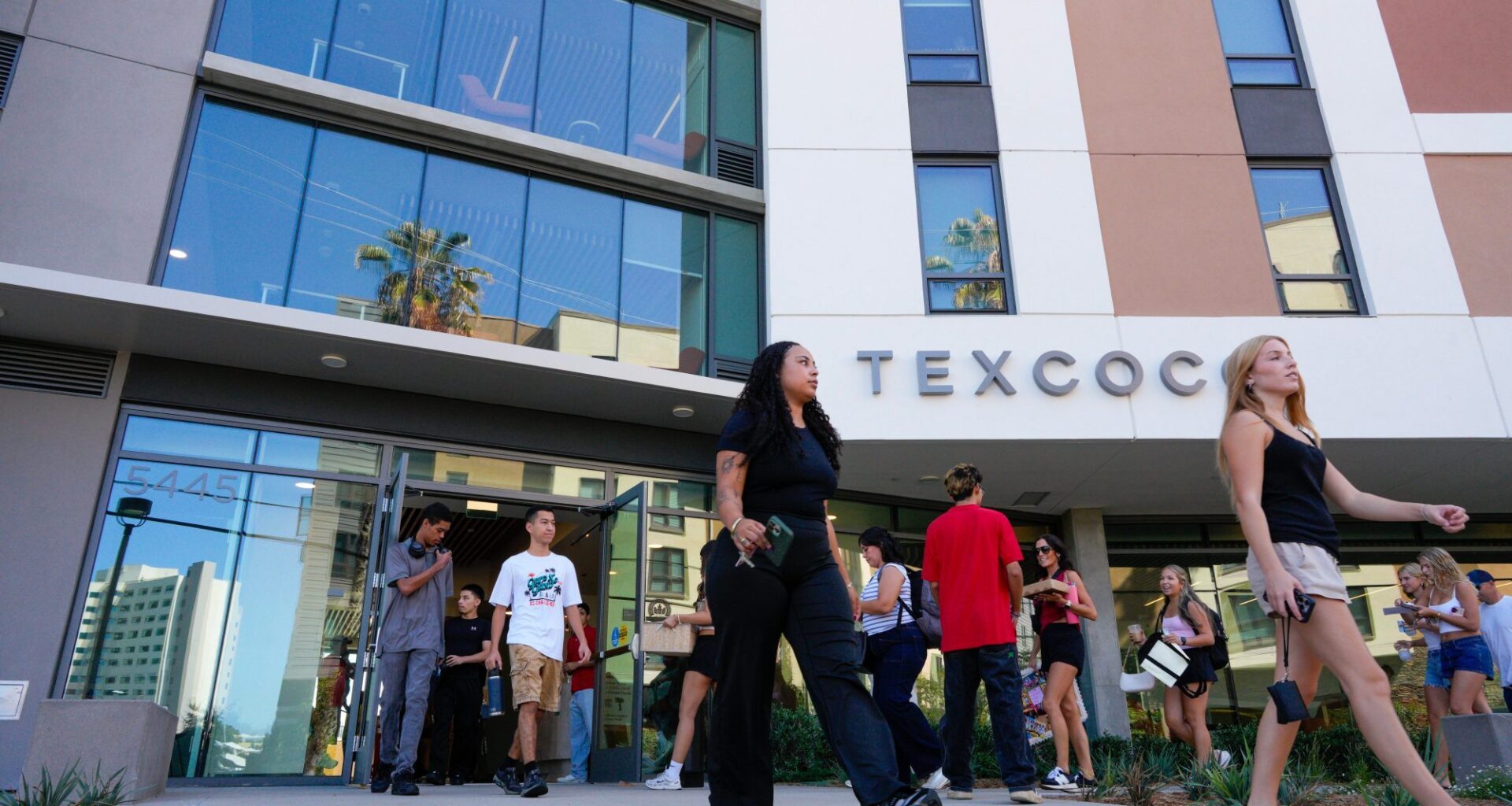
The students pouring into San Diego State University this past week for the start of the fall semester were greeted by the whine of skill saws and the whack of hammers as workers hustle to build tall dormitories and a spacious life science building overlooking Interstate 8.
There’s also lots of noise at Cal State San Marcos, which is erecting a science and engineering center. The University of San Diego is doing the same, while UC San Diego prepares to build one of the biggest student housing villages in the world. Mesa College, an incubator for Olympic athletes, will get a new sports complex.
And the Educational Cultural Complex in San Diego’s Mountain View neighborhood, which has hosted such luminaries as Coretta Scott King, Stevie Wonder and Jesse Jackson, is being renovated and expanded at the College of Continuing Education.
It’s boom time in academia. San Diego County’s colleges and universities are in the midst of a historic and frenetic effort to deal with rising enrollment and the need to provide students with a place to live in one of the nation’s priciest housing and rental markets.
Thirteen schools are collectively spending nearly $11 billion on construction, renovations and expansions, according to data from each of the institutions, which includes three public universities, nine public community colleges and one private university.
The work began about three years ago and will last at least until 2034. The boom could also mushroom in size if voters in the Grossmont-Cuyamaca Community College District on Nov. 3 extend an existing bond by $624 million. Part of the money would enable Grossmont to replace drab portable bungalows with new classroom buildings.
 Work continues on a new housing village, Evolve, at San Diego State University overlooking Interstate 8. (Meg McLaughlin / The San Diego Union-Tribune)
The pressure for results is intense. The websites of UCSD and SDSU say the schools collectively received about 265,700 total admissions applications for fall 2026. Many were turned away. But the two schools’ overall enrollment could exceed 90,000 this year.
These institutions are growing due to pent-up demand, and the fact that Southern California is not suffering the sort of deep demographic and chronic money problems that are upending many public and private universities in other parts of the country.
The enrollment of Pennsylvania’s state-owned public universities dropped by 36,000 from 2010 to 2023, a plunge attributed to declining numbers of college-age students, a lower percentage of people enrolling in college, limited government funding and rising tuition.
Such prominent universities as Syracuse and San Francisco State, as well as Hampshire College, are also struggling to attract students.
The number of college-age students in California is also dropping. But the percentage who choose to attend college has begun to rise as the state invests heavily in higher education.
The elite University of California system is projected to continue experiencing robust growth, while the California State University system is expected to expand at a solid rate, according to a 2024 study by the Public Policy Institute of California, using state estimates. Community colleges also will gain students but fail to reach previous highs, and private, nonprofit colleges will see modest growth, the report adds.
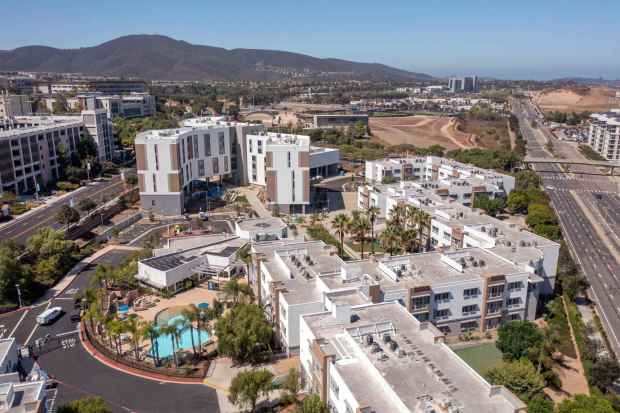 California State University San Marcos is investing in more student housing. Close right is University Village built in 2003, with the new adjacent Black Oak Hall at upper/middle left. At far right is Barham Drive. (Charlie Neuman / For The San Diego Union-Tribune)
A focus on housing
Roughly $4.3 billion of the $10.7 billion that local schools are spending is being used to create additional housing for nearly 12,000 students and others. Almost half of those people will live in Pepper Canyon East, a village at UCSD that will be composed of at least 10 buildings near the edge of Interstate 5.
Last year, UCSD Chancellor Pradeep Khosla floated the idea of building a 30-to-40-story tower, an idea he’s no longer pushing publicly. But he told the Union-Tribune recently that the new village will raise UCSD’s total housing capacity to 30,400, the highest of any school in the nation.
Bold thinking is also occurring at Southwestern College in Chula Vista, which told the Union-Tribune it is exploring whether to build a 23-story, 550-bed tower at a satellite campus in National City, with some beds possibly going to sailors from Naval Base San Diego.
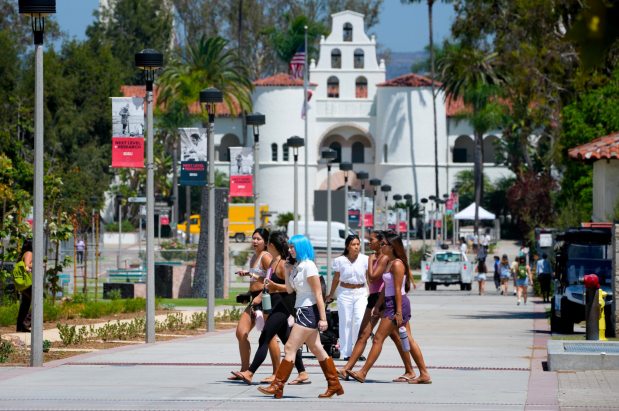 Students arrive on Aug. 21 ahead of San Diego State University’s first day of classes for the fall 2026 semester. (Nelvin C. Cepeda / The San Diego Union-Tribune)
The San Diego Community College District and the city of San Diego have been discussing ways to transform San Diego’s Golden Hall into a museum and education center in a step toward revitalizing the downtown Civic Center area. Greg Smith, the district’s chancellor, told the Union-Tribune he is exploring long-term opportunities for adding 4,000 to 5,000 units of housing.
Smith also said he would like to create housing for about 10,000 of the students who attend the district’s four colleges. Work is underway on a seven-story tower at City College that will house almost 800 people.
These ideas reflect an emerging belief among community colleges — which have the ability to raise lots of bond money — that they should help ease the housing shortage for many people in their service areas, not just for students.
Market analysts say the housing push is impressive but involves significant financial risk, largely because students are increasingly interested in taking online courses.
“It would not be surprising if some student housing begins to have vacancies 10 years down the road,” said Norm Miller, an emeritus professor of real estate finance at the University of San Diego.
Adela de la Torre, the president of SDSU, isn’t sweating it.
“There is more and more demand for students to be on campus precisely because of community engagement, the extra-curricular activities, the bonding that occurs,” said de la Torre, an entrepreneurial economist who is building beds for 3,600 students at Evolve, a village that’s rising on the edges of a campus short on space.
Playing catch-up
The building frenzy arose from the Great Recession of 2008. It led many colleges and universities to cut courses, limit enrollment and delay the comparatively small number of student housing projects on the books. The COVID-19 pandemic had a similar effect.
But it did not dampen students’ desire for an education. The long-term enrollment of the UC and CSU soared, eventually creating a student housing shortage that began to surface around 2015. Neither system was ready for it. Thousands of students were left to fend for themselves in places such as La Jolla, where they had to compete for a limited and expensive stock of housing.
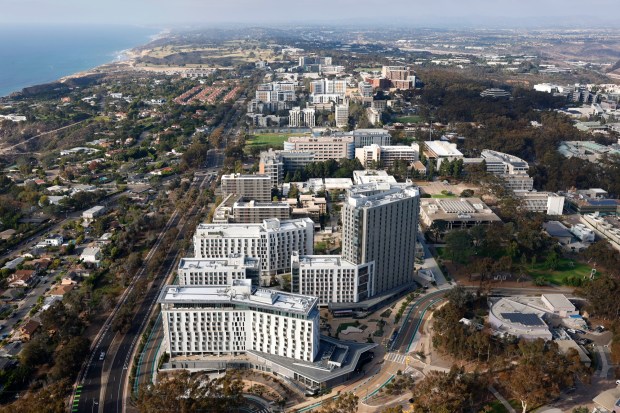 In an aerial photo, new student housing high-rises at UC San Diego are seen on Oct. 7, 2025. (K.C. Alfred / U-T file)
The UC sought help from Khosla, an engineer who loves to build. The La Jolla campus had lots of open space, and Khosla didn’t mind building residential towers that could be seen from miles away. This didn’t slay the housing shortage. But it made waitlists shorter on a campus that today has 45,000 students and is galloping toward the 56,000 mark.
De la Torre has also focused on housing, and not simply because she wants SDSU’s enrollment to rise to at least 50,000 from its current high of roughly 43,000.
The university is located in College Area, a roughly 3-square-mile community where students have crammed into privately owned rental homes and “granny flats” for decades. The neighborhood is dominated by fraternities and sororities that have often infuriated residents with raucous, and sometimes dangerous, parties. The school has been able to do little about it because the behavior occurs off campus.
Some of that tension may ease with the rollout of Evolve, a student housing village featuring dining halls, open spaces and better study areas. The first building, known as Texcoco, opened this month.
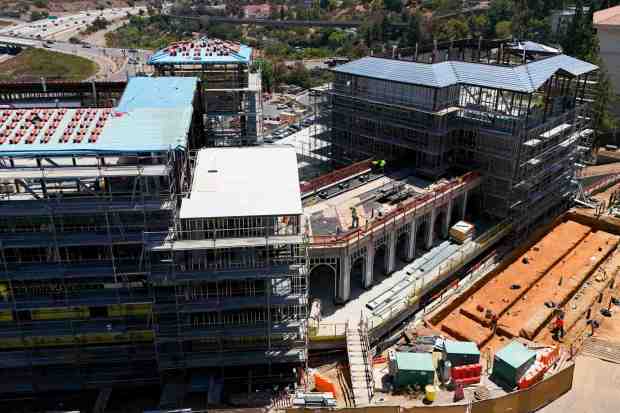 Construction continues on the Life Science Building at San Diego State University on July 31. (Meg McLaughlin / The San Diego Union-Tribune)
De la Torre also founded SDSU Mission Valley, a branch campus nearby that’s meant, in part, to enable the school to expand its research programs. A stadium has already been built there. And work is underway on 741 units of housing that campus officials say will mostly go to faculty, staff and the general public. She expanded her good neighbor policy earlier this month, announcing that a 250-unit senior living community will be built on the site.
Entertainment is also front-and-center in this era of building. Mesa College, Miramar College and City College are each developing new performing arts centers. In November, UCSD will open a six-story cylindrical alumni center whose exterior features screens that will allow the school to broadcast concerts, sporting events, movies and news broadcasts.
Such ventures can overshadow smaller projects, such as Miramar’s plans to open a new building next to Montgomery Field to better train the aviation workforce.
Public and private collaboration
Deep, expensive, long-term collaborations between colleges and the private sector and government used to be fairly rare in San Diego County. That’s no longer the case — something that will become evident.
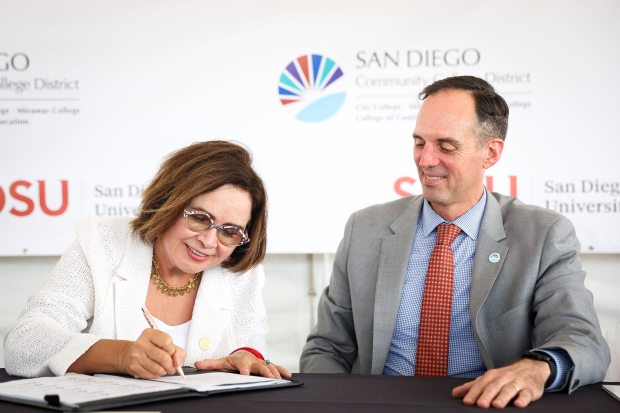 San Diego State University President Adela de la Torre and San Diego Community College District Chancellor Gregory Smith sign an educational partnership in the parking lot of Snapdragon Stadium on July 17, 2025, in Mission Valley. (Meg McLaughlin / U-T file)
The San Diego Community College District says it plans to build a $220 million, five-story, joint-use STEM education center at SDSU Mission Valley. This is meant to improve the chances that community college students will transfer to four-year schools, a long-standing problem in California. SDCCD and SDSU faculty will teach the courses.
“If we collaborate, we individually do better, and the region does better,” said Greg Smith, SDCCD’s chancellor.
The same mindset exists at Cal State San Marcos, where President Ellen Neufeldt has been collaborating with Sea Breeze Properties, which is developing North City, a fast-growing residential, entertainment, and retail center across the street from campus.
Sea Breeze, a private developer, is currently using its own money to build an 11-story tower in North City that will be occupied by 923 CSUSM students when it’s finished next year.
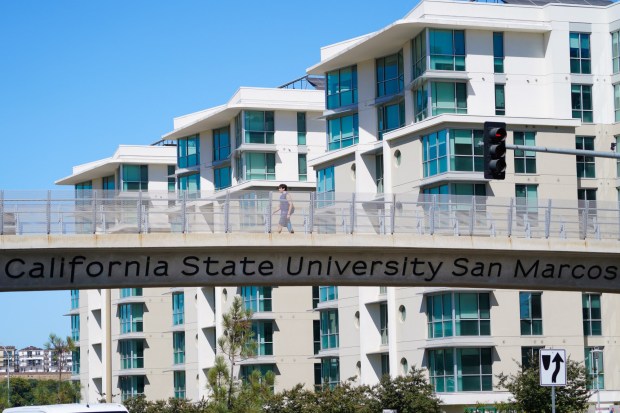 The new North City development, which includes student housing, classrooms, a student dining hall and restaurants, is being built just north of Cal State University San Marcos. (Nelvin C. Cepeda / The San Diego Union-Tribune)
The school will then have 3,548 beds, more than half of which were created by Sea Breeze.
At the moment, CSUSM is preparing to open Black Oak Hall, a 555-bed complex that zeroes in on student needs, such as providing “allergen-friendly rooms” that don’t have carpets.
Collectively, North City and CSUSM are beginning to resemble Westwood, the lively community next to UCLA.
Housing is only part of what occupies Neufeldt’s attention. The school is building Hunter Hall, which will greatly expand its ability to train workers for the region’s burgeoning health, science and defense industries.
Neufeldt is also extending academic programs off-campus. CSUSM will teach five bachelor’s degree courses at Southwestern College in Chula Vista. And it is trying to introduce courses at the Marine Corps Recruit Depot in San Diego and at Camp Pendleton.
“It’s not about competing with other universities,” Neufeldt said. “We serve the whole of San Diego County … I have no doubt in my mind that the people coming through post-secondary education right now will reinvent the workforce. It’s happened other times in history, and this will be another moment.”