
“What’s all that water, Dad?” the son asked the father, Gerald Haslam, as they drove down I-5 toward Bakersfield. “I don’t remember it.”
“For a moment I do not answer because we are seeing a ghost,” my friend Gerry wrote then, himself gone now five years. “Finally I reply, ‘Tulare Lake.’”
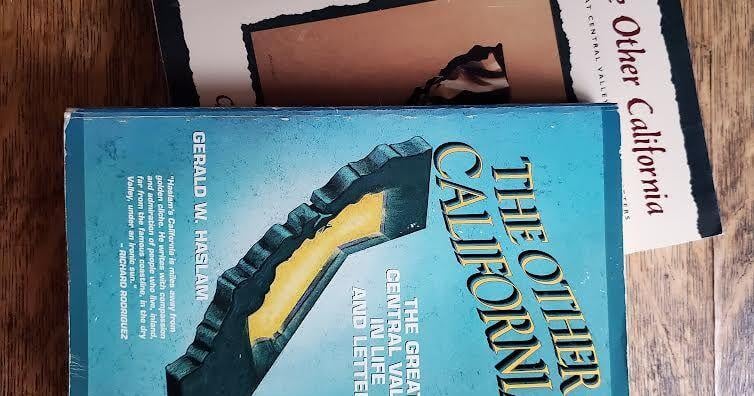
This is his introduction to “The Lake That Will Not Die,” the second essay in his collection “The Other California: The Great Central Valley in Life and Letters” (1990, 1994.)
This whole book is full of beautiful insights about the lake basin we live in from one of its proudest native sons, a treasure I’ve had on my bookshelf since he handed it to me in Oct. 1990. However, this particular essay, “The Lake That Will Not Die,” is essential reading right now, whether you’ve read it before or never heard of the guy. He puts his finger gently, but exactly on the myth that keeps us from seeing what we need to do. It could help us step up to the plate before we repeat the disasters of 2023 should the lake make its next appearance this winter.
What brought it back into my field of view was an envelope I’d found in my post office box from Gerry’s wife, Jan. She has been producing small chapbooks of his stories and essays, illustrated with drawings by their son Garth and photographs she took of this man she married. Just the day before, I had recommended “The Other California” to a writer friend who’d never heard of Haslam, this Valley author who gave so much to all of us. Having pulled the book from the shelf, I found myself re-reading it cover to cover. Immersed in his straightforward, affectionate writing, I found my feet back on hallowed ground, safe in knowing I’m home where I belong even though I wasn’t born here.
What makes Gerry’s writing about us different, whether fiction or non-fiction, is it’s an inside job. Born in Oildale to an Anglo working-class father and Mexican-American mother, he grew up in the ‘40s and ‘50s much like any other kid on his block or in his county, Kern. But he could see where not everybody had it as good as he did, and we hear their stories as well as his own. Looking back on that childhood as an adult, he adds the historic and geographic knowledge we acquire later about home if we’re lucky. The result is his writing is compassionate without being romantic and critical at times without being caustic. Those of us living here as imports can see we also are part of the picture. He writes about the literary landscape as well as the real one, and the demographics of immigrants and small towns. One stand-alone piece about family, “Father Comes Home,” still brings me to a standstill with its extraordinarily ordinary real love. In that piece, he refers to Jan as “the girl I married,” a term of endearment that shows how much he knew she meant to him.
His deep love for this place is contagious. One of my favorite essays is “The Kern, My River,” where he confesses his sense of possession of that stream – or perhaps a sense of belonging to it. Now I never drive across the Kern River without remembering his opening scene: the Kern at full flood stage, a rabbit clinging to a tree submerging in the water below the bridge Gerry’s school bus was crossing, the rabbit resurfacing on the other side, still astride the tree’s trunk.
Unlike his river, Gerry recognized you can’t possess the lake, or kill it off either. In “The Lake That Will Not Die” he captures the magical, spiritual feeling so many of us have experienced when the lake returns. It’s not just a Yokuts thing, although it might help us comprehend their concept of Spirit. I think it’s reassurance Man can’t totally triumph over Earth. That we’re not in charge after all. Haslam details the lake’s hydrology and history, a helpful summary. But his awe and excitement seeing the lake again is catching. It won’t hurt us to remember and re-vision it through his eyes.
There are 25 copies of “The Other California” available for check-out through the San Joaquin Valley Library System. Ask your librarian for help. Prepare to be enlightened.
Trudy Wischemann is a homebody who writes. Send her your lake ideas c/o P.O. Box 1374, Lindsay 93247.