
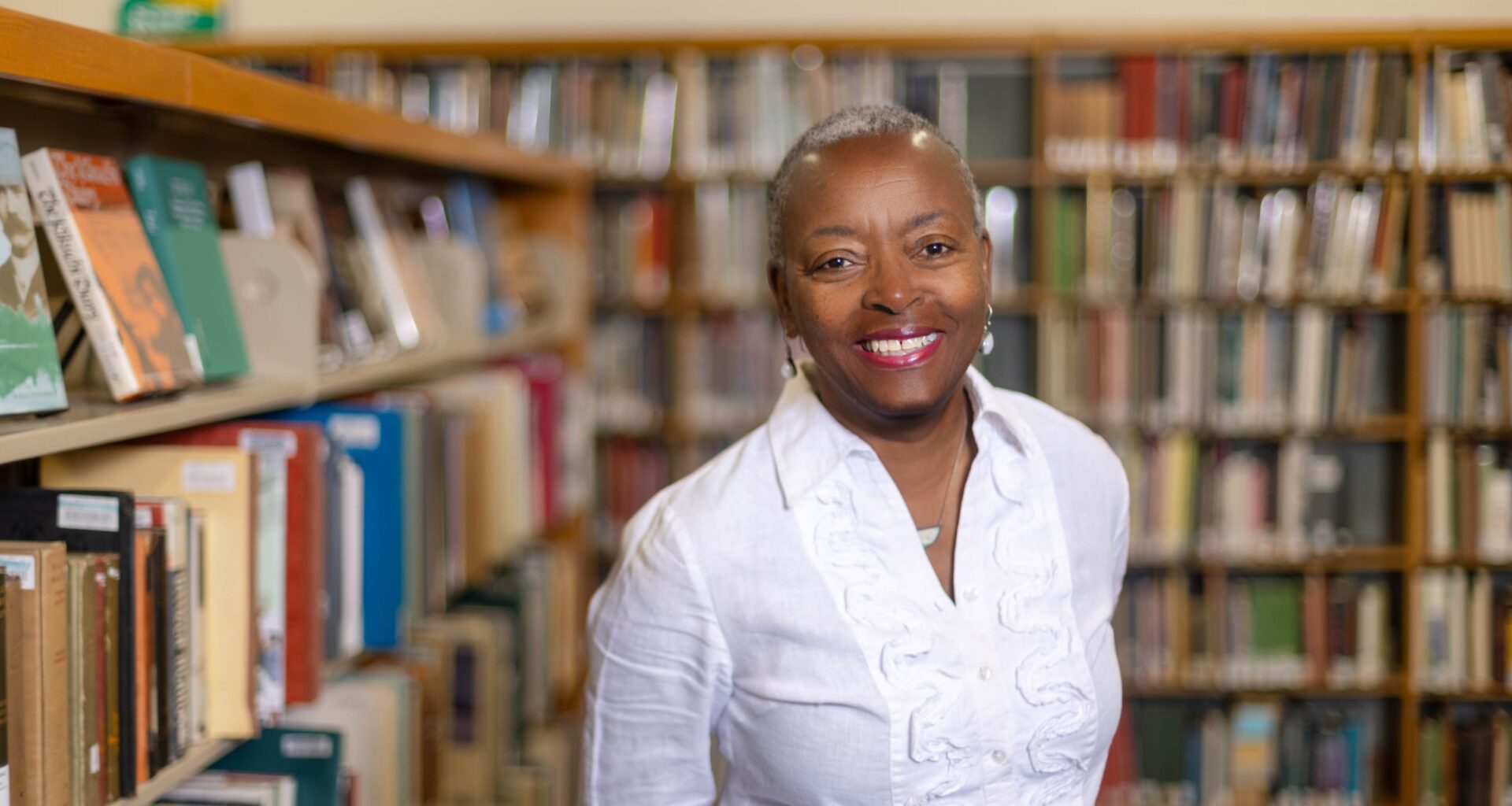
Dorothy Lazard retired as a librarian five years ago, but she has kept up a busy schedule as an author. She is now celebrating the release of her second book to appear since her retirement from the Oakland Public Library, “Behind the Desk at the Main,” from Berkeley publishing house Heyday. The book recounts the story of Lazard’s four-decade career as a librarian, how she landed her job at Oakland’s main library, and the bittersweet moments that marked her time helping patrons navigate the library on 14th Street.
In the book, Lazard writes about how libraries still play a pivotal role in promoting civics and literacy and serving as community hubs despite headwinds including budgetary constraints, book ban campaigns, changes in technology and the rapid rise of AI. She also describes the pivotal role she and her fellow Oakland librarians played during the pandemic and the safety threats they sometimes faced.
The memoir is also effectively a reference book filled with Oakland literary facts.
Lazard writes that Oakland’s first library, the Oakland Free Library, was established in 1878, just 26 years after the city’s founding. She notes that in 2021, when Oakland had a population of 433,823, the library system had an extraordinary 402,768 active library card holders. She also writes that the library’s Asian branch on 9th Street, an effort championed by librarian Judy Yung, was the first of its kind in the country. Or, how Oakland librarian Ina Coolbrith inspired and mentored author Jack London.
Lazard dedicated over two decades to the branch where she started at the reference desk, then took over the reins of the Oakland History Center.
Lazard writes about how she spearheaded the name change from the Oakland History Room to the Oakland History Center. That change, she writes, was inspired by the late author and artist Jeff Norman, whom Lazard calls the “unofficial historian of Oakland Temescal,” who had suggested the name change because, among other reasons, “the quaint word ‘room’ fails to capture the variety and depth of intellectual industry that goes on there.” When Norman died of cancer in 2019, Lazard successfully petitioned for a departmental name change to honor him.
During her time at the reference desk, Lazard writes, she would field a hilarious range of questions from patrons, from the basic (“Where’s your nonfiction section?”) to the silly (“How do you say Oakland in Pig Latin?”) to the poignant, such as a question from one English learner, “What would you call the man who is seeing your girlfriend? Would you call him your date?”
“You’d go home and even if you couldn’t find the answer for the patron, you at least set them on a journey to try to find the answer on their own,” Lazard told The Oaklandside. “Or, maybe you did find an answer, but those questions would resonate and stay with you for a while because you’d wonder why this person needs to know this, or what’s going on in their life where they’re having this question?”
Lazard’s connection to the main branch dates back decades when, as a student at Castlemont High School, she’d spent her afternoons perusing its aisles.
“Aimless as a ghost, I haunted its departments trying to absorb as much as I could from each area I wandered into,” she writes in the book. “I found the library a seductive palace, a forest of dreams and possibilities. Lured by its expansiveness and intrigued by its community, I was eager to learn about everything that piqued my interests.”
 Dorothy Lazard’s new book was released on Aug. 18. Credit: courtesy of Heyday
An abrupt cancellation
Given her history with the branch, it seemed fitting to hold her book launch there. The event was scheduled for Aug. 19, and Lazard was thrilled to return to the place she had considered her second home. That excitement turned into shock and anger when a month before the event was to take place, the launch event was abruptly canceled.
Many, including Lazard, saw it as censorship.
“Any info on this? Ms. Lazard helped me research on several occasions very efficiently,” read one Facebook post.
“It is outrageous and ironic: A public library cancelling a talk about such library because it couldn’t cope with a little criticism. This will backfire on Oakland. And drive book sales,” someone else wrote on Reddit.
Lazard said she only learned the news when a librarian at the main branch called her on July 15 asking her why the event had been canceled.
“Is my event being canceled?” Lazard recalled responding. “I hadn’t heard anything.”
Through a public records request, The Oaklandside obtained the email that library director Jamie Turbak had written to library staff notifying them of the event’s cancellation, saying the “program is not an appropriate fit for the Oakland Public Library” and that Lazard had been notified.
Lazard said it took scrolling through various email accounts, some of which she rarely uses, to locate an email from the library’s community relations manager, Tarshel Beards, which The Oaklandside separately obtained.
Beards says in the email that she’d received and reviewed and advanced copy of the book, and then writes, “After careful consideration, we have determined that the book talk/launch program scheduled for August is not an appropriate fit for the Oakland Public Library and the Oakland History Center, because the book centers on your experiences as a former employee. We believe sponsoring this event would create an institutional conflict, and we are unable to move forward with hosting the program.”
“I was personally hurt. I was personally insulted,” Lazard told The Oaklandside. “But here’s a more frightening, troublesome issue for me. We are already in an era of censorship, book bans, and people demonizing librarians, calling them pornographers, saying that they’re grooming kids, and banning anything that is about BIPOC LGBT+ community members. When the library itself starts to self-censor, we have fallen down a really deep, dark rabbit hole that we may not come out of.”
Lazard was aware that her book was at times critical of the library, describing instances when her safety and that of her colleagues was at risk. In one passage, she describes an encounter with a patron who had been accosting female staff with sexual threats and violent outbursts. Library workers, she writes, are “besieged with social problems that extend well beyond the library’s capacity to provide real help for the neediest people entering the building.”
Lazard said that she had not spoken to anyone in management at the library since receiving Beard’s email. But Steve Wasserman, Heyday’s publicist, emailed Beards, asking the library to reconsider its decision given Lazard’s illustrious career at the branch.
In his July 27 email, obtained by The Oaklandside, Wasserman writes, “Surely you can understand that by disinviting Dorothy, you risk dishonoring the very institution you serve and whose interests you have at heart.”
He adds, “The optics aren’t good.”
Beards responded the same day, in an email The Oaklandside obtained, saying: “Thank you for your message and thoughts. Consistent with Oakland Public Library’s mission and Collection Development Policy, OPL will order copies of ’Behind the Desk at the Main: A Librarian’s Memoir by Dorothy Lazard’ for the circulating collection.”
The reasoning behind Turbak’s decision only became clear yesterday, when the library system responded to The Oaklandside’s public records request.
In one of the emails we obtained, dated August 27 and sent to Sean Maher, the city’s communications director, along with some members of the library staff, Turbak writes, “In her book, Ms. Lazard cites the first name and the first and last name of library patrons in describing the books and resources they sought and used. There are at least four separate instances of this in the book.”
Turbak goes on to explain that Lazard’s decision to name patrons in her book violates California Government Code 7927.105, which prohibits sharing any “personally identifiable uses of library resources, information requests, or inquiries.”
“The Oakland Public Library’s expectation of all employees, past and present, is that they respect the privacy of our patrons and comply with the corresponding rules and regulations,” Maher told The Oaklandside. “While the book in question remains widely available in our system for OPL patrons to borrow and read, we chose not to host a book event because it violates those expectations.”
The memoir does in fact pay tribute to the countless patrons Lazard helped during her tenure, from high school students looking for guidance on how to research a topic, to journalists needing to fact check a story, to older patrons who found community through the library’s programming. And Lazard named a few of her favorites, such as a man who learned how to read thanks to the library’s Second Start adult literacy program.
“I genuinely didn’t know that,” Lazard told The Oaklandside when asked about the potential code violation. “The reason why I wrote about those patrons is because I wanted to honor how much they meant to me when I was a librarian.”
“Why didn’t Tarshel [Beards] tell me this when she first emailed me?” Lazard said.
For weeks, Lazard had been convinced that the book was being censored because she’d written about safety concerns at the library, an issue that was formally addressed by Oakland Public Library management just months after Lazard retired.
“OPL decided not to host an event promoting the book, which I’d argue is pretty different from censorship, especially since the book is readily available to library patrons,” said Maher.
In June 2022, the Oakland Public Library hired a consultant, Joseph Maurer of Omni Mediation, to address safety concerns and burnout among the system’s librarians. According to the resulting report, Maurer met with 50 staff members working at all levels of the library system, many of whom mentioned how “the culture of the library has changed and [patron’s] behavior that would have once been unacceptable is now tolerated.”
Of the low staff morale, the report concluded, “The Oakland Public Library is at an inflection point and needs to decide upon its path for the future or its path may be decided for it.”
Lazard’s book touches on similar themes.
“My coworkers had been worn down to a nub,” Lazard writes in the chapter titled “Why We Leave.” Our principal concerns were about safety — the public’s as well as our own. Library staff were routinely threatened by angry or mentally unstable patrons. And the threats and violence had only increased in recent years.”
A librarian at heart
In the wake of the library’s event cancellation, Lazard went on to have a sold-out launch at The New Parkway on Aug. 19, where she was in conversation with radio host and author Alexis Madrigal. The two talked about the need to preserve libraries as civic institutions and how AI is changing the landscape of literacy. Some audience members wanted to know why the event had been moved from the library to The New Parkway Theater.
The event was so engaging, she said, that there wasn’t enough time to field through all of the audience questions before the event ended.
Some days after the event, Lazard told The Oaklandside she remains a librarian at heart.
“I miss the people. I miss my coworkers. I miss the people who would come in,” Lazard said. “I miss doing something good for people every day. That was the joy of my life.”
“It is not just the books and other materials that make the library a community resource,” she writes in her book. “It’s the dedicated skilled people who invite the community to ably guide them through the library that make the place socially important.”
While the book is mostly about Lazard’s time at the main, it also serves as a tribute to Lazard’s sister Sarah, who played a central role in Lazard’s journey as a bibliophile. It was Sarah who helped her get her first library card, at San Francisco’s Western Addition branch.
“She was the first avid reader I knew, and introduced me to poetry and gothic tales and history,” Lazard writes. “Her curiosity about the world piqued my own desire to know more.”
After Sarah died in 2024, Lazard was the one who cleared out her sister’s home.
“Among the many beautiful and elegant things in her Chicago condo,” Lazard writes, “Sarah’s bookshelves told a rich and nuanced story.”
Lazard said her favorite of Sarah’s most prized books in her extensive collection was the “Ebony Pictorial History of Black America,” released in 1971.
“That was the first encyclopedia set that she had invested in buying when I was young,” Lazard told The Oaklandside.
One of Lazard’s last acts before retiring, she told The Oaklandside, was to lead an in-depth training for reference librarians on how to preserve the library’s African American Reference Collection, pointing out how the collection, which includes rare encyclopedia sets published in the 1960s, served as a “type of historical retrospective, capturing so much of the history we had not been taught in school for hundreds of years.”
And her book offers readers a call to action during a period of assaults on the First Amendment by the Trump administration. “We must fight for everyone’s right to read what they want,” she writes. “That freedom is the bedrock of our democracy, a symbol of our personal and national independence. It is what binds us together as a nation, educates us, teaches us to appreciate and respect each other, and, as a result, dare I say it, civilizes us. The erosion of that freedom impacts all of us in direct and indirect ways.”
“*” indicates required fields