
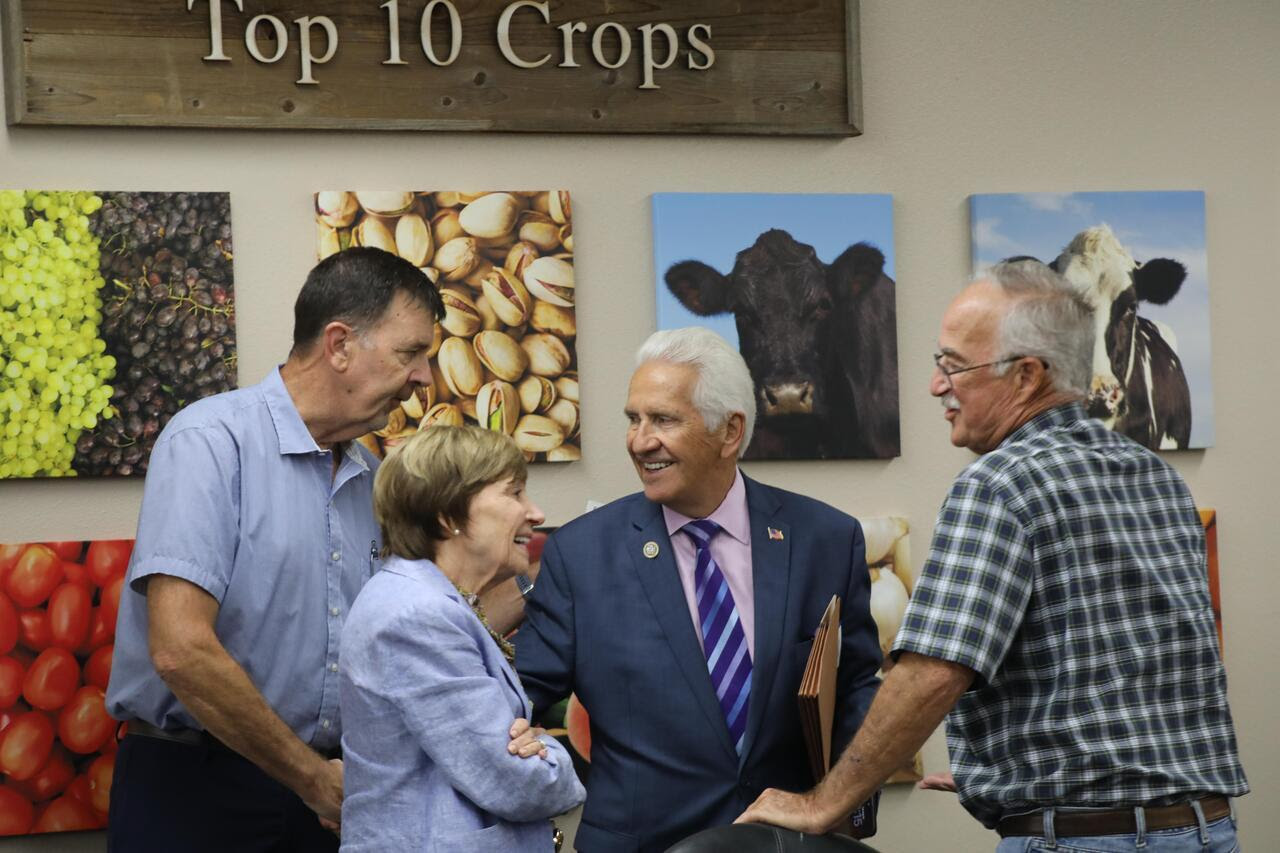
U.S. Rep. Jim Costa, center, speaks with attendees at a Farmers for Free Trade USMCA roundtable last week at the Fresno County Farm Bureau. Photo courtesy of Farmers for Free Trade
published on August 24, 2026 – 4:17 PM
Written by Frank Lopez
Farmers, agribusiness leaders and elected officials gathered last week at the Fresno County Farm Bureau to press for tariff-free trade with Canada and Mexico as the U.S.-Mexico-Canada Agreement moves through its Joint Review — days before a separate U.S.-Canada dispute escalated into new tariffs.
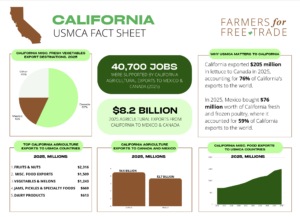
According to Farmers for Free Trade, California exported $8.2 billion in agricultural products to Canada and Mexico in 2025 and the trade supported an estimated 40,700 jobs. The Business Journal could not independently verify those figures.
The issue carries weight in the San Joaquin Valley. Fresno County recorded $9.03 billion in agricultural production in 2024, according to the county’s 2024 Crop and Livestock Report, making it the top-producing agricultural county in the United States.
What’s happening with USMCA
The Fresno gathering was part of Farmers for Free Trade’s national USMCA Roundtable Series. The U.S., Mexico and Canada held the first mandatory Joint Review of USMCA on July 1, 2026. A full 16-year extension was not confirmed, moving the agreement into annual reviews while it remains in force, according to the organization.
Rep. Jim Costa, California Department of Food and Agriculture Secretary Karen Ross and Farmers for Free Trade Executive Director Brian Kuehl moderated the discussion. Growers representing table grapes, almonds, pistachios, citrus, cotton, dairy and processed tomatoes discussed the importance of predictable trade rules for planting, packing, labor and investment decisions.
“Canada and Mexico are the San Joaquin Valley’s closest and most important customers,” Costa said. “As the Joint Review moves forward we need to keep that focus so our growers can be price makers rather than price takers. Reliable trade with our closest neighbors is also a matter of national security.”
Roundtable comes amid renewed U.S.-Canada tensions
The gathering took place days after U.S.-Canada trade talks collapsed. Negotiations broke down late Aug. 21, and the U.S. imposed 50% tariffs on about $20 billion in Canadian goods. Canada announced retaliatory tariffs on U.S. steel, dairy, agricultural equipment and other products, set to take effect Sept. 8, according to The Associated Press.
That dispute is between the U.S. and Canada specifically and is separate from the trilateral USMCA framework, which remains in force. But it adds to the uncertainty participants said complicates growers’ decisions.
Trade rules remain a concern
Participants also discussed issues beyond tariffs, including maximum residue levels, sanitary and phytosanitary standards, protection of common food names and Canada’s dairy tariff-rate quotas. Specialty crop representatives raised concerns about proposals to introduce seasonality and regionality standards into trade remedy law, which they said could disrupt the year-round supply system used by California growers, importers and retailers.
The discussion also touched on truck emissions rules affecting cross-border freight, labor and immigration policy, and financial pressures facing the farm economy.
“California farmers and ranchers help feed families across North America, and they do it through supply chains that depend on predictable rules,” Ross said. “The longer disruptions continue, the more our customers look for alternatives, which is why continuing USMCA matters so much.”
Why it matters to California agriculture
Canada and Mexico are major destinations for California agricultural products. Data presented at the event showed California exported $205 million in lettuce to Canada in 2025, or 76% of the state’s lettuce exports worldwide, and Mexico bought $76 million in California poultry, or 59% of that category’s worldwide exports. Those figures came from Farmers for Free Trade.
“Mexico and Canada are our top two agricultural export markets, and few states have more riding on North American trade than California,” Kuehl said.