
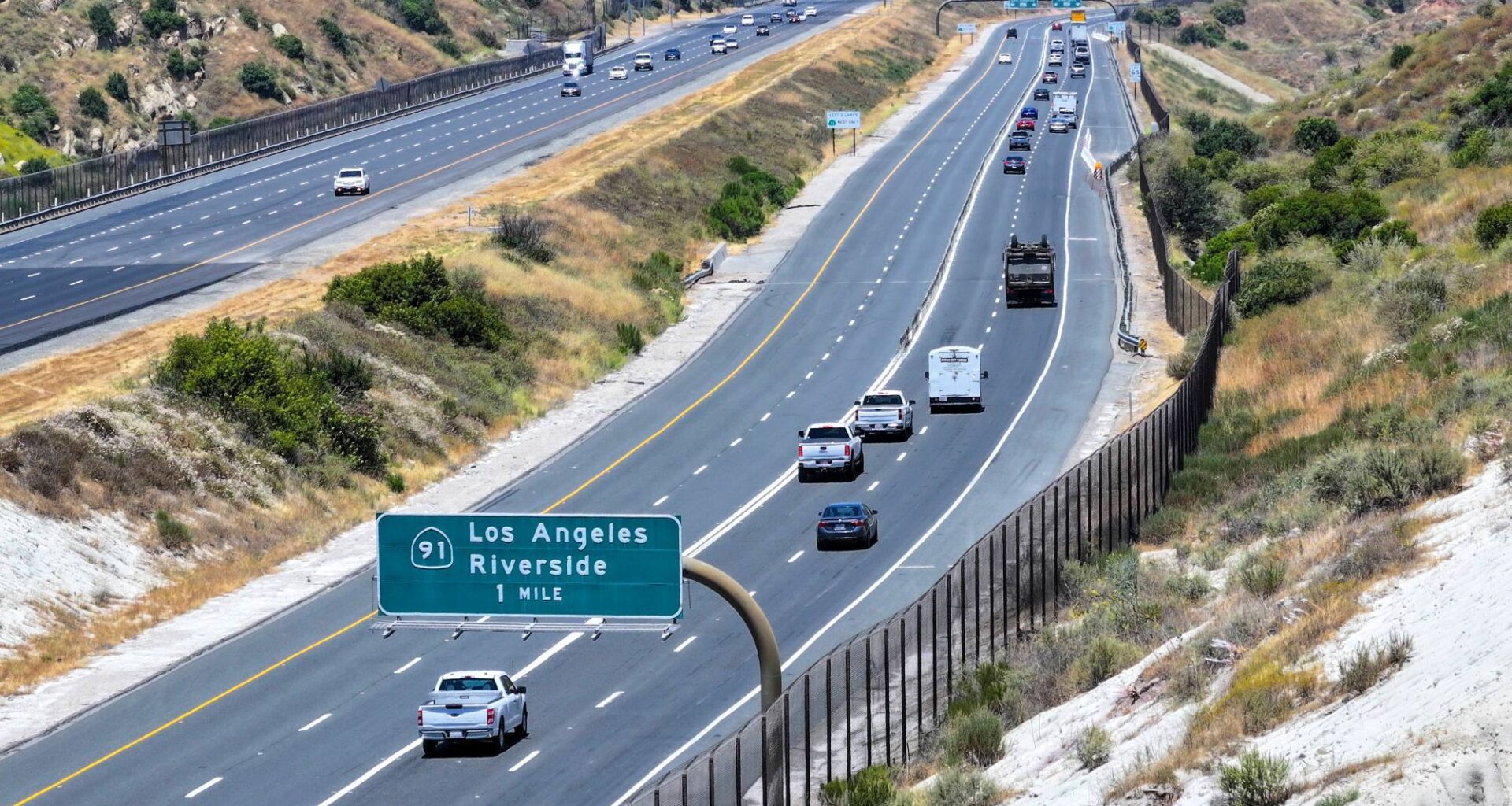
Southern California drivers pay some of the highest gas taxes in the country, and waste too much of that gas sitting in traffic jams. The state spends billions on roads but hasn’t made enough progress improving highways or reducing traffic congestion.
The region needs a network of managed lanes, so drivers, businesses, buses and emergency vehicles have congestion-free options for their trips.
Managed lanes are variably priced toll lanes added alongside existing freeway lanes. No existing free lanes are tolled. Use of managed lanes is a choice. The free lanes remain, and no drivers are forced to use the toll lanes. Variable pricing helps manage demand, ensuring that managed lanes remain free-flowing 24 hours a day, 7 days a week, especially during peak travel periods. Buses, vanpools and emergency vehicles always use managed lanes for free.
California was an innovator in high-occupancy vehicle (HOV), or carpool, lanes, which two- or three-person vehicles use for free. But HOV lanes suffer from the so-called Goldilocks Paradox. Sometimes the lanes are too hot (too many vehicles use them, making them slow and congested), and sometimes they are too cold (not enough vehicles use them, leaving a lot of underutilized capacity).
Managed lanes help solve these problems by raising and lowering rates throughout the day to match demand, allowing drivers to reach more destinations within a given time, such as 30 minutes.
Managed lanes are most popular among drivers making time-sensitive trips. For example, someone heading to the airport, picking up a child from daycare, or running late to a doctor’s appointment may be willing to pay for a faster trip.
Critics sometimes call managed lanes Lexus lanes, but research shows the percentage of Lexuses in toll lanes matches the percentage of Lexuses in free lanes. In fact, lower-income drivers report higher satisfaction with priced lanes because they have more time-sensitive jobs and use the lanes only when they need them most.
According to traffic studies, the five most common vehicles in managed lanes are the Ford F-150, Honda Accord, Honda Civic, Toyota Camry, and Toyota Corolla, which are also the five most common vehicles on U.S roads overall.
Managed lanes are currently under construction on I-105 near Los Angeles International Airport. The Southern California Association of Governments is also planning managed-lane extensions on I-105, I-10, and I-15, as well as toll lanes on I-5 and SR 60.
Most of these lanes are added capacity, although some are conversions from carpool lanes. Eventually, a network of toll lanes should connect much of Southern California, offering drivers the option of a congestion-free trip to most key destinations.
The Southern California region (Los Angeles, Orange, Riverside, San Bernardino, and Ventura counties) currently has 286 miles of managed lanes. San Diego’s I-15 express lanes provide 80 miles of managed capacity.
Reason Foundation’s recent policy paper on managed lanes found several viable corridors for managed lane expansion in Southern California.
In Los Angeles and Orange counties, new managed lanes could be added on remaining sections of I-5, and existing carpool lanes could be converted to express lanes on I-10, I-405, US 101, SR 55, SR 57, and SR 60.
In San Diego, the study recommended adding managed lanes on I-5, I-8, I-805, SR 52, SR 54, SR 94, and SR 125.
Most of these projects were not included in the region’s long-range transportation plans due to their high costs. But state and local leaders don’t have to accept traffic congestion as a fact of life. The study illustrates that public-private partnerships could help provide Southern California’s needed infrastructure, raise capital, shift the financial risks of cost overruns from taxpayers to investors, and offer a modernized, efficient approach to managing and operating the lanes.
Decades ago, the lanes on SR 91 in Orange County were the first successful public-private partnership managed lanes in the country. By expanding managed lanes across the region and using private investment to help pay for them, Southern California’s drivers can have the faster, more reliable road network we need for the future.
Baruch Feigenbaum is senior managing director of transportation policy at Reason Foundation and author of the Annual Highway Report, which ranks each state’s roads and bridges.