
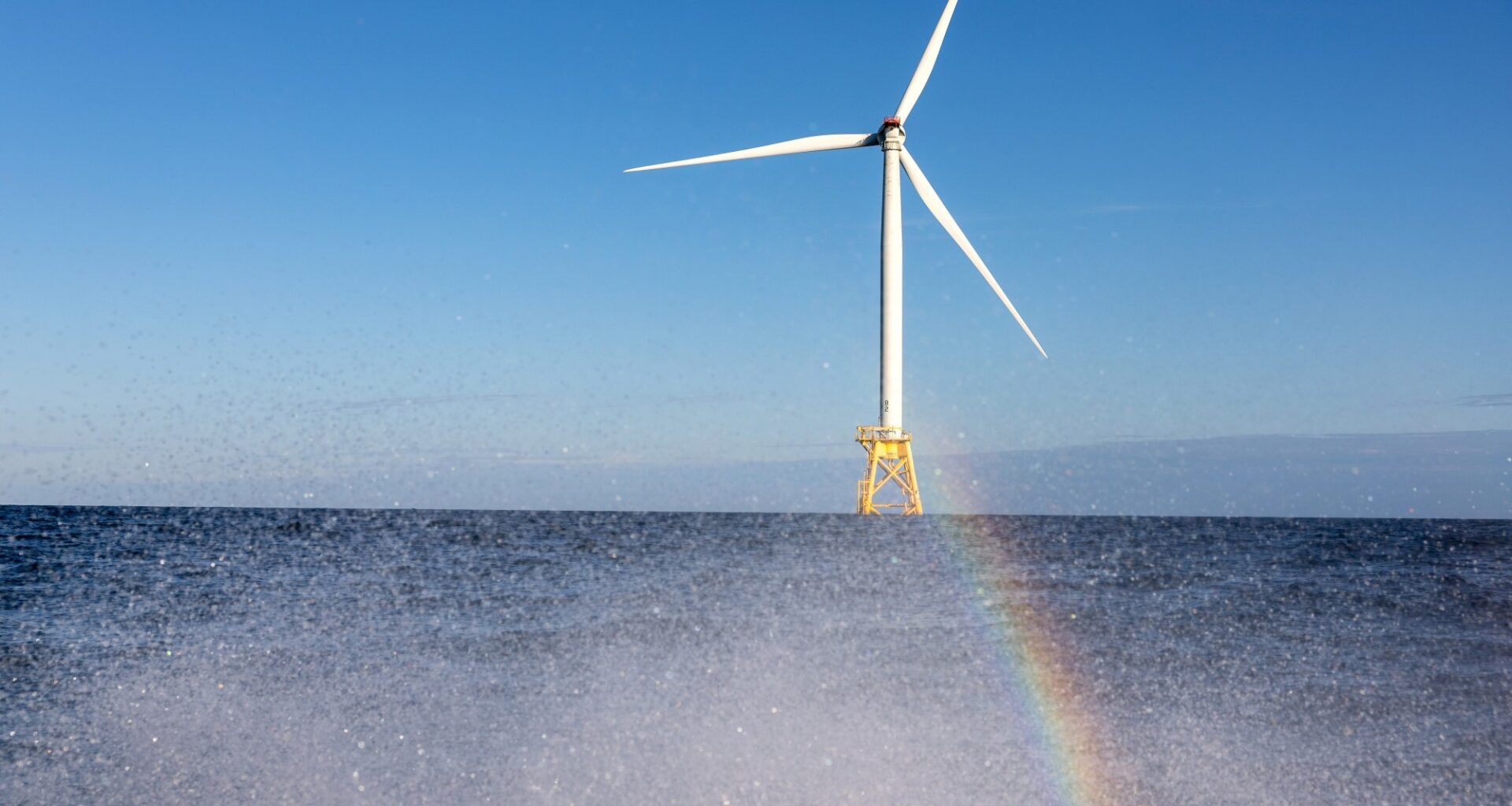
California is taking the Trump administration to court to reverse a deal that blew a large offshore wind project off the table.
A lawsuit filed Friday in federal court accuses the U.S. Department of the Interior and other agencies of making an “unconstitutional and unlawful” deal earlier this year with Golden State Wind LLC that resulted in the company backing out of its lease agreement to build a floating offshore wind farm in Morro Bay.
“California will continue to aggressively fight back against the Trump administration’s outrageous abuses of taxpayer dollars to abandon offshore wind investments that could have delivered union-paying jobs and reliable clean energy to Californians,” California Attorney General Rob Bonta said in a statement.
“We have no comment to offer at this time due to pending litigation,” a spokesperson for the Department of the Interior said in an email to the Union-Tribune. But earlier this year, Interior Secretary Doug Burgum said that Golden Wind LLC was “basically sold a product in 2022 that was only viable when propped up by massive taxpayer subsidies” and called offshore wind “expensive, unreliable, intermittent energy projects.”
Golden State Wind LLC did not respond to an email from the Union-Tribune asking for comment on the lawsuit.
Arcata-based Environmental Protection Information Center applauded the move by Bonta’s office.
“EPIC applauds the decision by the California Attorney General to file this lawsuit to defend California’s offshore wind lease from Trump’s illegal buyback deals,” Matt Simmons, an EPIC climate attorney, said in a news release. “If allowed to proceed, these deals would harm ecosystems, communities and ratepayers by stymying an important piece of California’s energy transition.”
Four years ago, Central California Offshore Wind LLC purchased a lease covering more than 80,000 acres in federal waters for $120 million. The company — later renamed Golden State Wind — sought to develop a 2-gigawatt offshore wind farm, which is the equivalent to powering about 1.1 million homes.
But on April 27, the Interior Department announced that Golden State Wind committed “to voluntarily end” its lease in Morro Bay. In exchange, the company would be eligible to recover the $120 million by spending an equal amount on U.S. oil and gas assets, energy infrastructure or liquefied natural gas projects on the Gulf Coast.
In Friday’s 55-page complaint, California says the executive branch has no authority to give offshore wind leaseholders a “dollar-for-dollar reimbursement” of their lease fees and accused the Trump administration of “buying out developers’ offshore wind energy leases through collusive settlements.”
The lawsuit says the state has already spent more than $100 million to support investments in offshore wind, and the lease buyout harms California’s climate policies, such as the state’s commitment to derive 100% of its electricity from carbon-free sources by 2045 or earlier.
Offshore wind is a cornerstone of the state’s clean energy efforts. California policymakers want to produce 25 gigawatts of electricity from offshore wind farms by 2045.
“We will not let the Trump administration’s reckless actions turn back the clock,” David Hochschild, chair of the California Energy Commission, said in a statement. “California’s clean energy future is worth fighting for. See you in court.”
On the heels of the Golden State Wind LLC withdrawal, two other companies have made U-turns on their California offshore wind leases.
In June, Invenergy, a Chicago-based multinational power generation company, agreed to a $765 million deal announced by the Department of the Interior for four leases that included the 2-gigawatt Even Keel floating offshore wind project, also in Morro Bay.
And earlier this month, German-based energy company RWE announced relinquishing leases in New York, Louisiana and California as part of a $1.22 billion settlement with the Interior Department. One of those projects is the Canopy Offshore Wind Farm in Humboldt Bay in Northern California.
When asked during a video conference with reporters Friday if similar lawsuits were in the works to bring back the Invenergy and RWE projects, Bonta said, “there’s nothing else to report at this time.”
However, the Attorney General’s Office and the energy commission last month sent a letter to federal officials and Invenergy, notifying them of an “intent to sue” over alleged violations of the federal government’s Outer Continental Shelf Lands Act.
Five California offshore wind leases were purchased in 2022, but after the respective announcements by Golden State Wind, RWE and Invenergy, just two remain — one in Morro Bay and one in Humboldt Bay.
Offshore wind is in its infancy in California. The first facility has yet to “put steel in the water” and getting the projects done is more complicated than in other parts of the country.
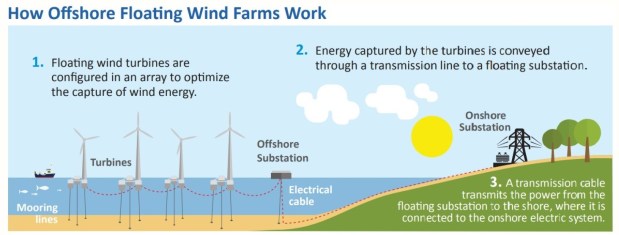 California Offshore Renewable Energy Fact Sheet by the Bureau of Ocean Energy Management, from Feb. 22, 2017.
Unlike the East Coast, where turbines can be bolted into the seabed, the continental shelf off the Pacific coast plunges steeply.
That means offshore wind farms in California will float on the water’s surface, tethered or moored by cables to the ocean floor. Electricity generated by turbines will be transmitted to a floating substation and carried to a power plant onshore via buried cables.
California is expected to be the first region in the U.S. to use floating wind turbines.
There are no plans to develop offshore wind generation in San Diego and Southern California. That’s in large part due to discussions years ago between military officials and the Bureau of Ocean Energy Management that ultimately designated Southern California a “wind exclusion” area because of concerns that offshore wind facilities would interfere with training missions.
Besides, wind speeds in the south are not as steady and strong as those in Central and Northern California. That’s why floating offshore wind projects have focused on Morro Bay and Humboldt County.