
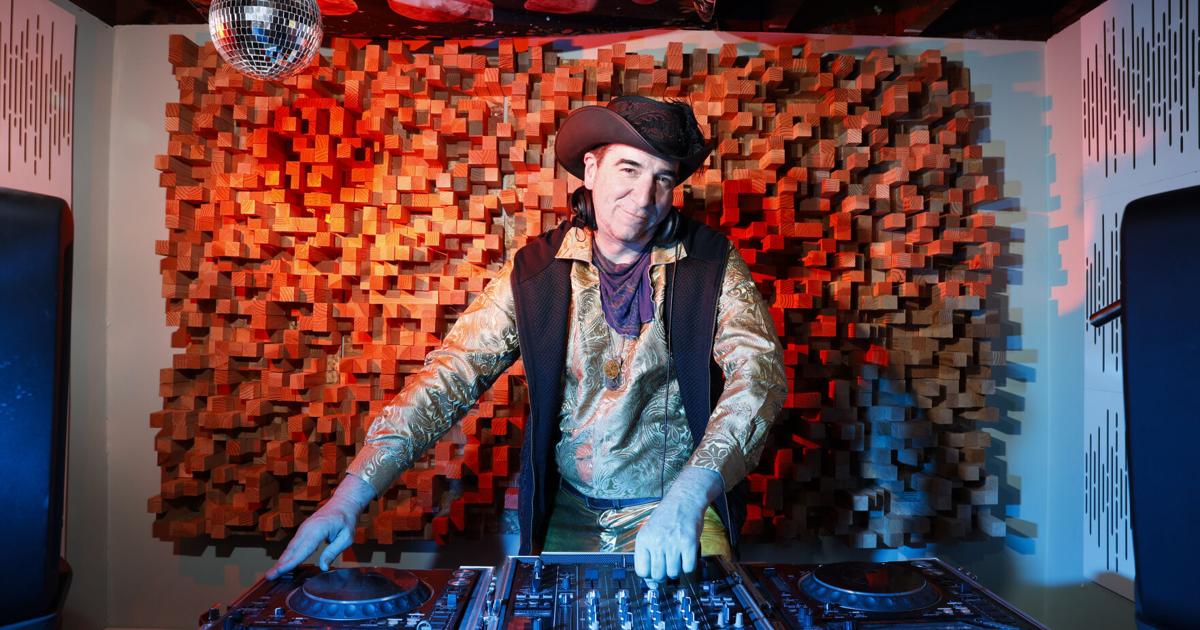
San Francisco native Jeff Taisch said he’s been a burner since 1996, when a buddy of his from high school told him about some rave in the desert.
Taisch said they piled into his friend’s mom’s Volvo and made the trek out to Black Rock Desert in Nevada with no clue what to expect.
“There was like zero infrastructure,” he said of the event’s seventh year in the desert. “I don’t know if we had tickets. I don’t know if they required tickets.”
Between getting caught in a sandstorm, cramming into a single tent with 15 people, and meeting a naked guy carrying around a baby Redwood tree who would become a lifelong friend, Taisch would be forever changed by the experience.
He would go on to perform DJ sets for thousands of people, with his vinyl records melting in the heat; host a flash-mob pizza party with the musician Diplo; and eat sushi flown in by helicopter that day, among other things.
In the past 30 years, he said, he’s only missed Burning Man a few times, for various reasons. This year, he’s missing out again due to “parental duties.”
But as the notorious desert party turns 40, he reflected on how much things have changed about it over the decades, how much has stayed the same, and how it might change in the future.
“Not only do you have influencers and content producers out there, but you have their support crews running around with reflectors and various extra elements to make their productions,” he said. “That exists. The costs have increased, and that’s real. But there’s still something there for people whose inner child is not yet dead.”
Burning Man was created 40 years ago in San Francisco when a group gathered on Baker Beach, and founders Larry Harvey and Jerry James built and burned a giant wooden sculpture of a man.
The event (attendees dislike the term festival) has taken place in the Black Rock Desert since 1990, expanding into a temporary city covering nearly six square miles. It’s known for art installations, music and all things creative — all while fostering human connection.
Taisch said that despite the location, it’s still a San Francisco event through and through. That much is noticeable every year as The City empties out during the week it takes place.
“The burners have left the building,” he said.
This year’s theme is “Axis Mundi,” referring to a center point of existence or “a celestial column connecting us to powers greater than ourselves,” according to an informational flyer created by organizers. Other topics highlighted this year include sustainability, global impact and looking ahead to the next generation.
“The connection, creativity, and leadership opportunities that Burning Man offers are a timely remedy for next-generation leaders,” the statement said.
When asked about the milestone, organizers told The Examiner on Friday in a statement that the ethos of Burning Man is very much intact, and that as “a creative culture at its core, Burning Man has always changed and evolved.”
“Every generation of participants brings new ideas, new challenges, and new ways of expressing creativity, community, and ways to participate,” they said. “In Black Rock City alone, about a third of participants every year are new.”
While the chaotic weeklong event has seen accidents and worse over the decades, Burning Man still claims the devotion of longtime attendees and inspires fascination in newcomers every year. This year, as the event officially becomes middle-aged, more than 75,000 people are expected to descend upon the desert.
Joana Ayala said she’s one of the thousands going, and this year is her first time.
“It’s just been a matter of time,” she said.
Ayala said she’s been living in intentional communities, groups who choose to live together, for the past eight years, so she has long felt that her lifestyle is “Burning Man-adjacent.” But despite having received invitations to go in the past, it hadn’t been the right time — until now.
She said that after speaking with other friends who’ve attended, she found that’s a common sentiment.
“They say when it’s your time to go, you’ll know,” she said.
Ayala said that while she’s excited about the music and the art, she’s most looking forward to experiencing the type of human connection that Burning Man fosters among attendees. She said she’s joining a camping group with a work connection, but otherwise doesn’t know most of the people she’ll be living with.


A rift is growing as powerful women line up in dueling camps, choosing sides in the Chan-versus-Wiener contest for The City’s seat in the House of Representatives

The SF-based band launched its 12th album, ‘Mad Dog in the Fog,’ with a free concert in The City where the band got its start

Popular franchise taking over two venues and bringing photo opportunities, workshops, panels and other events to The City
“I’m curious to see how people really take in the values and principles of Burning Man and embody them,” she said. “I’m really excited to be with other humans in this other culture that’s co-created.”
Ayala said she works in business operations at an arts nonprofit and an investing firm focused on creativity. But her third gig is as a “sound practitioner,” which includes leading workshops on sound improvisation and meditation. She said she plans on leading at least one such workshop while out on the playa, as the desert — which is actually a dry prehistoric lake bed — is known.
“I love sharing my love of sound and voice with people,” she said.
She said she’s a little nervous about experiencing her first sandstorm, but otherwise is optimistic about the week.
“I’m going with the intent to connect with humans and see what comes from there,” Ayala said.
Oleg Lobykin had a bit more work to do before setting out for the desert this week. The sculptor said he’s been a burner for the past 17 years, unveiling a new piece for the event each year.
He was mum about what this year’s piece will look like, but did share that it was eight feet wide and eight feet tall, and he’d be calling it “Diamond Heart.”
“It’s going to be a brilliant work,” he said.
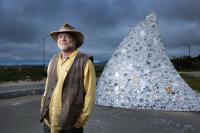
Burning Man artist and sculptor Oleg Lobykin, seen beside his sculpture, “Unsafe to Swim” near Ocean Beach: “Burning Man actually is pretty much about interactive art. When I make new work, I want to go and share it with people over there.”
Craig Lee/The Examiner
Lobykin has made other works in the Bay Area, including a shark-fin sculpture beside Ocean Beach, on the former Great Highway, but has a special love of the pieces that he creates for Burning Man.
He declined to share much about his past “babies” that he’s brought to the event, but he said it’s where he gets a lot of his inspiration.
“Burning Man actually is pretty much about interactive art,” he said. “When I make new work, I want to go and share it with people over there.”
Lobykin said that in his first year at the event, he was “blown away” by the sheer creativity of everyone in attendance — what people wore, what they drove, the physical art.
Some of his favorite pieces over the years made by other people include a 20-foot-high sculpture made out of toys painted gold, spelling out the word “ego,” that was later set on fire.
Another was a “clumsy” three-foot-high sculpture of the phrase “you might die tomorrow” that kept coming back to him over the course of the week that year.
Lobykin said that while there’s some truth to some of the criticism leveled against Burning Man in recent years, with the influx of influencers and others who might not be as committed to the message of the event, burners still welcome everyone who wants to attend.
“There’s even a category — they’re called observers,” he said. “But many of those observers come back, and later they actually transform into participants.”
Every year, he said, he has friends who gripe about all the trouble it takes to go and resolutely say they won’t be coming back. But every year, they’re drawn in again.
“You’re stuck in line for six or nine hours, and it’s hot, and everybody’s tired, everybody wants to go home,” Lobykin said, of the snarling traffic jam that develops annually during the mass exodus from the playa at the end of the event. “And I’m saying, ‘Oh, no more next year. I’m not coming. I need to skip.’”
“Then I have a project, and that’s it,” he said. “I have a project. I must go to Burning Man. That’s how it is this year for me.”
No matter how much time has passed, or how much the event has changed, it’s always going to be meaningful to him and the other burners, Lobykin said.
“I’ll still be home after all these years,” he said.