
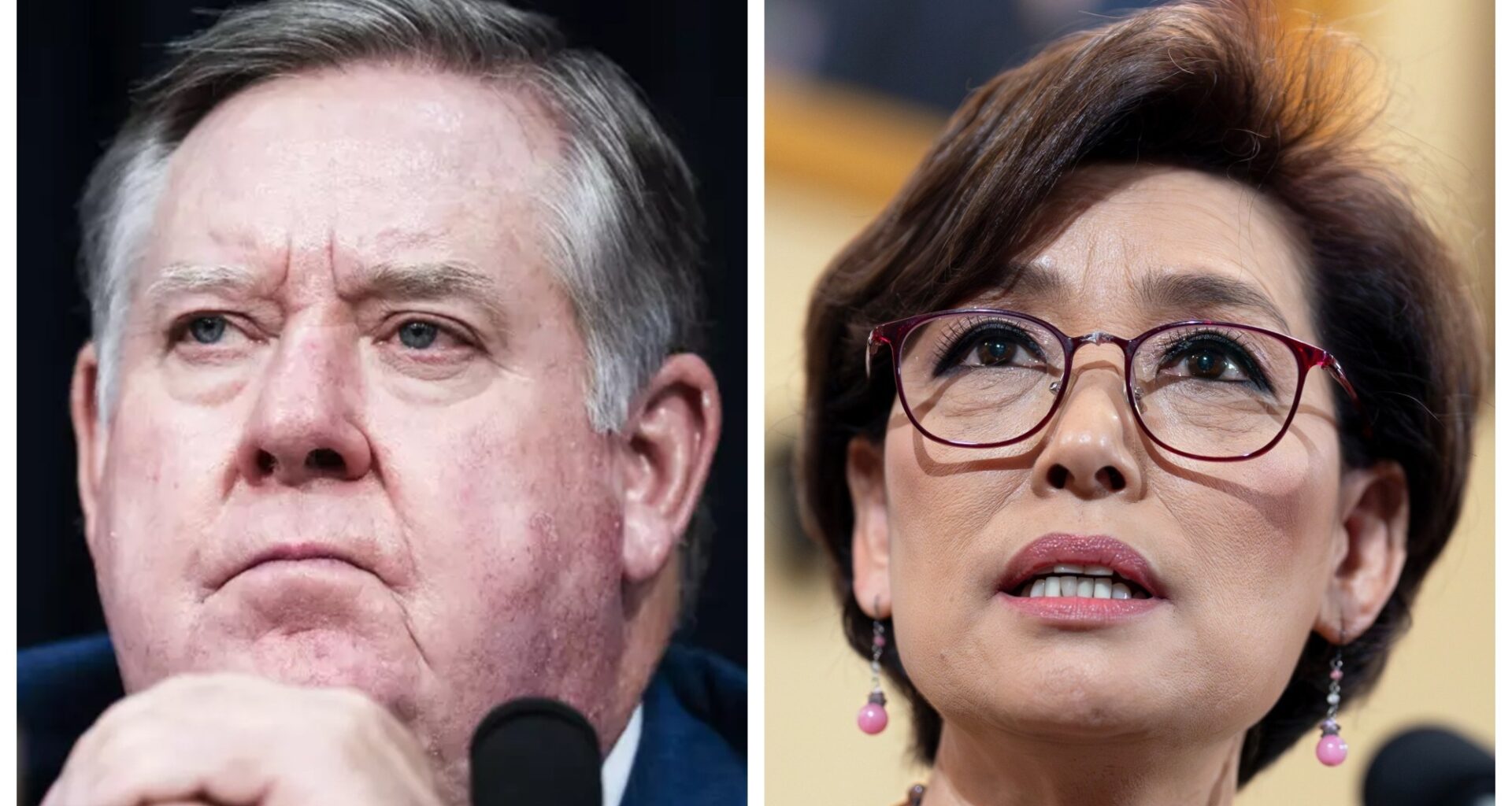
In the race for the realigned California’s 40th Congressional District, the messaging coming out of each campaign — and their supporters — may make all the difference come November.
Voters will have their say between Rep. Ken Calvert, a Corona Republican who has served in Congress since 1993, and Rep. Young Kim, an Anaheim Hills Republican who defeated a sitting Democrat in 2020 to join the House.
This is the kind of race any political party hates to see: Two well-respected Republican candidates pitted against each other for the single seat, said Dan Schnur, who teaches political messaging at USC and UC Berkeley.
Calvert, 73, and Kim, 63, represent two different versions of the same party, Schnur said: Calvert reflects the traditional Republican base, while Kim exemplifies the GOP’s gains in Orange County and elsewhere in California over recent years.
Those differences came to a head in the primary election. And experts say that divide — and how each camp and their supporters message those differences — will ultimately decide how the results shake out come November.
Any candidate’s campaign boils down to two main goals: motivating their own base of support while successfully reaching beyond just those voters.
Goal one: Rally the base
Going into the June 2 primary election, the two campaigns were trying to “out-MAGA each other,” said Jorge Flores, a Los Angeles-based public affairs consultant and veteran campaign strategist. Flores is familiar with the ins and outs of the primary: During the race, he advised independent candidate Nina Linh, who came in last place among the eight candidates and did not advance to the runoff.
Calvert and Kim, through their respective campaigns and with outside groups and independent expenditures, aggressively hammered one another with personal ads. Both Calvert and Kim issued advertising and public statements to tell primary voters that they, not their opponent, were most loyal to President Donald Trump. Both accused each other of being secretly liberal or not MAGA enough.
Trump, who has praised both Calvert and Kim at times, has not yet endorsed in this race.
So far, to no one’s surprise, the race has become incredibly expensive. As of Friday, Kim’s campaign has spent more than $8.8 million for her bid, while Calvert’s has spent more than $4.9 million, according to the Federal Election Commission.
Goal two: Reach for votes beyond the base
Earlier this week, supporters of Kim’s campaign began trotting out a specific political message: that she’s the candidate who will deliver “bipartisan results for California families.” The mailer by Golden State Rebellion, Inc., a political advocacy group with a goal of defending “California taxpayers from waste, fraud, and abuse.”
According to filings with the Federal Election Commission, the “CFF” super PAC in the month of May spent nearly $600,000 in advertising and text messages opposing Calvert. CFF, according to filings with the FEC, shares the same address listed on the mailer sent by Golden State Rebellion, Inc.
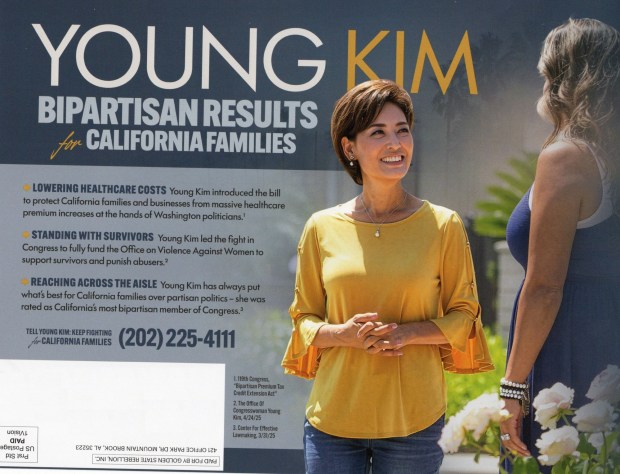 A mailer from Golden State Rebellion, Inc., in support of Rep. Young Kim, The outside group positions the Anaheim Hills Republican as the bipartisan candidate in the 40th Congressional District race against Rep. Ken Calvert, R-Corona. (Provided to SCNG)
Although the tactic — an outside group presenting a political candidate as more middle-of-the-road post-primary — is not unique, it’s a step that suggests Kim’s supporters may see her as needing votes from outside the party to cross the finish line first, said Marcia Godwin, a politics and elections expert who teaches at the University of La Verne.
“The fact that (outside groups) are doing these mailers indicates there’s at least, in the eyes of the funders, some probability that she could overtake Calvert in the general election, but it is pretty rare for a leading candidate in the primary to not carry that over to the general.”
After redistricting, California’s 40th Congressional District is one of only a handful with a majority of registered Republican voters: 208,011 (39.93%) are registered Republicans, while another 162,312 (31.16%) are registered Democrats and nearly 122,381 (23.49%) are no party preference.
Chris Pack, a spokesperson for Kim’s campaign, said their message to voters will remain consistent despite what outside groups say — and it’s one that suggests the general election will be just as personal and volatile as the primary contest was between these two.
Pack said the campaign is focused on telling voters they have a choice between “an effective leader who has delivered results in under three terms in Congress versus someone working on his fourth decade in Congress with nothing to show for it except personal enrichment.”
“Three-plus decades is more than enough time to do what you said you were going to do. That has been our message from the beginning, and it will remain our message through Election Day,” he said.
Calvert has the advantage in the district with the most-loyal MAGA Republicans, though Kim is better positioned to reach out beyond that core, Schnur said.
But reaching out to non-Republican voters carries a risk, he said: Kim can’t afford to lose the Republican base she has, so the message from supporters has to appeal to voters outside the base without alienating those within it.
“(Outside groups) can raise far more money than most candidates are capable of doing, which gives them a much bigger megaphone to have their message heard,” he said. “Those messages can often overshadow what the candidates themselves are saying.”
“Ironically, that can make it more difficult for the candidate to have their own messages heard,” he said.
And Calvert’s campaign certainly is messaging any bipartisan bona fides as a negative. In a review of press releases by Calvert’s campaign dating back to February, the campaign has made it clear that the Corona Republican’s agenda is in stride with that of Trump’s, while repeatedly lambasting Kim over her “Dangerous Anti-Trump Rhetoric” while also questioning her credibility with voters, because of “repeated flip-flops, misleading attacks, and false claims about her own records.”
Calvin Moore, a spokesperson for the Calvert campaign, said in a statement that Kim’s willingness to work with Democrats in the House is an example of her being a “political chameleon.”
“The only thing that’s consistent with Young Kim is she’s willing to say anything she thinks will help her get elected, which is why neither Republicans nor Democrats can trust anything she says,” he said.
But a key aspect in this race, and it’s messaging, is a grim November forecast worrying Republicans, Flores said.
With the possibility of losing a House majority, the focus of the race may become more about who can work best within a Democratic congressional majority to secure funding for the district and land key committee assignments, all while making strides to advance the Republican Party’s platform as much as they can, said Flores.
The strategy by Kim’s supporters to present her as a bipartisan pick to Democrats or independent voters is a smart choice, Flores said, and one that he would suggest Kim’s campaign pursue.
“If I were the Young Kim campaign, I would also lean into this dynamic,” he said. “She has a brand of her own, but she needs to make the case that she has the ability to have dialogue across the aisle with the incoming leadership. … It isn’t like she’s unfamiliar with this dynamic.”
While Flores suggests Kim’s campaign leans into goal two, Calvert’s campaign has consistently focused on goal one, despite the risk of alienating non-Republican voters.
Schnur agrees.
“He clearly thinks it’s sufficient. I think that’s the important thing, because Calvert starts with an advantage with the MAGA base, and he may be less well-positioned to reach out to other voter groups. He and his team may be calculating that, in a low-turnout midterm election, motivating the base is enough.
“It becomes a question of voter turnout. The lower the turnout, the more likely this strategy is successful.”
Calvert carried nearly 35% of the vote to win the eight-candidate primary election in June. Kim came in second, receiving 20.6% of votes cast.