
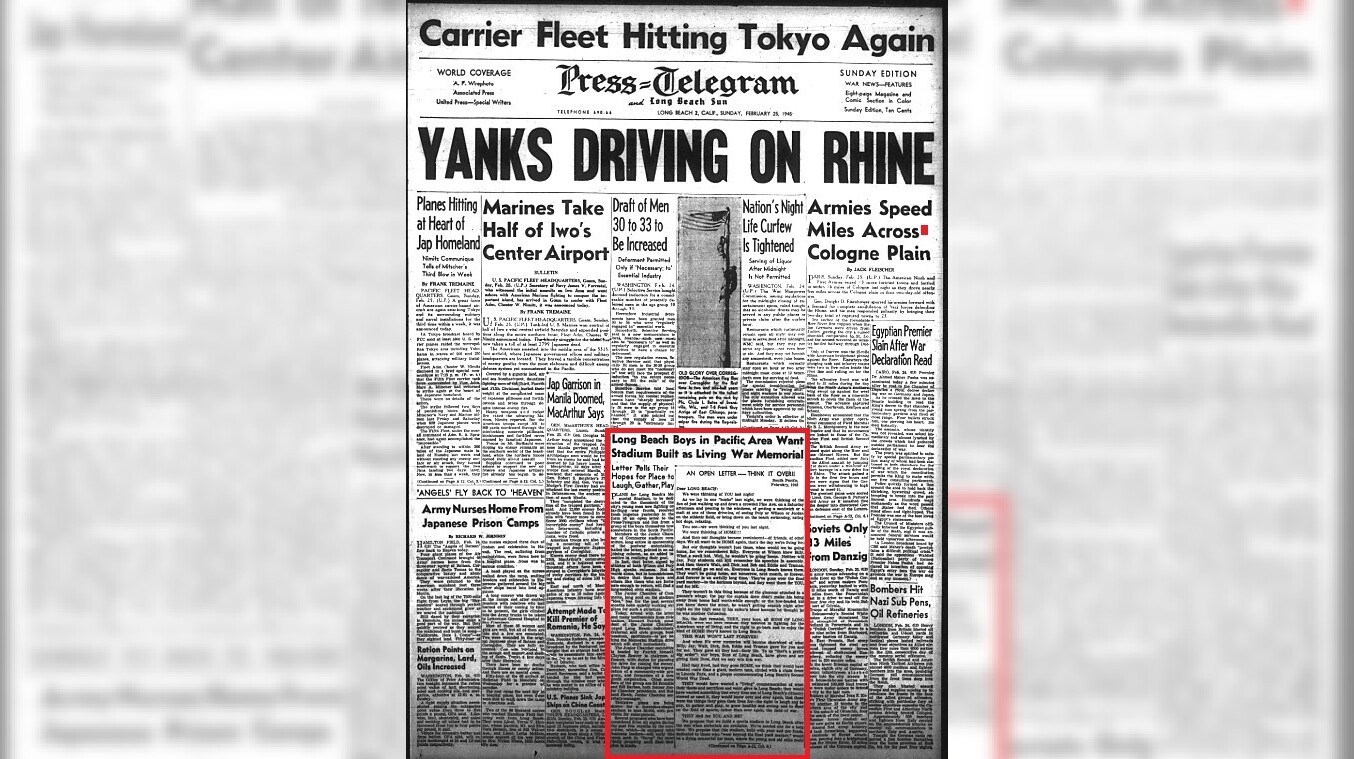
If you had walked out on the morning of Feb. 25, 1945, to pick up the Press-Telegram on your driveway, the front page was, not surprisingly, dominated by World War II news from faraway places — with headlines like, “Yanks driving on Rhine.”
But toward the bottom of that front page was something different, a story with a strong Long Beach connection. It was accompanied by a letter signed by 17 local young men who were serving in the Pacific Theater. They made a poignant request to their hometown: to build a sports stadium as a memorial to the “sons of Long Beach” who had died in the war.

Press-Telegram front page on Feb. 25, 1945 featuring the letter from 17 Navy servicemen requesting a sports stadium be built as a memorial to the “sons of Long Beach” lost in the war. (File photo)

The names of the 17 servicemen who wrote an “open letter from the Pacific”. The names of Stan Duree and Harold Hofman were misspelled in the printed story. (File photo)

Photo of the 17 Navy sailors who wrote a letter in 1945 requesting a sports stadium be built as a memorial to the “sons of Long Beach” lost in the war. (File photo)

A reunion of most of the 17 letter writers in 1950 the year Veterans Memorial Stadium opened. (File photo)

October 1950 newspaper ad for one of the first non-sporting events at the new Vet Stadium featuring cowboy hero Hopalong Cassidy. (File photo)
Show Caption
1 of 5
Press-Telegram front page on Feb. 25, 1945 featuring the letter from 17 Navy servicemen requesting a sports stadium be built as a memorial to the “sons of Long Beach” lost in the war. (File photo)
They remembered “sons like Billy, Jay, Walt and Truman, among others, who would not be returning as they went beyond the final yard marker.” Those killed in the war had been friends of the 17 signees, who were all sports-loving graduates of Poly and Wilson high schools. They had conceived the idea at a new year’s party in Hawaii while on active duty.
“Had they lived, they would have wanted a ‘living’ commemoration of what their deeds and sacrifices and valor gave to Long Beach,” the letter said. “They would have wanted something that every time one of Long Beach’s citizenry viewed or used it, they would know that these were the things they gave their lives for – the right to laugh and be gay, to gather and play, to grow healthy and strong and to meet on the field of sports, rather than ever again, the field of war.”
It took five years before their idea was finally realized with the dedication of Veterans Memorial Stadium, better known today as Vets Stadium, in 1950. The stadium as been a city landmark ever since.
But the historic stadium, now showing its age and needing extensive repairs, will soon be demolished and replaced with a more modern sports complex. Veterans Memorial Stadium hosted its last high school football game on Friday, Aug. 28, when Poly played Yorba Linda. The LBCC Vikings had the honor of playing the last game ever at the stadium on Sunday, when they hosted Riverside City College. A groundbreaking ceremony for the new facility will take place next month.
“Veterans Stadium has proudly done its job for generations, serving not only as a home for athletics but also as an important gathering place for our community,” said Randy Totorp, LBCC’s dean of athletics. “As we build for the future, we are committed to honoring its history and preserving the nostalgic elements that make Veterans Stadium so memorable.”
The 17 servicemen who signed the stadium letter came home after the war and several went on to become well-known Long Beach residents.
The first name on the list was Jim Lineberger, who is believed to be the principal writer of the letter. He was a 1937 Poly graduate who, ironically, coached the underdog Wilson football team when they played their longtime city rival at the first high school game held at the new Veterans Stadium in October 1950.
Lineberger’s team was triumphant, with the next day’s newspaper headline saying, “Wilson Passes Subdue Jackrabbits, 13-12.” He was also an ardent Rose Bowl fan, having attended 50 games in a row by 1995, which surely must be some kind of record. He even umpired a few Rose Bowl games and went on to become a highly regarded trainer for hundreds of football officials. Later in life, Lineberger and his wife, Dottie, ran a Long Beach travel agency and traveled the world for 20 years before he died in 2002.
Another letter signer was Harold Hofman, whose name lives on in the restaurant empire he founded. He started out with a popular hamburger stand right on the beach in the 1940s, which evolved into the first Hof’s Hut restaurant in 1951 in Belmont Shore. That original dining spot on Second Street, now called Saint and Second, is still operated by the Hofman family.
Harold and his wife, Donna, opened the Hof’s location on Bellflower Boulevard in the Los Altos shopping center in 1955. Hofman was an avid amateur golfer who participated in the pro-am division of the Bob Hope Desert Classic in Palm Springs just a few months before he died of a heart attack in 1969, when he was only 51.
Another signer – Irvin Meairs, better known as Red because of his hair – was born and raised in Long Beach. He graduated from Wilson High in 1941. He began playing with the Long Beach Nitehawks in the early 1950s — and became a legend. The Nitehawks were one of the best fast-pitch softball teams in the country.
As a player, Meairs was part of seven International Softball Congress world championship teams. As their coach, he also led three Nitehawk teams to world titles and was inducted into the ISC Hall of Fame in 1988.
Also on the list of 17 was Stan DuRee, who served on the Long Beach Fire Department and retired as a captain in 1976. DuRee was a member of Long Beach’s “First Family of Firemen.” The first of the DuRee family to join the LBFD was Allen Duree, who led the department from 1933 to 1946. After Stan retired, he was followed by his son, Rick DuRee, who served for 30 years and retired in 2001 as a deputy chief.
Rick’s son, Mike DuRee, became Long Beach’s fire chief in 2012, though he has since retired. Rick Duree said his father, Stan, played second base for the Long Beach Nitehawks and has also been inducted into the softball Hall of Fame.
The 17 letter writers knew that Long Beach in 1945 lacked any facility large enough to host a sizeable crowd at a football game or track meet. Local teams, in fact, would often trek to the smaller city of Compton, which had a large large stadium, to play their games.
Instead of a mere commemorative plaque somewhere in the city, the letter writers wanted a stadium “dedicated to those who gave their lives so others might live.” The letter suggested it be built “after the war when materials are available.” They even sent $75 with the letter to jump start the building fund. An inflation calculator puts that amount at nearly $1,400 today.
The hard-fought campaign to build the stadium was spearheaded by the now-disbanded Long Beach Junior Chamber of Commerce (Jaycees), which lobbied the City Council to approve a $550,000 bond issue that would partially fund construction. That organization printed and distributed 50,000 pamphlets to persuade voters to approve the expense.
The Jaycees also reserved a 50-acre parcel of land just south of Carson Street by Clark Avenue. The site was sold for $50,300 by the Montana Land Company, owned by the Clark family, that developed the nearby Lakewood Village.
Even after the war, though, some locals felt that still-scarce building materials should be used to construct housing for the growing number of veterans who were moving to Long Beach instead of a stadium.
The bond issue required a two-thirds majority approval, and it finally passed in November 1946 on the second try, largely because of the dogged determination of the Jaycees.
Leading the Jaycees during those years were some familiar names, such as Jack Dilday of the mortuary family and Gerald Desmond, who later became city attorney and had a bridge named after him in 1968. (To allow for tall container ships at the Port of Long Beach, the iconic Gerald Desmond Bridge was replaced in 2020 by the International Gateway Bridge.)
Ground breaking for the new stadium began in December 1948. The final cost to build it was $1.25 million, a considerable increase from the original donation of $75 from the 17 letter writers.
And it could have been even more.
The original plan was to have a two-sided stadium with seating for 12,500 on each side. But rising costs for construction materials and declining oil revenues that affected the city’s budget slashed the east side stadium from the final plan — which is why Vets only has seating on one side.
Despite fierce lobbying from the Jaycees and other community sports boosters that it would be more cost effective in the long run to build the second side at the same time, the City Council was reluctant to commit to another large expenditure in the municipal budget.
Veterans Memorial Stadium was officially dedicated on June 2, 1950, with 6,000 people sitting in the gleaming new facility. It was a three-hour spectacle that included high school bands, 320 square dancers, an 880-yard relay race with teams from seven high schools (won by Wilson High School) and an equestrian show.
The evening opened with music from the Long Beach Municipal Band, which just completed its 117th season in 2026, making it the nation’s oldest, city-funded municipal band.
Then-Long Beach Mayor Burton Chase dedicated the stadium to “the citizens of the community, both living and dead.” Enjoying the results of all their hard work at getting the stadium built were Desmond and a few others from the Jaycees who were there as honored guests.
Also sitting on the stage was the architect, Hugh Gibbs. Gibbs also designed some of the early buildings at Cal State Long Beach, the demolished Long Beach Naval Hospital (that site is now the Long Beach Towne Center on Carson Street), and the 1977 Long Beach Civic Center (which was demolished in 2022). His son, Don Gibbs, designed the iconic blue pyramid at CSULB in 1994.
While we don’t know if the 17 letter writers were also in the stadium that night, it’s highly likely they were. After all, they were still living in Long Beach, according to a column written by Frank T. Blair, the Press-Telegram’s longtime sports editor and the namesake of the city’s baseball stadium.
Since its opening in 1950, Vets Stadium has been the venue for countless football matches, soccer games and other sporting events, such as roller derby. Long Beach State’s football team played there until the program disbanded in 1991.
And for years, it’s been the home stadium of the Poly Jackrabbits and the Long Beach City College Vikings football teams. In 1987, the college acquired Veterans Stadium from the city for $1.
The stadium has also hosted many non-sporting events. One of the first ones was when the hugely popular fictional cowboy hero Hopalong Cassidy came to town as part of a variety circus. Ticket prices in October 1950 were $1 for adults and 50 cents for kids.
For more than five decades, the Long Beach Firefighters Memorial Association put on a charity show on the Fourth of July at the stadium. It featured a vintage fire truck display and live entertainment, with a fireworks finale. It was finally canceled in 2011 because of declining ticket sales and other budgetary issues.
Since the 1980s, the stadium’s parking lot has also been the venue for two different flea markets featuring cars and antiques, which take place monthly.
And every year, thousands of graduates march across the field to receive their diplomas while their families proudly beam from the grandstand. Earlier this year, LBCC and six local high schools held their commencement ceremonies there.
The Sept. 9 groundbreaking for the new stadium complex, meanwhile, “represents an important opportunity to celebrate the (current) stadium’s rich history while looking ahead to an exciting new chapter for Long Beach City College,” Totorp said.
As for the 17 signers of that inspirational 1945 letter, they should be proud of what they achieved and the legacy that will continue with the new and improved Long Beach Veterans Memorial Stadium.
Note: Thanks to my wife, Pat, for her research on the history of Veterans Memorial Stadium.