
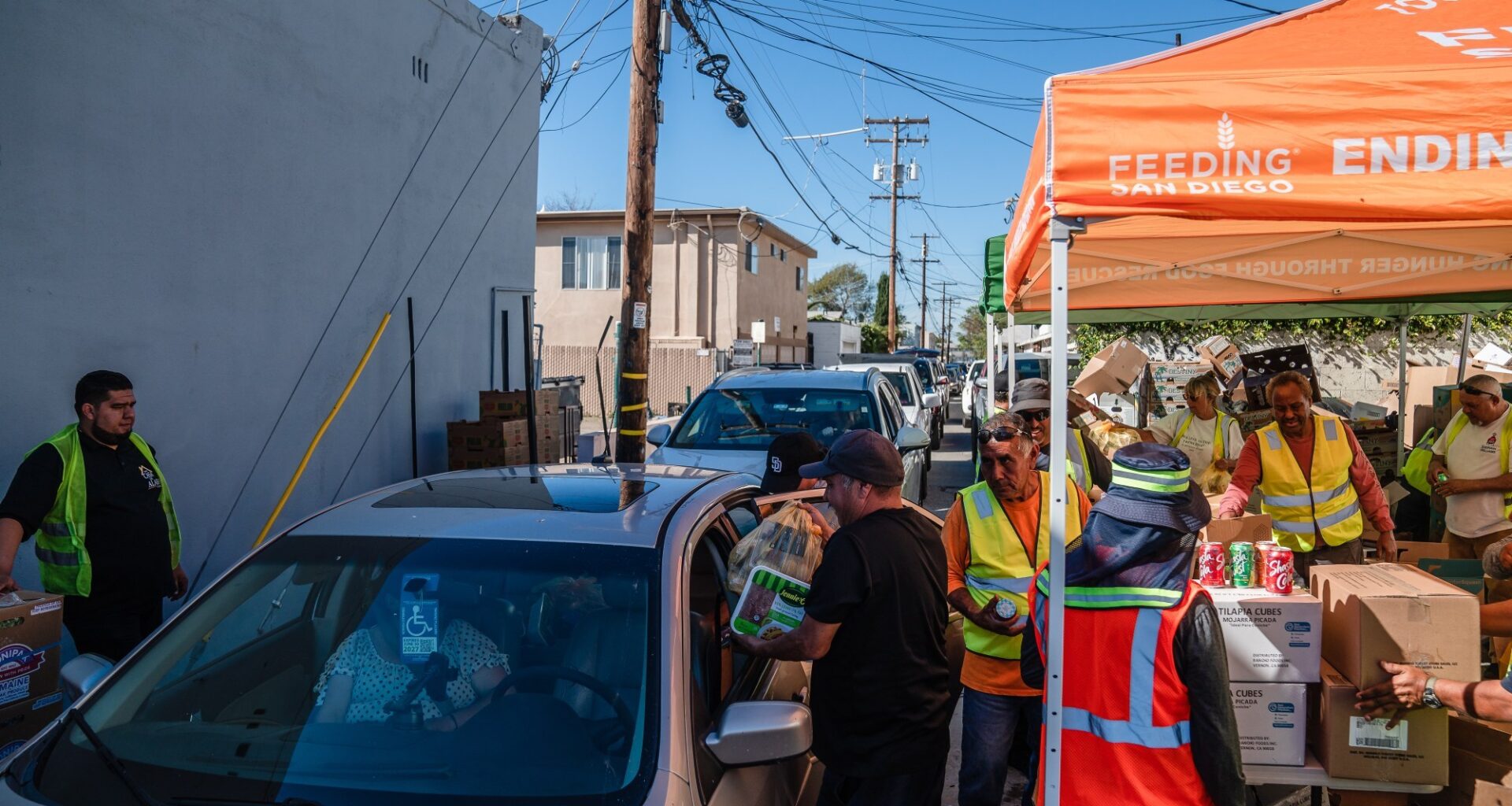
Reductions in federal food and healthcare programs are being felt in waves as cuts and new requirements continue to kick in.
Some big ones are coming.
On Tuesday, people participating in the Supplemental Nutrition Assistance Program (SNAP) will have to start complying with new work requirements that are expected to reduce the number of recipients.
The requirements took effect on June 1, but they had to be met within three months. It will be a rolling reduction, however. Work requirement evaluations will be completed at the time of initial application and recertification, according to the county of San Diego.
Then on Sept. 18, a new “public charge rule” allows federal officials to consider recipients’ use of non-cash benefits such as food assistance and Medicaid (Medi-Cal in California) to determine immigration status, including for people already approved for long-term residency.
(Meanwhile, last week the United States paused all immigrant visa appointments to train officials on a new policy to assess whether applicants are considered a potential drain on public resources.)
The eventual impact of the cuts and changes included in H.R.1, President Donald Trump’s “One Big Beautiful Bill” approved by the Republican Congress last year, is not yet fully clear. But it won’t be small. In California, for example, officials for some time have estimated about 2.2 million people will eventually lose healthcare coverage.
Tens of thousands of San Diegans have dropped out of food and healthcare programs, many even before changes in eligibility for noncitizens took effect April 1 and before work requirements kick in.
Some healthcare organizations are already cutting back in anticipation of the reductions. Hospitals, some of which already are operating at a loss, expect increases in uncompensated care because they can’t turn away anyone who shows up at emergency rooms. That ultimately could affect services and costs for insured people.
Officials at Covered California, a health coverage marketplace that utilizes federal subsidies through the federal Affordable Care Act, said first-time applicants are down about a third since the bill was approved.
The changes have already rocked food stamp recipients. Less than a year after the bill was signed, nearly 30,000 San Diego residents had dropped off CalFresh, as SNAP is called in California, according to inewsource.
“It’s a slow-moving avalanche,” Andrea Caldwell, director of government affairs and advocacy at San Diego Food Bank, said in an interview.
Some 13,000 people in San Diego County must leave SNAP because of the new rule prohibiting the benefits from going to certain “legally present” immigrants — to use the state’s term — including people with asylum status, refugees, parolees, trafficking victims, battered noncitizens, and individuals with deportation or removal withheld.
Nearly 400,000 people in San Diego relied on SNAP last year.
Here and elsewhere, there have been reports that some people dropped out of the program out of fear that it could jeopardize their immigration status.
The food bank and its partners experienced an overall 20% increase in demand over the past year, Caldwell said.
Perhaps even more telling, she added, is that the federal Emergency Food Assistance Program administered locally by the food bank has seen an increase of 35% in food going out.
“We’re seeing more demand and less food in that program,” Caldwell said.
The need is spiking, she added, saying 200,000 people in San Diego County are eligible for SNAP but not enrolled.
Recipients now will have to work 20 hours per week or participate in “community engagement” for 80 hours a month to qualify for SNAP, though there are some exemptions.
Data has shown such work requirements for food and health benefits don’t significantly increase employment but keep millions of eligible people out of the programs.
“It’s bureaucratic red tape that makes it harder for them” to apply, Caldwell said, adding that the food bank helps people navigate that process.
“It will take the entire next year to fully understand the impact of the new requirements,” she said in a later email.
About 93,000 CalFresh recipients in San Diego will be subject to the new requirements. Caldwell said that doesn’t include those who could be affected by the so-called public charge rule incorporating benefit assessments into immigration status decisions.
The San Diego County Board of Supervisors in June approved millions of dollars in one-time spending to help offset federal cuts to food and healthcare programs. Supervisor Jim Desmond, a Republican running for Congress, voted against the spending, saying the claim about onerous work requirements is “politically-generated mania and hysteria.”
“If they’re able-bodied, they’re single, got no dependents, are able to work — we’re only asking for 20 hours a week … to pay for the services that you’re receiving,” he said, according to KPBS.
The Trump administration has said the new rules for food and health programs will help combat fraud and promote self-sufficiency.
Cuts, new requirements and other changes have also been rolling in for federally funded heathcare programs that cover about 1 million people in the region, or about 1 in 3 San Diego County residents, according to Paul Sisson of The San Diego Union-Tribune.
The cuts will mostly affect low-income residents, noncitizens, refugees and undocumented immigrants. Faced with budget problems, Gov. Gavin Newsom also cut state healthcare funds for undocumented immigrants, among others.
California officials estimate Medi-Cal could lose more than $30 billion annually once federal changes fully take effect in 2027.
In addition to fewer people signing up for Covered California, state officials say people facing higher premiums are increasing their deductibles, reducing coverage or going without it entirely.
Many middle-class people who benefited from the Affordable Care Act will also be affected by the loss of enhanced tax credits.
Premiums for middle-class residents will increase by an average of $500 per month, according to Covered California Executive Director Jessica Altman.
Covered California said nearly 374,000 renewing consumers had canceled or terminated their renewal plan in the past year. That’s 19% of renewing consumers, compared with 13% to 14% cancelling their coverage in prior years.
Covered California says about 1.8 million people are currently enrolled.
Universal health insurance coverage has long been a goal of many healthcare advocates. In 2024, California was close to achieving that. The record 95% insured rate was reached in part by expanding Medi-Cal to all low-income residents, regardless of immigration status.
For a while, Republicans and some moderate Democrats expressed concern about costs, and including undocumented immigrants was criticized in some quarters.
Much has changed.
With the Trump administration enacting sweeping cuts, and Newsom grappling with budget shortfalls, that goal is drifting farther away.
What they said
Matt Macauley (@VisualAlgebra) Clemson University professor surprised at his 7-year-old daughter’s sadness over Dolly Parton’s passing.
“’You know Dolly Parton?’
‘Well, I don’t ‘know” know her. But she sent me books.’”