
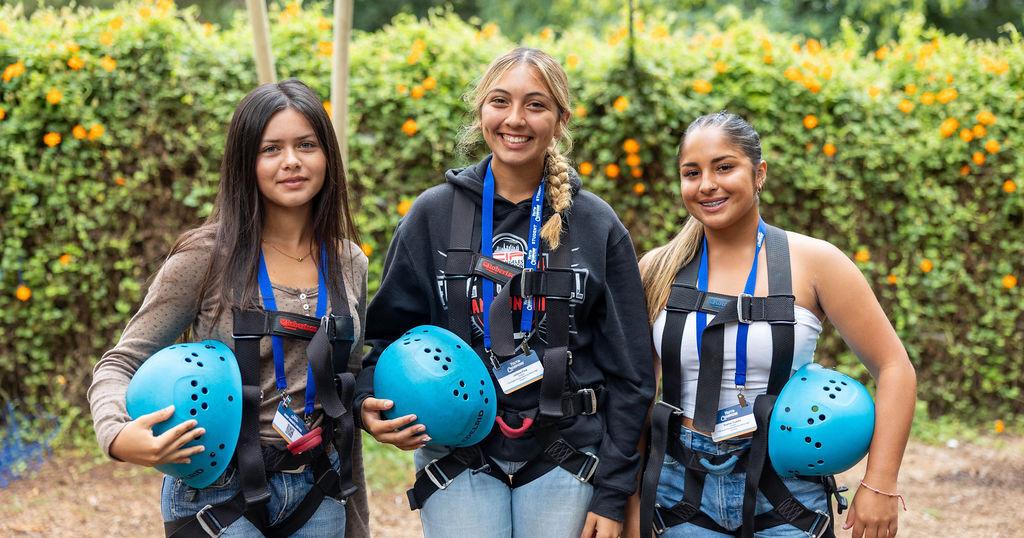
Michelle Durand loves to travel — so much so that about five years ago, she started living nomadically. Possessing no permanent residence, she hops around from place to place. It seemed like the natural order of events for someone who is always seeking to learn from other people and things all the time. It is also what landed her in her current position of executive director of the LA-based nonprofit Youth Champions.
Youth Champions provides paid personal growth internships to high school students (grades 10-12) in underserved communities. The 24-week program offers mentorship, career exposure and life-skills development while teaching financial literacy, leadership and critical thinking. Accepted students can earn up to $1,000 based on their participation in virtual workshops and in-person field trips.
“I recognize I am not the expert in everything,” Durand said, “but there are a lot of people out there who know a lot of things. I try to learn in different and unique ways, and so often it comes down to exposure. Just giving students exposure is important. For me, that resonated because I am big on exposing myself to ideas and concepts that I’ve never interacted with before.”
Co-founder Jack Cline saw a problem: Nearly one in 10 young adults in Los Angeles County are disconnected from both school and work. His solution was Youth Champions. Last school year, it distributed more than $300,000 to nearly 800 high school students to help them prepare for success beyond high school.
Durand met Cline when she worked in financial analytics, at which time he mentioned that his nonprofit was in an incubator program. He was looking to launch but was missing a crucial element: management and the support to make it happen. Durand signed on three years ago, and Youth Champions became an independent nonprofit on Jan. 1, 2024.
“The goal is to try to expose students to ideas and concepts they may never have heard of before,” said Durand. “One of our students, she wanted to be a lawyer, and she had never met a lawyer. One of the adults she was interacting with every single week was the first lawyer she had ever met.”
The program runs 24 weeks from September through April — 12 weeks in the fall and 12 weeks in the spring, aligned with the academic calendar. Students are paid depending on their engagement with the offered online workshops and events. They earn points that translate to dollars.
“Often finances are a restricting factor in whether or not the students can attend a program,” Durand explained. “Even if the program is free, it comes at an opportunity cost for them, because they could be making money or doing something their family needs them to do. For a lot of these students, the dollars they’re earning are going either directly to support family funds or toward things like books for college, college admissions or the fees associated with being a graduating senior. They’re using the money for practical things.”
Students are placed in a cohort with the same 30 students every week throughout the duration of the program. Each cohort is assigned one facilitator. Past facilitators have been an ex-FBI agent and a COO of a movie production company, who sign up to meet for about two hours a week, including the prep time required for the workshop. Each week, a different working professional is invited to present. Youth Champions hosts between 150 and 200 professionals from different industries each year.
The most heartbreaking part of the program is that demand trumps availability: 600 spots for 900-plus applicants.
“We try to make sure especially Title I schools know about the program,” said Durand. “There’s an application open date, and it works a lot like a Taylor Swift concert. It’s on a first come, first served basis so that we can make it as fair as possible. We don’t want to make it merit-based. We think our program is just as important for the D student as it is for the A student. It just has a different meaning for both types of students. We do prioritize by need-based.”
One of the best parts of the program is hearing the success stories. One former Youth Champion graduated from USC and now works in investment banking. At a recent organization event, his single mom, who only speaks Spanish, was asked what was the biggest change she saw in her son during the program. It actually was not one that she saw during the program but seeing him as he continued to develop into his college years and into an adult.
“I think that’s true for a lot of change,” Durand said. “You see seeds of it when it’s happening, but you don’t see the fruit of it sometimes, like you’ll see things start to sprout. I love it. We live on that. We have so much of that, but also knowing that it does turn into a tree, and you can see that years later, and you can trace it back to this.”
For more information, view youth-champions.org.