
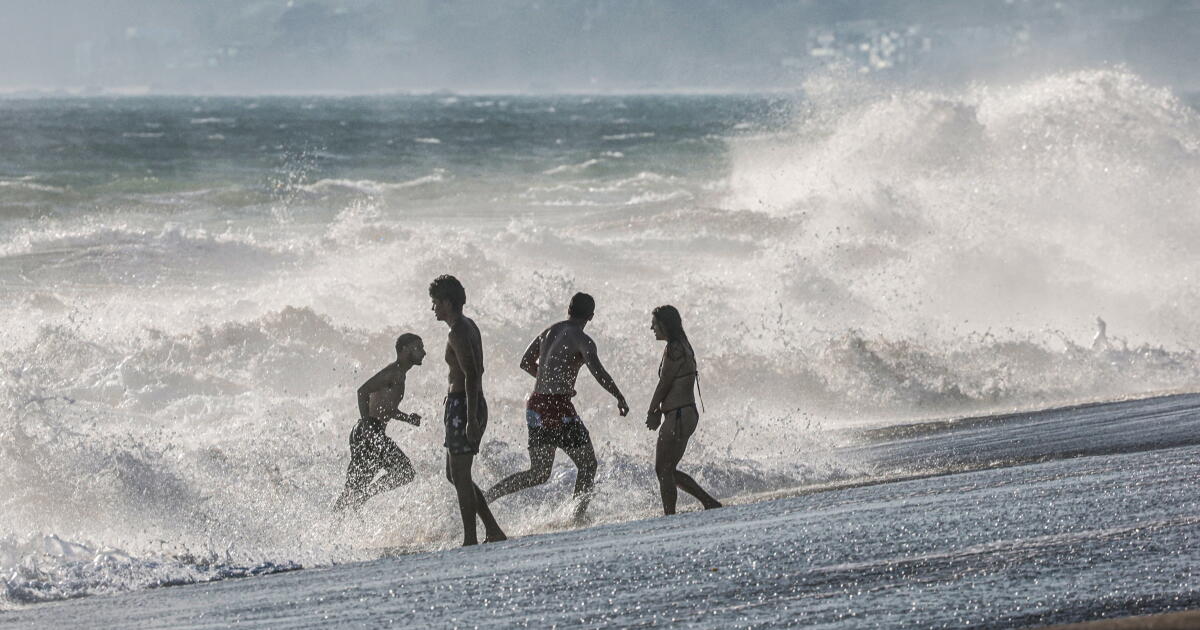
California’s modern coastline is under assault like never before, and El Niño is poised to make things worse.
Hotter ocean waters are pushing tide lines higher. Powerful Pacific hurricanes are lashing the shoreline with series of strong waves, leaving teetering infrastructure and blotted-out beaches in their wake.
And the forecast for a powerful El Niño this winter is expected to put more pressure on beaches. From Carlsbad to Malibu to Santa Cruz, erosion is already remaking the maps of popular beaches in dramatic ways.
Erosion has gotten so bad along Point Dume Beach in Malibu, for example, that the ocean threatened to collapse a key road essential to access the parking lot.
Churning ocean forces from a distant hurricane just “ate away, I want to say, 50 or 60 feet of sand, and then it got all the way to the roadway,” said Warren Ontiveros, deputy director of the L.A. County Department of Beaches and Harbors, which manages the beach.
Workers have been frantically building an emergency revetment — placing rocks on the coast to armor the shoreline against the waves — to shore up the roadway, located on a narrow strip of coastline pinched between the ocean and a cliff. It’s the only access point vehicles can reliably take to what locals call Westward Beach.
“The ocean has been taking sand from this area for decades, and so there’s been a shrinking buffer to protect that roadway,” Ontiveros said. “The sheriff’s, the fire department, lifeguards — they all depend on that road, because they can’t always drive on the beach when the tides are high.”
Communities along the coast are facing similar challenges.
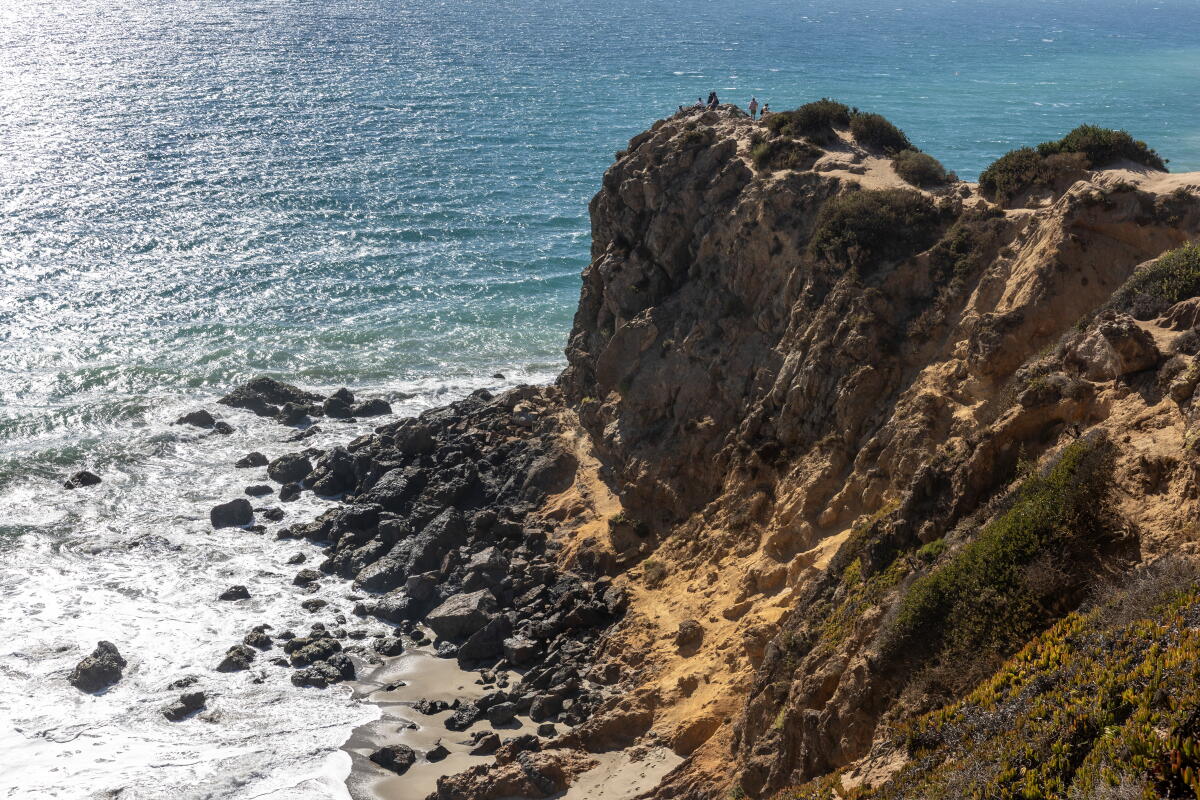
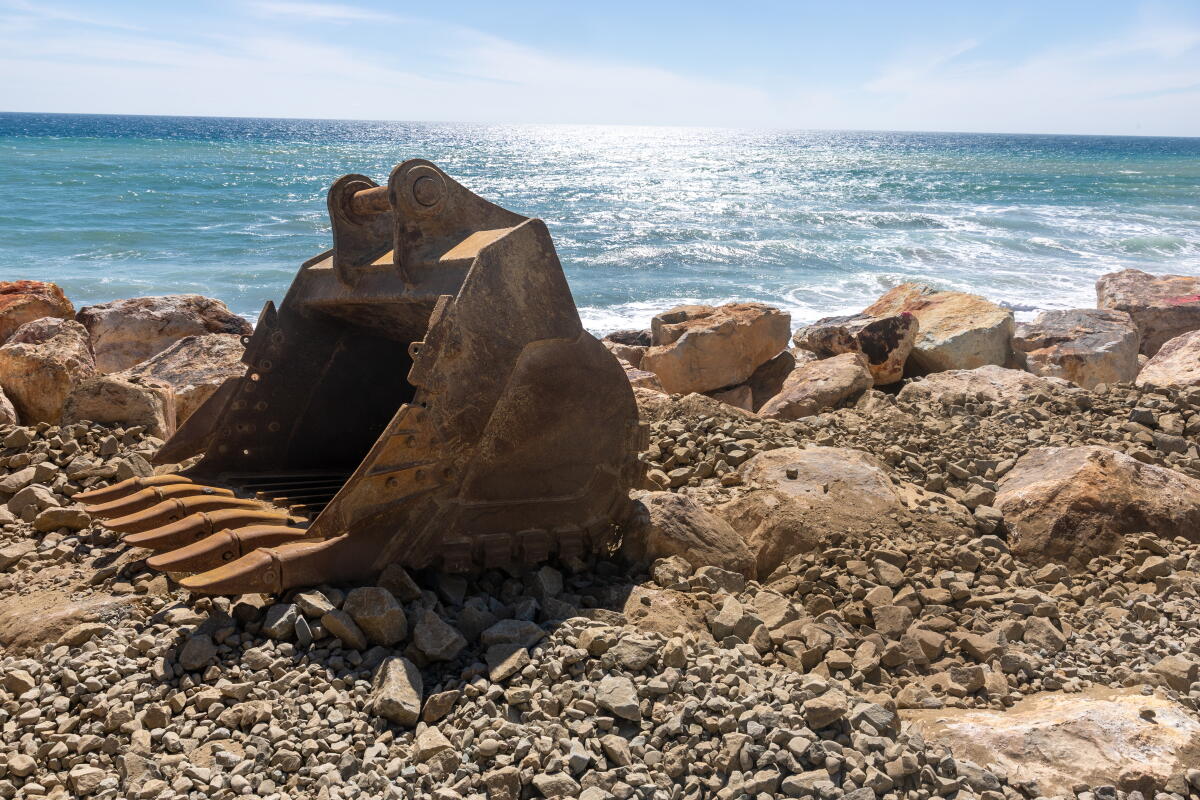
1. Locals worry that access to Pirates Cove at Westward Beach is being threatened by beach erosion. 2. A powerful hurricane season in the eastern Pacific Ocean, likely influenced by El Niño, has sent strong swells to the California coastline, eroding some beaches significantly. Workers installed rocks on the coast at Point Dume Beach to prevent the collapse of a key road for vehicles to access Westward Beach. (Robert Gauthier/Los Angeles Times)
“We’re seeing exceptional erosion in those places, and one of the concerning things is that we most likely will have larger waves this winter, and so sections of our coast are going to get that one-two punch,” said Jonathan Warrick, a research geologist with the U.S. Geological Survey.
“It should be concerning to our coastal residents.”
::
Past winters influenced by “very strong” El Niños — as forecasters say this one is almost certain to be — have battered the California coast.
The previous record-strong El Niño in modern times, in 1982-83, coincided with significant damage across the coastline, wrecking the piers in Santa Monica and Seal Beach. In 1997-98, the Ventura County fairgrounds next to the coastline flooded.
The 2015-16 El Niño also coincided with a season of record beach erosion for many California beaches — an astonishing 76% higher than normal.
Computer modeling released in 2023 by the U.S. Geological Survey and an Australian university estimated that between 24% and 75% “of California’s beaches could become completely eroded” by the year 2100 without any interventions, given estimates of sea-level rise of somewhere between 3 feet to 10 feet over that time frame.
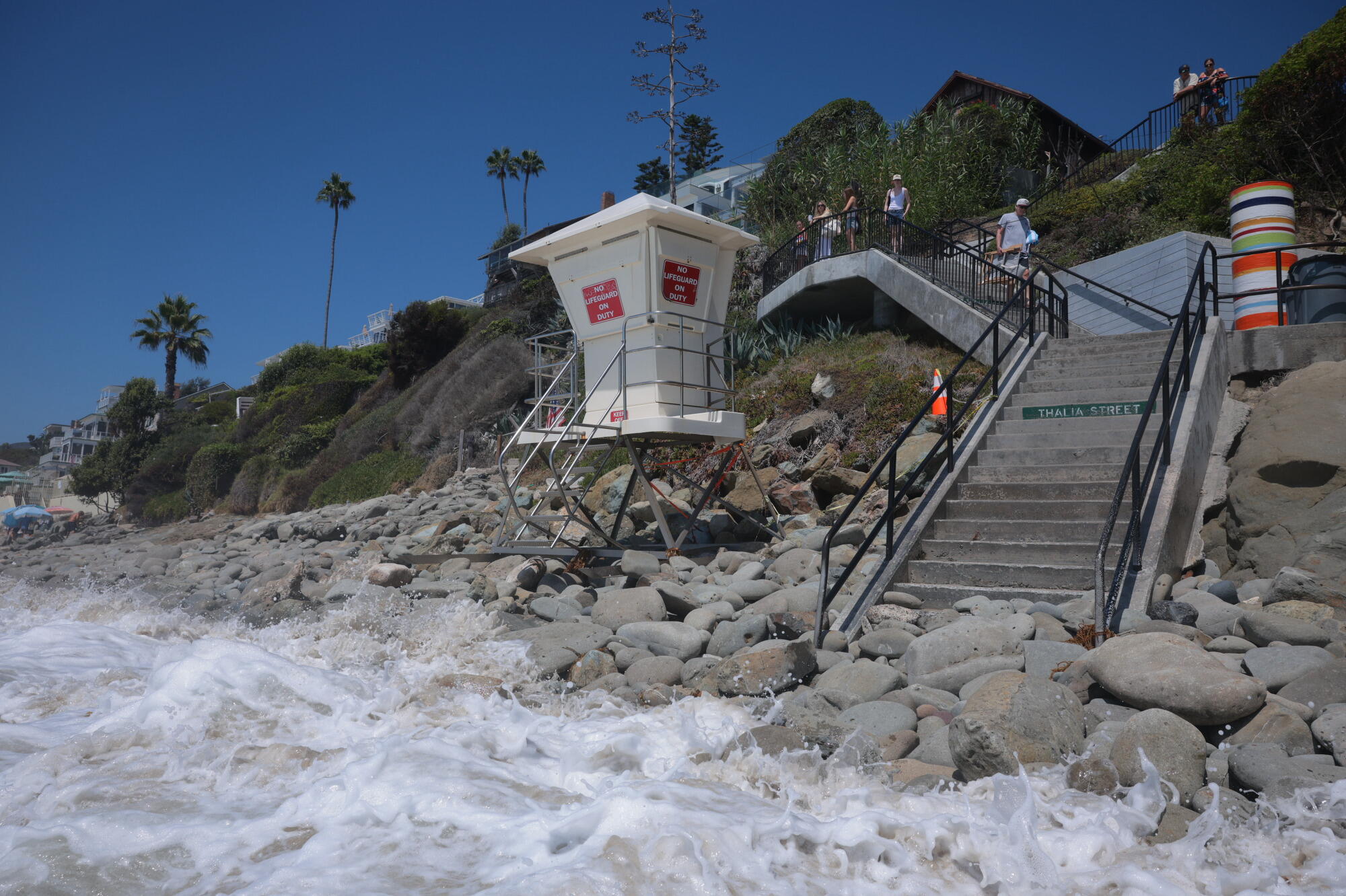
A lifeguard tower at Thalia Street Beach sits with no sandy beach to guard in Laguna Beach.
(Kayla Bartkowski/Los Angeles Times)
El Niño is a climate pattern that refers to a warming of a section of the central and eastern tropical Pacific Ocean. A typical El Niño shifts the storm track during the winter, sending above-average precipitation over Southern California, while leaving the Pacific Northwest drier than normal.
El Niño’s influence on rainfall in California doesn’t typically appear until well into the winter. But the climate pattern’s might is already being felt.
“We’re kind of in a precarious place because we are seeing the effects of El Niño already from these hurricanes,” Warrick said. “We’ve had increased hurricane prevalence this summer, and that’s caused erosion throughout Southern California to beaches that are exposed to those southern waves.”
In San Diego County, sections of Carlsbad State Beach have washed away, including the area in front of the Tamarack parking lot, forcing part of it to be closed.
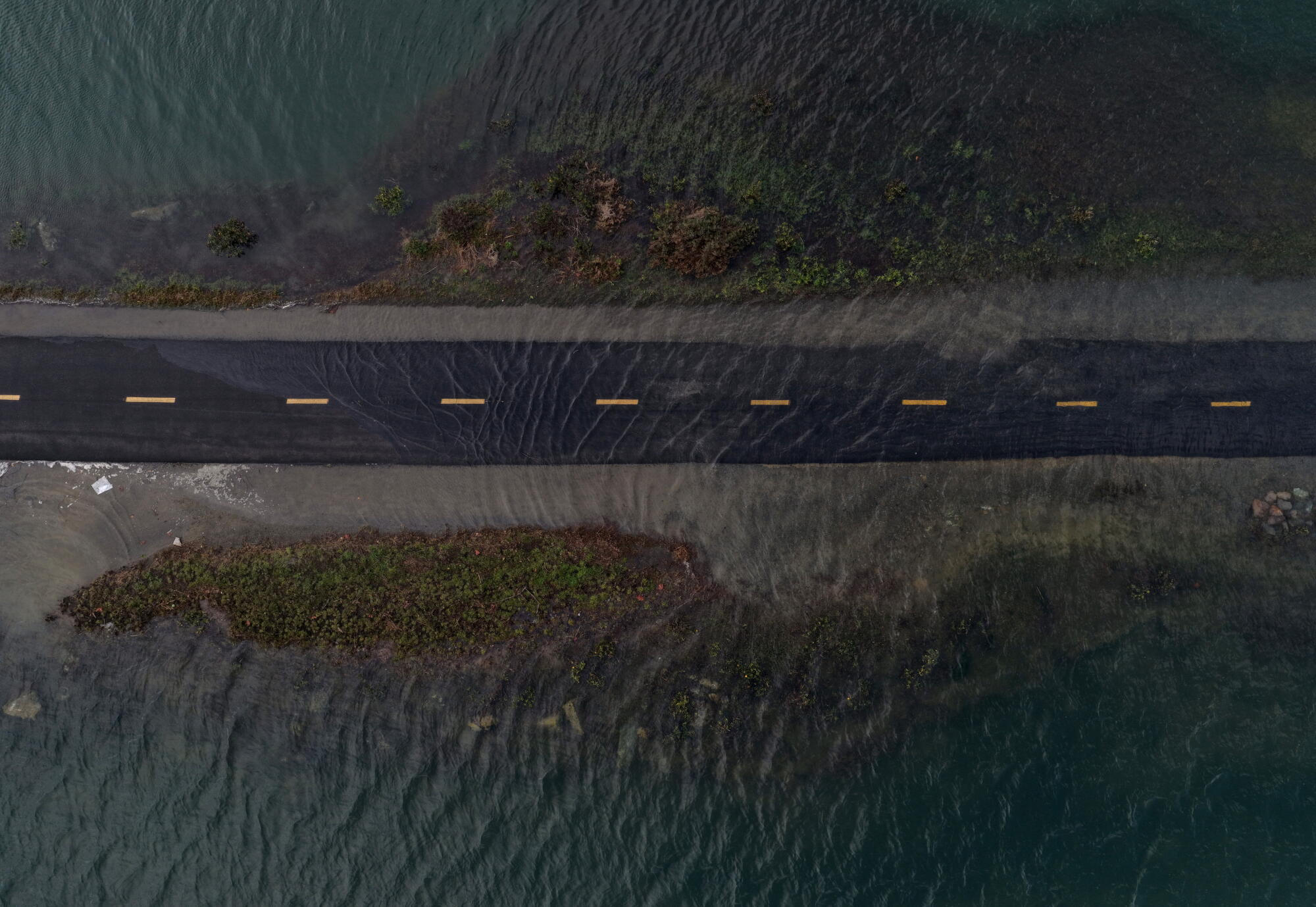
In an aerial view, seawater floods a bike path during a king tide in Mill Valley, Calif., on Dec. 5, 2025.
(Justin Sullivan / Getty Images)
Some commuter train service had to be suspended in Orange County and San Diego County for a week due to powerful high tides. And in Laguna Beach, back-to-back storms have eroded the sand so much that a lifeguard station was tied to the shore to make sure it wouldn’t be washed out to sea.
“A lot of our lifeguard towers are very close to the water’s edge,” said Laguna Beach Marine Safety Capt. Dane Doran.
Not all beaches are seeing extreme erosion. And there are typical seasonal changes where sand could return in the winter.
But with the last “very strong” El Niño in 2015-16, and the record coastal erosion it unleashed, still relatively recently in the rearview mirror, some fear that time is short for some beloved beach destinations.
“That’s why we came to climb today, because we don’t know how much longer we’ll be able to,” said Caroline Baxter, 29, during a visit to Pirates Cove on the west side of Point Dume, which is accessed from Westward Beach and is a popular climbing spot.
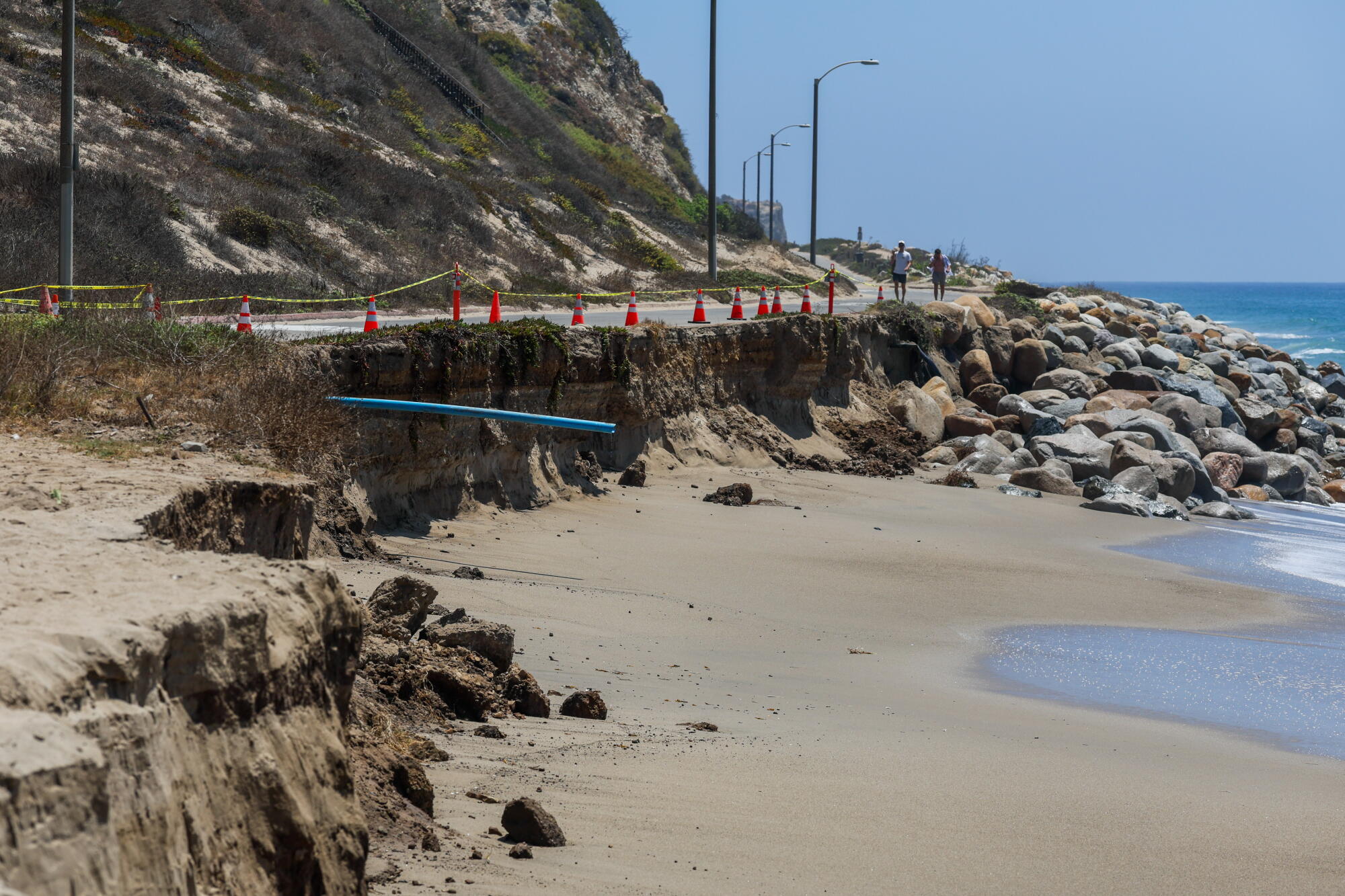
A portion of Westward Beach Road is blocked on Aug. 2 after extreme waves eroded the beach and nearly undermined the road.
(Ronaldo Bolaños/Los Angeles Times)
One potential troublespot would be if very large storms coincide with super high king tides, which — due to an unhappy cosmic coincidence related to lunar tide cycles — are set to come this winter.
The other problem is the role of human-caused climate change in increasing sea levels. Data show that the monthly average sea level has risen by about one foot in San Diego and San Francisco since the start of the 20th century.
Already, warm waters off the California coast are raising sea levels, and tides are currently 4 inches to 9 inches above the official forecast. California has been dealing with an unusual marine heat wave on the coast unrelated to El Niño for more than a year. Previous marine heat waves have warmed ocean water for only about 130 feet down from the surface, but the effects of the current heat wave are being seen between 325 feet and 500 feet under the surface.
“That kind of warming will significantly raise the sea level,” said Andrew Leising, a research oceanographer at NOAA’s Southwest Fisheries Science Center.
::
Manmade infrastructure on California’s coast has been battered and beleaguered in recent years — even without El Niño.
The 2022-23 La Niña season brought severe winter storms that damaged the Ventura Pier and Santa Cruz County’s Capitola Wharf to the tune of millions of dollars.
In Santa Cruz, the famed West Cliff Drive was badly damaged by big waves, and suffered more damage and erosion during the following El Niño winter. Then, at the end of 2024, when there was a weak La Niña, a strong storm caused part of the Santa Cruz Wharf to collapse.
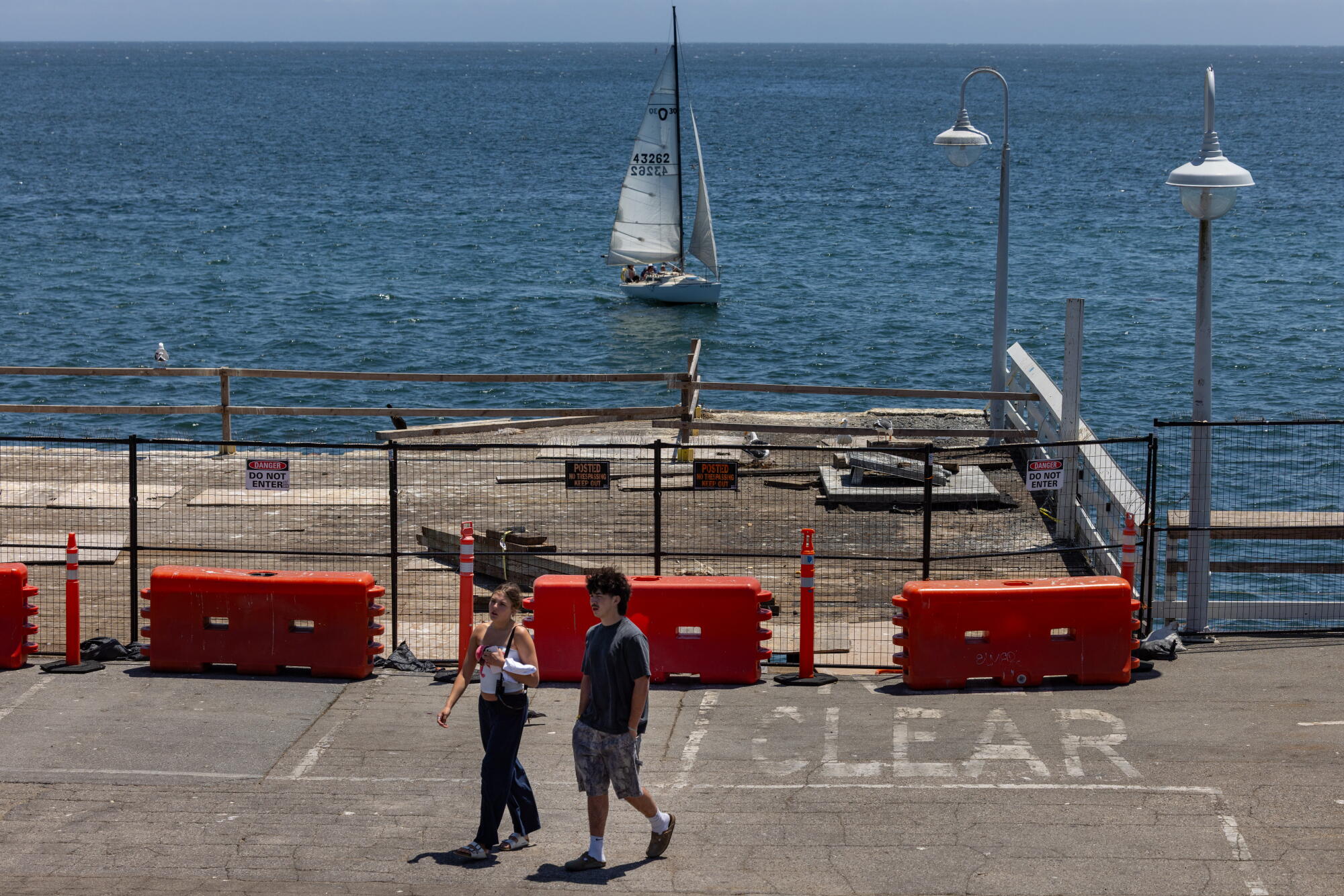
The Santa Cruz Wharf partially collapsed at the end of 2024.
(Jason Armond/Los Angeles Times)
For UC climate scientist Daniel Swain, the warning signs are clear.
“Coastal flooding is going to be a big, big risk this winter, and not just along the oceanic coast, but also the coasts of all of California’s coastally connected bays and estuaries,” Swain said. Certain roads — such as Highway 37, which connects Marin County to Napa County on the bay shoreline — as well as parts of Highway 101 and coastal Highway 1 are all at risk for flooding.
In Southern California, concern is picking up across the region. Nancy Pinckert, who lives in the Naples Island neighborhood of Long Beach, is worried about whether the nearly 90-year-old seawalls will stand up to storms.
“Without repair, the potential of unprecedented winter conditions could bring significant destruction to this area,” she said.
Officials are racing to prepare. In Ventura County, public works crews are sending teams out to look at vulnerable spots and seeing if they can be strengthened, said Public Works Agency Director Gregg Strakaluse. Orange County has been rehabbing critical pump stations that are needed if floodwaters threaten neighborhoods, said Hugo Pineda, engineering deputy director for operations and maintenance at the public works agency.
In Long Beach, crews have stepped up efforts to maintain storm drains, seeking to keep them from getting clogged up during storms, said Todd Leland, the city’s marine bureau manager. In L.A. County, public works crews will closely monitor areas burned in the Eaton and Palisades fires, which remain vulnerable to mud and debris flows, said Sterling Klippel, assistant deputy director for the county Department of Public Works. And in Seal Beach, the city is working to train volunteers for sandbagging, said City Manager Patrick Gallegos.
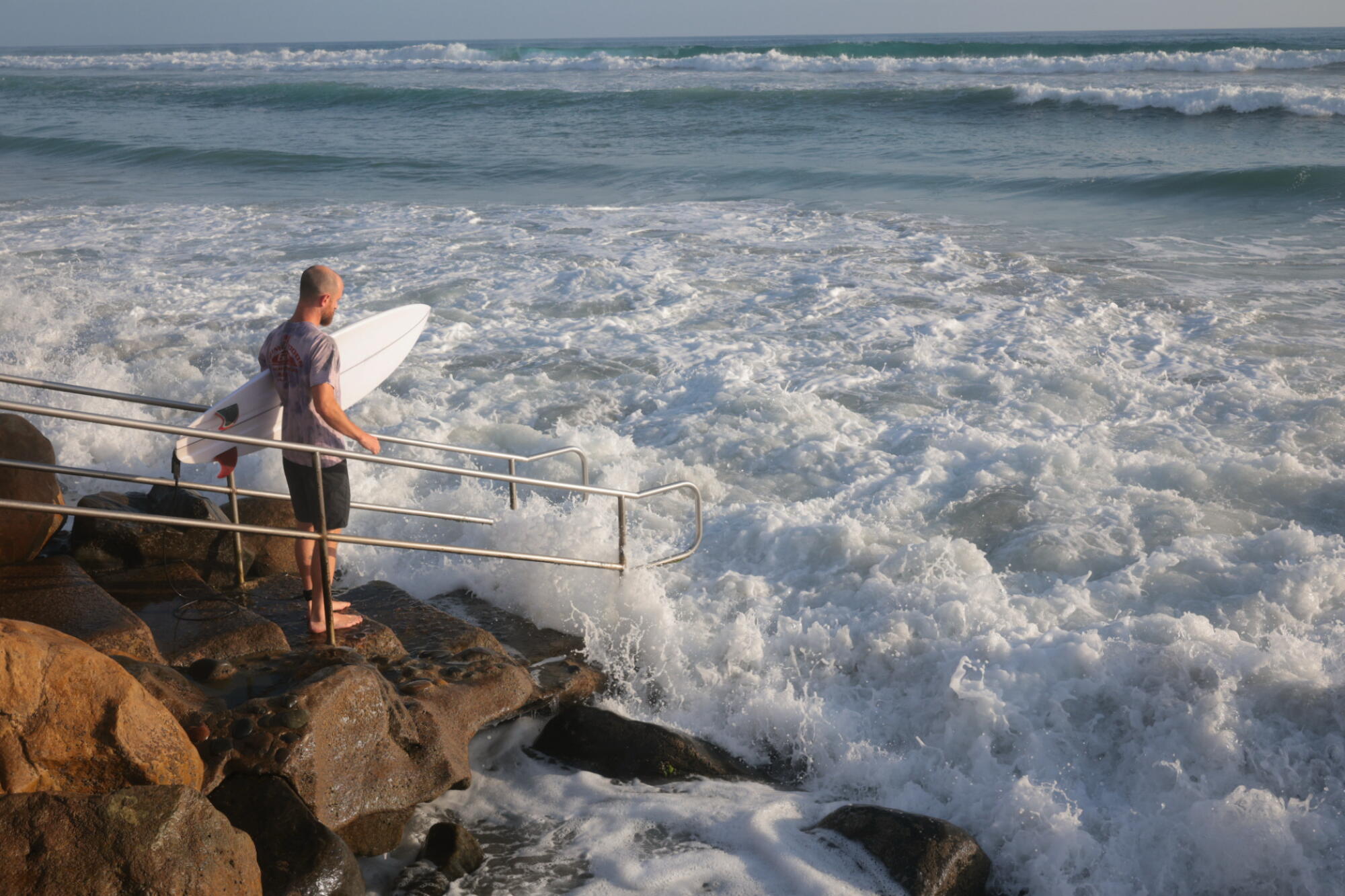
A surfer looks out at the ocean at in Oceanside, where there is no sand between the water and the rocks.
(Kayla Bartkowski/Los Angeles Times)
Some cities have struggled with sand erosion for years, but have seen that accelerate recently. Oceanside has seen its beaches diminish for decades, blamed on the construction of the federal Camp Pendleton Boat Basin during World War II, which blocked replenishing sand from coming out of the Santa Margarita River, said Jayme Timberlake, the coastal program manager for the city.
Homeowners who once looked out onto beach volleyball courts now just “have a rock revetment that is 15 feet to the wet sand.”
Oceanside is working on a project, called RE:BEACH, that is seeking funding to build an offshore reef, intended to allow ocean waves to break onto it, in hopes of keeping “the sand around longer because the waves won’t be breaking directly onto the sand,” Timberlake said.
On a nearby section of the coast, crews have been placing rock to shore up a crumbling coastline and keep nearby trains running.
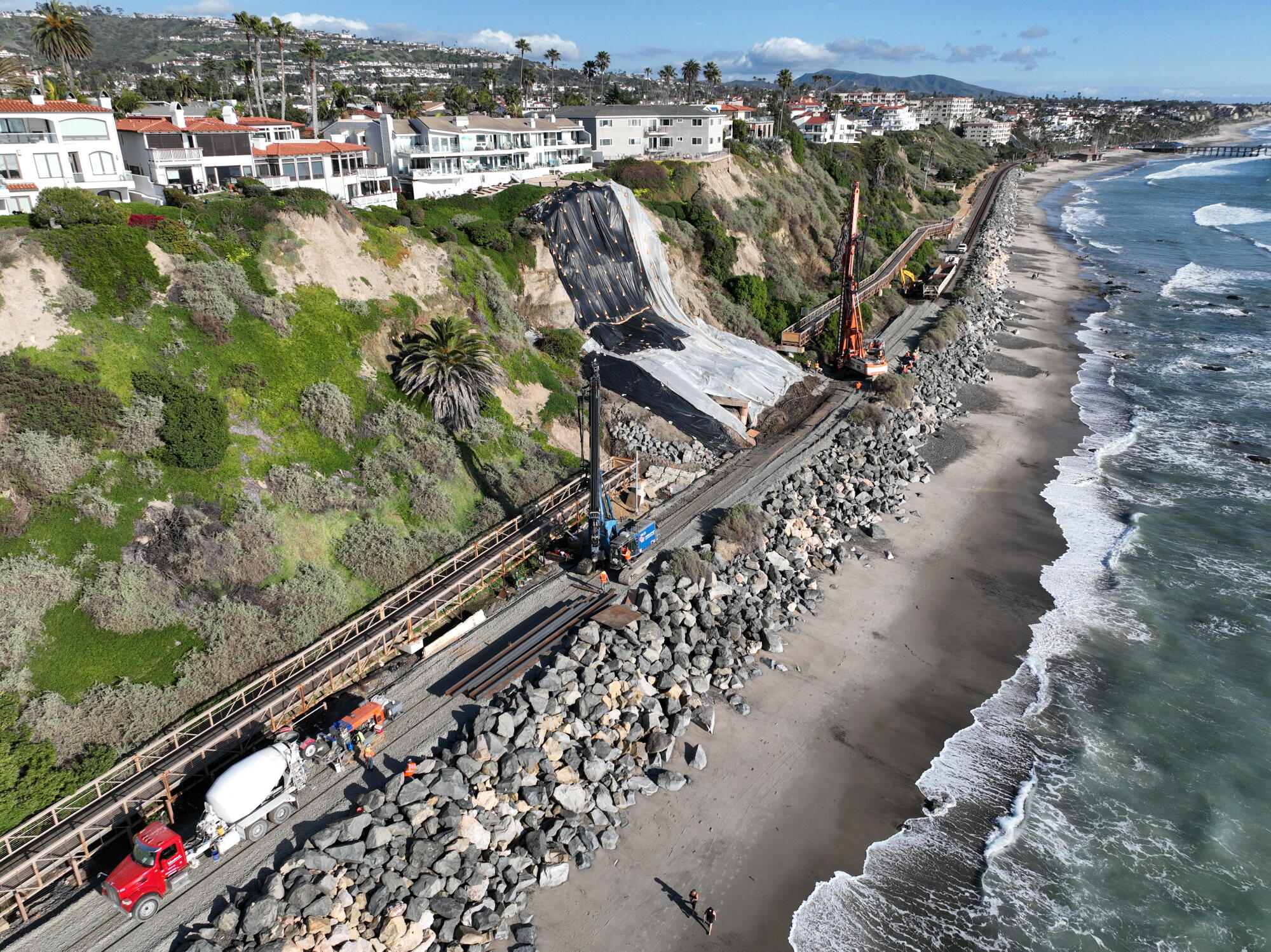
An aerial view, in 2024, of a landslide near cliff-top homes and protective tarping to prevent further slides from upcoming rain storms, to protect train tracks in San Clemente.
(Allen J. Schaben/Los Angeles Times)
But some coastal advocates say officials need to come to terms with this new reality and embrace long-term efforts to reroute roads, railroad tracks and other infrastructure that would allow sandy beaches to move inland as the sea claims more land.
Doing things like lining the beach with rocks to protect a railroad is “just business as usual for the past, you know, 100 years,” said Zach Plopper, senior environmental director for Surfrider Foundation, a nonprofit that aims to protect the world’s oceans and beaches.
“We could have looked at alternative solutions of realignment that would have been a lot cheaper,” he said.
Times staff writers Ruben Vives and Noah Haggerty contributed to this report.