
Join our zero2eight Substack community for more discussion about the latest news in early care and education. Sign up today.
Several years into California’s robust expansion of public transitional kindergarten, private preschool providers are facing challenges that could ultimately upend care for young children of all ages.
The program, which comes at no cost to families, added a new, pre-kindergarten grade level to public school districts throughout the state. The 2026-27 school year marks the second full year that all 4-year-olds in California are eligible for TK.
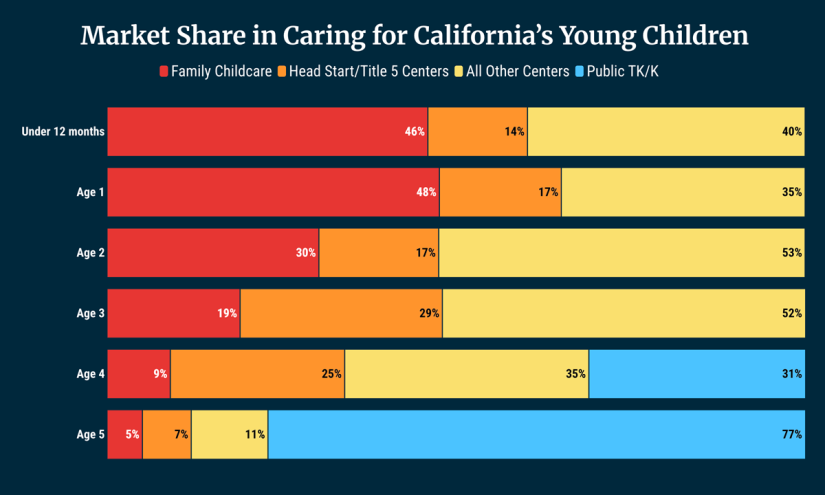
It is, in many respects, a boon for families and the state. But for early care and education providers — many of whom have long depended on the lower cost of serving preschoolers to help offset the more expensive work of caring for infants and toddlers — the siphoning of 4-year-olds from their enrollment represents an existential threat to their businesses and, they say, the health of the sector and variety of options available to families statewide.
Already, some private preschools have closed their doors permanently; others are trying — and often struggling — to pivot to serve younger children.
“Parents will likely have fewer choices for pre-K in the long run,” said Anna Powell, associate director of research and policy at the Center for the Study of Child Care Employment at the University of California, Berkeley. “If we sort of accept that the 4s and 5s will move into TK, many providers will not be able to serve 3s and younger. If that happens, we could see fewer options for younger children as well.”
Details of the challenges that TK has created for California providers are captured in her organization’s report, which used data collected from a survey of 10,000 early childhood educators and focus groups with center directors and family childcare providers.
TK expansion is just one piece of California’s Master Plan for Early Learning and Care — it’s even just one element in the Master Plan to achieve universal pre-K for all 4-year-olds — but it is the one that has received the most attention and investment by far, said Powell, lead author of the report.
“TK has reached critical mass,” she said. “What started as a trickle is now a tidal wave of movement. We have to reckon with that as a state.”
In the 2025-26 school year, when all California children who turned 4 years old by Sept. 1 became eligible, about 52% of the eligible TK population had enrolled — more than 200,000 children, according to the California Budget and Policy Center.
RelatedCalifornia Schools Now Offer Free Preschool for 4-Year-Olds. Here’s What They Learn
“This might seem like not a big deal,” Powell added, noting that many people wonder why early care and education programs who have lost 4- and 5-year-olds can’t just pivot to care for more infants and toddlers. “The business model has been calibrated where 4s and 5s are the biggest and most stable group. When you start to tinker with that, it can really raise problems for providers.”
California is not the first state to roll out free, universal preschool for 4-year-olds, although no program ends up looking the same, given the fragmented system of early care and education in the United States, noted Powell. California’s approach of adding a new grade level to schools and making that the “one free choice” for families inevitably pits the public option versus the private ones.
An alternative, such as one underway in Colorado, supports the mixed-delivery system of early care and education; the state pays licensed providers across a range of settings — such as centers, homes and schools — to serve 4-year-olds and lets families choose which setting best fits their needs.
So when the public option is free, it becomes hard for private providers to find a winning argument with the families of 4-year-olds.
That was true for Heather Posner.
Posner is the former director of the Carquinez Garden School, which closed permanently on June 12 after losing too much of its enrollment to the public TK program, she said. In the three years leading up to its full implementation in fall 2025, “I lost a preschool classroom every year,” Posner said. Her enrollment went from 30 kids one year, to 20 the next, and finally to 10 children last school year, she said. When the spring term ended, the school shut down.
The garden school was licensed to serve children from age 2 to 6. Posner’s plan had been to “pick up extra 2s,” creating classrooms for younger 2-year-olds and older ones. But between a low birth rate, hiring extra staff and all of the changes she would have had to make to the space to comply with licensing requirements for serving younger children, it just didn’t seem feasible.
“It was kind of a double whammy,” Posner said of losing older kids and being unable to adapt easily to serve the younger ones.
In early care and education, staffing makes up the vast majority of a program’s costs. States set requirements for adult-to-child ratios based on age, since younger children typically need more attention and care. At a center-based program in California, three adults are required to care for 12 infants, while only one adult is needed to care for 12 4-year-olds. While childcare costs for infants tend to be higher than for preschoolers, it is not three times as high. As a result, older children help subsidize the cost of caring for younger children in many programs.
Because of the challenges inherent in caring for infants and toddlers (defined as children under age 3), only one quarter of childcare centers in California are licensed to serve that age group, CSCCE found. The majority of programs, including the now-closed Carquinez Garden School, focus on serving older kids.
Programs cannot pivot to serving infants and toddlers overnight, providers told CSCCE. Not only does it require more staff, it requires staff with different expertise and experience.
“Our past research shows becoming an infant/toddler teacher is not a priority for preschool teachers,” said Powell. “Preschool teaching is an identity.”
Even for center-based administrators who want to make the switch, it’s not as simple as saying yes. Programs designed for older children typically have playground equipment higher off the ground that is not safe for children crawling or new to walking. They have fewer changing areas than would be needed for younger children. Prices would also need to be raised on parents to help afford the additional teachers. “All of those things would be necessary along the way,” Powell explained. Several program leaders who have applied for a license to serve younger children told CSCCE they’re still in a queue with the state licensing division, waiting to get approved.
Family child care providers, who work out of their homes, face another set of constraints.
Rachel Bymun is the owner and director of Luv Muffins Preschool & Childcare, which she has run with her husband for the past 17 years. It is licensed as a large family childcare, meaning they can serve up to 14 kids. Only four of those children, however, can be under age 2, according to state licensing requirements.
So even if Bymun wanted to transition to serving more infants and toddlers, she and other home-based providers are strictly limited in how many they can take.
“Really everyone is struggling, maybe for slightly different reasons,” Powell said of providers. “None of them can beat the trend and keep their 4-year-olds.”
Many are trying anyway, though. Bymun is one of the California providers who has been dabbling in marketing and education with families, she said.
“We are trying to be more diligent about how we explain our program and what we do,” she said, adding that she feels strongly that her program has several advantages over TK, even if the public program is free.
For one, most traditional early care and education programs have smaller class sizes than TK. That means each child gets more attention and engagement from teachers, Bymun said. Another is that many children start in Bymun’s program and have “continuity of care from 0 to 5,” which she finds meaningful. Then there’s the fact that most TK programs are half-day, which is not a childcare solution for working parents; they still need to find another arrangement for their child for the second part of the day.
TK is also more structured and academic. Some families now believe that, by age 4, that’s what their child needs to be “kindergarten ready,” Bymun said. But she rejects the idea that “a kid needs to be able to do a worksheet, sit at a desk and be quiet. We all know that’s not how kids learn, and it’s not best practice.”
Bymun’s program is nature-based and takes place primarily outdoors. Everything from reading, to dramatic play, to math instruction is held outside. That creates a stark contrast between her program setting and a school-based one, she said.
Still, what Bymun and countless other California providers have found is that, even with their upsides, it’s hard to compete with free. Bymun’s preschool program is $360 per week for a 4-year-old, or about $18,000 a year. That’s a hard pill to swallow for a family who could otherwise choose the no-cost public TK option.
“There’s going to be a lot more of us closing down, as it gets harder and harder to compete with ‘free’ and compete with the marketing of, ‘Your kids should go to TK,’” Bymun said.
Bymun was able to make inroads with her current families this year. She has 13 kids enrolled and is considered “full.” One is school-aged, four are under age 2, and the rest are in that 2- to 5-year range, she said. This is the first year that she’d been able to convince her families with 4-year-olds to stay in her program instead of leaving for TK, she said. Next year, she said, could be a different story.
“People are ultimately price sensitive,” said Powell of CSCCE. “Even if they had a wonderful experience when their child was 3, it ends up not being much of a choice after all.”
RelatedCalifornia Schools Now Offer Free Preschool for 4-Year-Olds. Here’s What They Learn
It’s not too late for the state and counties to step in to support providers during this period of upheaval and transition, Powell said. They could provide grants so teachers can get trained on working with children from birth to age 3 and programs can convert their facilities and equipment to better serve younger children. The state could focus on reducing turnaround times for centers that need to update their licensing to serve younger children. The state could increase reimbursement rates for providers who accept children whose families pay with subsidies. And the state could give more attention to the other pillars of its universal preschool strategy — not just TK.
The impact on providers throughout the state is already being felt, Powell said, but “California doesn’t have to sit back and let this happen.”
Did you use this article in your work?
We’d love to hear how The 74’s reporting is helping educators, researchers, and policymakers. Tell us how