
In the northeast quadrant of Los Angeles’ Chinatown, just down the way from Dodger Stadium and a short jaunt from the 110 Freeway, sits the headquarters of an organization dedicated to providing opportunities to young people while preserving California’s environment.
That organization is the Los Angeles chapter of the California Conservation Corps.
Since its founding in 1986, the L.A. Conservation Corps has provided nearly 600 young people with work experience, education and support — with those youth compiling nearly 350,000 hours of on-the-job training.
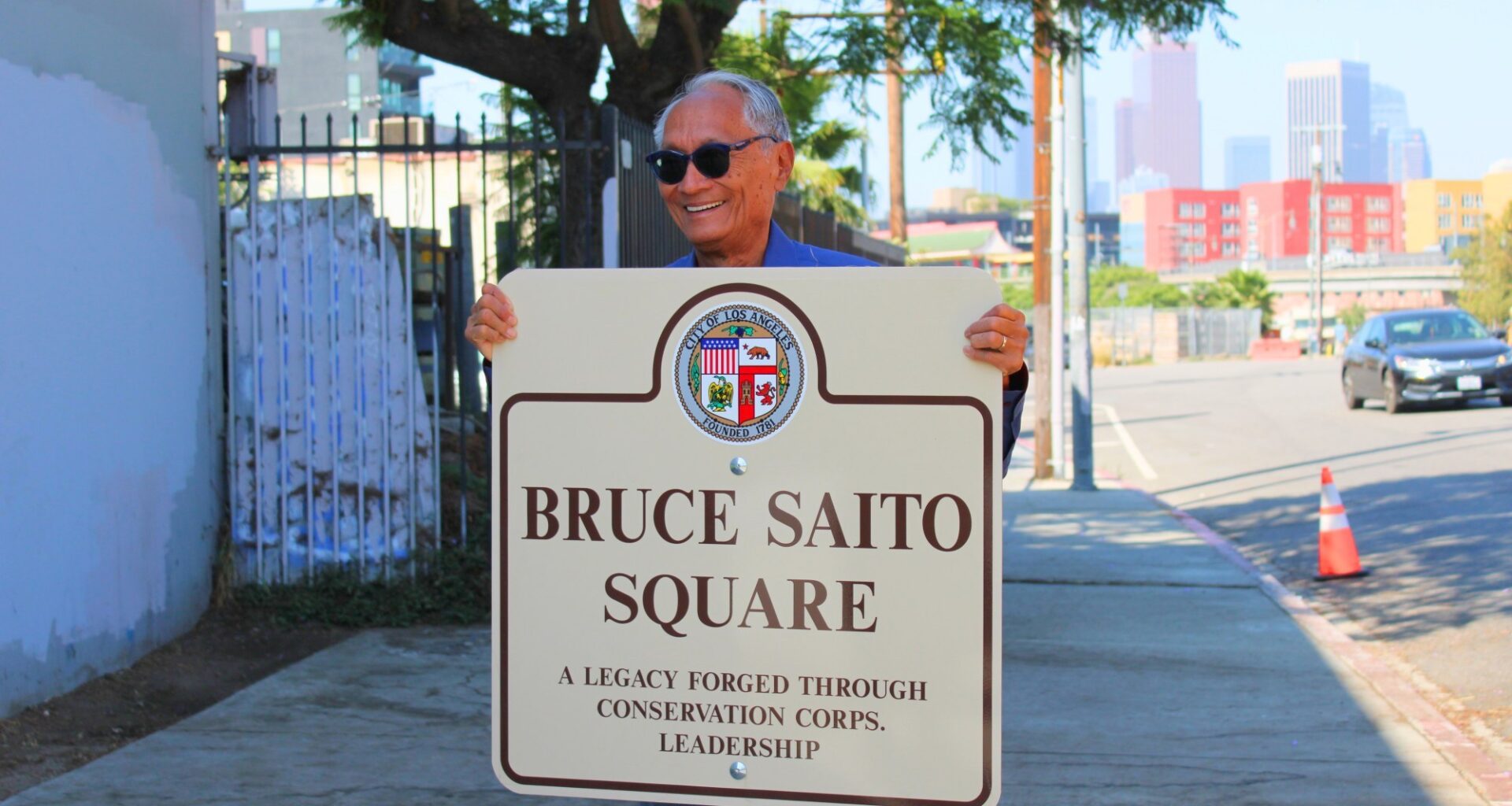
Adjacent to the organization’s headquarters, at the intersection of Ann and North Spring streets, is a new landmark dedicated to one of the icons of the California Conservation Corps: Long Beach resident Bruce Saito.
Los Angeles Councilmembers Monica Rodriquez and Eunisses Hernandez hosted a dedication ceremony for Bruce Saito Square earlier this summer, honoring honored the local conservation leader for his decades-long career in workforce development and environmental training.
“Bruce has been at the forefront of leading workforce development opportunities for young people and providing second chances for decades,” Rodriguez said in an interview. “It’s for that reason that it was clear we wanted to acknowledge and celebrate his contributions to areas not just throughout Los Angeles but, frankly, his contributions across the state of California.”
While Saito lives in Long Beach with his wife, Alex, he’s lived up and down California. He grew up in Norwalk and Artesia, but moved to Anaheim when he was about 12 years old. After graduating from Magnolia High School, he attended several colleges and eventually moved to the Bay Area.
He received a bachelor’s degree in painting and drawing, with a minor in literature, from San Francisco State University in 1976. Although he wanted to be an artist, he also considered teaching, having worked at an early childhood education program and as an elementary playground supervisor.
Little did he know, however, that by the following year, he would find his calling — and embark on a nearly five-decade career workforce development and environmental training.
Saito’s first job with the California Conservation Corps, in fact, fell into his lap. He was unloading a truck at the paint store where he worked in 1977 when he heard that the the newly formed organization was hiring instructors to supervise work crews.
Then Gov. Jerry Brown had created the CCC the year Saito graduated from San Francisco State, with the organization’s mission to have its members work on environmental projects and respond to natural and manmade disasters, whiles also preparing young adults for careers and providing them with educational opportunities.
Saito was drawn to the idea of spending time in the classroom, the office and outdoors. So he applied to run a Conservation Corps squad in San Jose.
He got the job.
And his journey to becoming a Conservation Corps legend began. His accolades include launching local Conservation Corps organizations, including co-founding the L.A. chapter; and helping the CCC create summer employment opportunities and after-school programs to keep students out of trouble during breaks. He’s so well-respected that beside his eponymous public square, which was dedicated on June 16, Saito also has a school named for him.
Saito became the executive director of the entire CCC in 2015, a post he held until his 2023 retirement.
“What better place to do it than outdoors, working out to sea doing Pacific Ocean research on kelp beds on the Long Beach coastline?” Saito said. “Those are cool projects that really provide that incentive to learn and grow and develop those skills.”
“The appeal to me then was it wasn’t going to be just about supervising crews,” Saito said in an interview about his first Conservation Corps job. “It was supervising and educating young folks about not just the environment, but the care of the planet, this holistic approach to ecology as an experiential learning process.”
After about 10 years with the CCC, Saito helped found the Los Angeles Conservation Corps in 1986 and became LACC’s executive director in 1995. He also helped start the Conservation Corps of Long Beach in 1987.
CCLB opened a school under the L.A. Education Corps in 1996 at CCLB’s Atlantic Avenue site. The Education Corps Saito High School is a free public charter school for young adults ages 18-24 receiving their high school diplomas. The program provides students with counseling, case management and paid job training conservation.
As for the public square, Saito didn’t want to accept the renaming, he said, but did it to recognize his parents, who were imprisoned in Japanese internment camps in the 1940s.
“I hope when folks drive by there,” Saito said, “they don’t just think of me, they think of my mom and dad and their own families.”
Saito’s parents and grandparents were held at a camp in Postin, Arizona. His parents were married there. His mother was taken while she was in high school, and she received an honorary degree when she returned home.
A third-generation Japanese American, Saito said his family taught him the value of hard work and conserving resources. His father worked in the produce section of a grocery store.
“He would have the best presentation of his produce. His apples were perfect, and his lettuce,” Saito said. “That’s the most important thing that he taught me. If you’re going to do something, do it right, and he would always tell me, ‘If you don’t like something, don’t complain. If you don’t like it, then change.’”
Saito and his wife moved to Long Beach in 2001. His three sons grew up in Long Beach, and their youngest still lives nearby. Saito retired in 2023 and spends every Monday with his 3-year-old granddaughter, whom he enjoys taking to the dinosaur-themed playground at Recreation Park.
Saito’s other favorite spots in the city include the beaches, Los Cerritos Wetlands, Pine Street and CCLB sites. CCLB works with the Rivers and Mountains Conservancy to restore the Los Cerritos Wetlands.
“A kind of funny favorite place of mine is the cemetery,” Saito said. “I love the history there.”
Saito himself is part of the community’s history — and not just in Long Beach.
“He’s the type of person that (when) you go to the airport, he knows somebody,” Bo Savage, LACC’s deputy director of conservation programs, said in an interview. “That’s how steeped he was in the community, particularly the nonprofit and environmental community of Los Angeles.”
Savage has worked with Saito since 1992 and recalled that he often started his workday at 5 a.m.
“He’s a giver, he’s a problem-solver and he’s a doer,” Savage said. “He left a legacy to the point where, even today, people will say, ‘Bruce works there,’ and I have to remind them that Bruce hasn’t worked here in 12 or 15 years.”
And now, with a public square named after him, there’s another landmark by which people can remember Saito.