
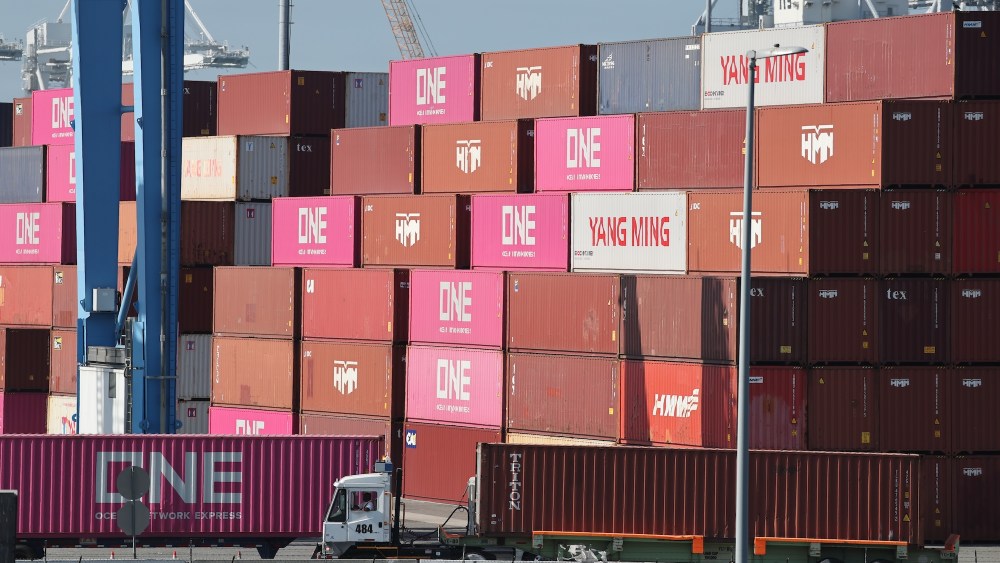
Container dwell times at California’s twin ports are increasing to heights unseen since early last year, and a potential new flood of imports into the West Coast could exacerbate the issue.
According to the Pacific Merchant Shipping Association (PMSA), rail container dwell times in July increased to an average of 6.34 days, up from 5.43 days in June. This marked the highest dwell time for rail-going boxes out of the Los Angeles and Long Beach ports since March 2025.
For containers moving via truck, dwell times were the longest in 18 months going back to last January. Containers waited an average of 3.03 days to be transported last month, up from 2.89 days in June.
“While we saw a modest increase in dwell times in July, cargo continues to move through the San Pedro Bay ports at manageable levels,” said Natasha Villa, senior manager of public affairs for the PMSA. “The ability of marine terminals, dockworkers, drayage providers, rail partners and other supply chain stakeholders to adapt to changing cargo patterns and maintain fluid operations demonstrates the strength and resilience of our supply chain.”
The dwell times overlap with an abundance of imported cargo into the two ports. The Port of Long Beach handled 467,461 20-foot equivalent units (TEUs) of loaded imports in July, its highest monthly total in 2026. The Port of Los Angeles brought in 499,551 TEUs, marking the year’s second-highest total after June.
The lengthening dwell times also coincide with a recent prediction from Port of Los Angeles executive director Gene Seroka that West Coast ports could see a roughly 5 percent increase in the coming months due to the congestion taking place near the Panama Canal.
According to Seroka, the port and several other port stakeholders on the West Coast have engaged in conversations to plan for the possible import influx.
A Friday report from the Journal of Commerce highlighted chassis shortages and temporary street closures as two culprits of the recent rise in dwell times.
During his media briefing earlier this month, Seroka said the port was “95 percent likely” to honor an appointment if a trucker makes a reservation to pick up imports or drop off exports.
But according to the JOC report, some terminals are limiting truck appointments for the return of empty containers, which eliminates dual transactions where empty containers are dropped off and import boxes are picked up. This results in more empty containers sitting idle on chassis throughout the ports.
The Vincent Thomas Bridge, a key route for trucks moving cargo to and from the Port of Los Angeles, has undergone a redecking project since late March that has forced some streets in the surrounding area to close. This has further constricted trucking activity in and out of the port.
Seroka described landside operations at the port’s largest terminal, Pier 400, as “fluid,” noting that truck turn times average roughly 30 minutes per stop.
Concerns about fluidity at ports followed commentary from Maersk CEO Vincent Clerc, who indicated in the carrier’s earnings call that there has been an industrywide underinvestment in landside operations within and around global ports compared to overall container handling growth.
“As long as we are having the type of demand that we are having today, we need to invest in landside capacity to alleviate these bottlenecks,” Clerc said. “Until then, we will see these bottlenecks as a not constant, but common feature of the markets that we operate in.”
Seroka agreed with Clerc’s wider concerns about port infrastructure, but he asserted earlier this month that landside operations at the twin gateways had not impacted vessel berthing times.
“We have not seen a single ship backed up in more than five years here at the Port of Los Angeles,” Seroka said.
At the Port of Long Beach, its busiest container terminal had reported problems with some ship-to-shore cranes in July, with the backlogs persisting into August.
As the ports look to move through the cargo, this month’s inbound volumes are expected to remain consistent with July.
After the San Pedro Bay ports handled nearly a combined 1.9 million TEUs in July, the Los Angeles gateway expects more of the same in August. The L.A. port expects to handle more than 900,000 container units next month.