
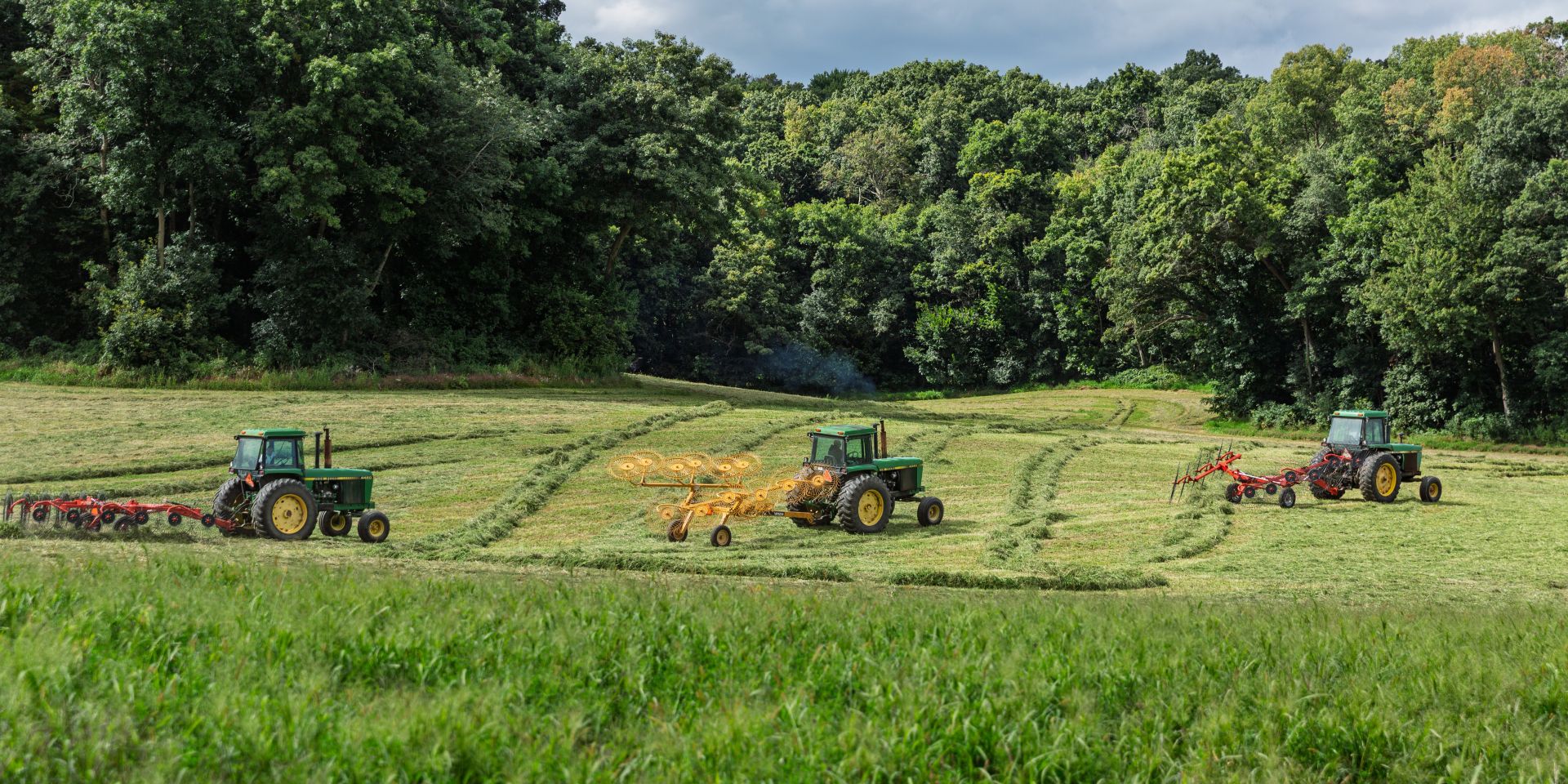
If you ever saw Ate9, led by artistic director and choreographer Danielle Agami, you will definitely remember Sarah Gordon Butler. When onstage, it was difficult to watch anyone else and that pleasure was only doubled when she was paired with Rebecah Goldstone. Butler performed with Ate9 from 2012 to 2021 and now resides in Berlin, Germany as a freelance artist.
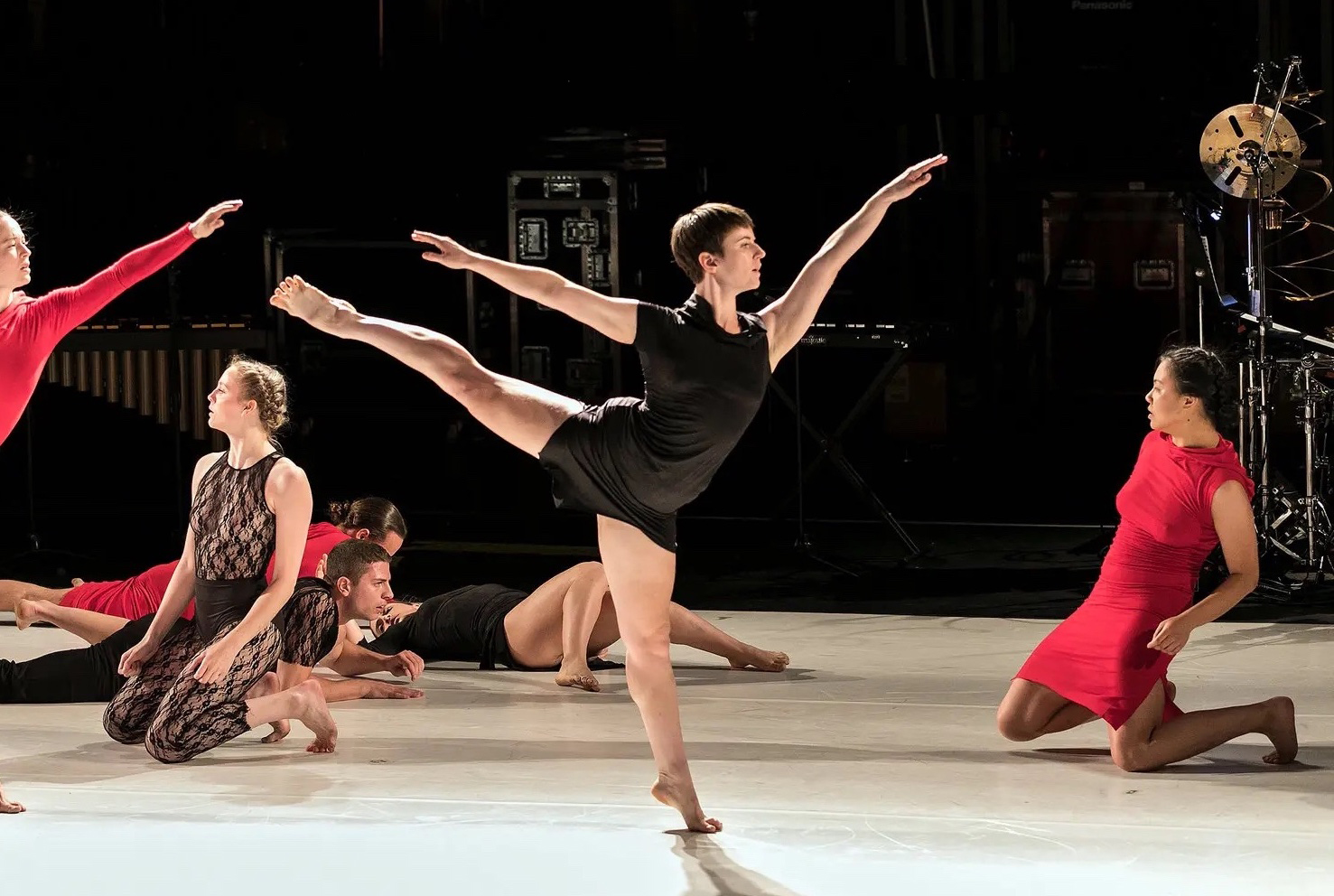
Sarah Gordon Butler in “Calling Glenn” by Danielle Agami/Ate9 at the Joyce. Photo by Rachel Papo for New York Times – Courtesy of the artist.
The beginning of Butler’s current bio is as wonderful and unassuming as she opens with, “Hi, my name is Sarah. I like making things.” Knowing all of her talents, I never would have foreseen Butler creating a six-act production titled Hay Rake Ballet featuring 18 local farmers harvesting alfalfa with machinery in choreographed patterns inspired by classical ballet. In addition, the farmers will be accompanied by a chamber ensemble from the Madison Symphony Orchestra along with the Grammy award-winning Opera soprano, Sarah Brailey. Assisting Butler with the Hay Rake Ballet project this year is Julia Eichten, a founding member of L.A. Dance Project who is a noted choreographer in her own right.
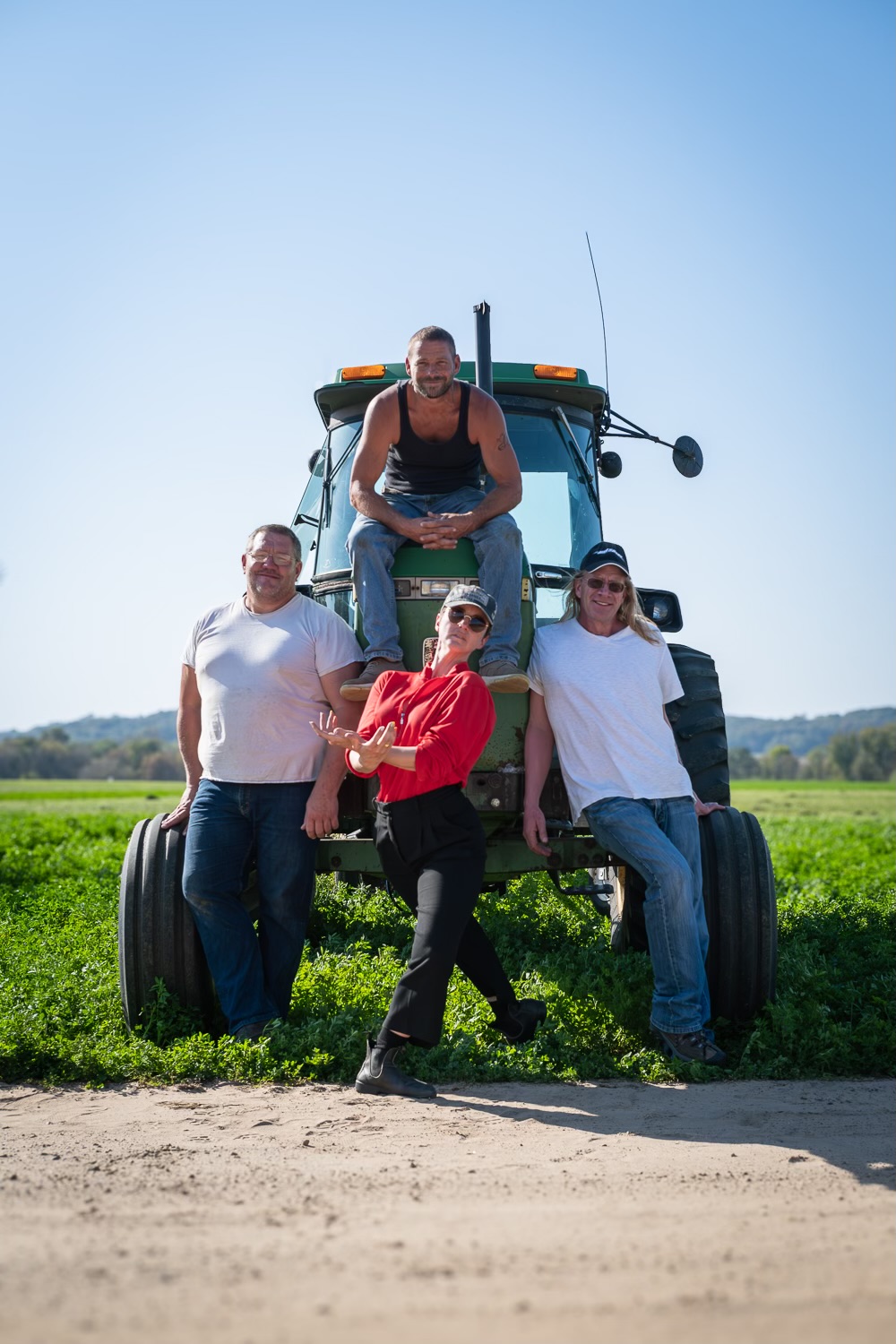
“Hay Rake Ballet” – Brian Markley, Darin Rosenbaum, Sarah Gordon Butler, Andy Enge – Photo by Alexander Arena.
Begun in 2024, this one-time performance will take place on September 12, 2026 at a specific farm location in southern Sauk County, Wisconsin. The exact location will be shared with ticket holders the week of the performance. There are no human dancers in Hay Rake Ballet. The dancing will, however, be performed by the machinery driven by farmers whose ages range from 15 to 79.
Butler agreed to a Zoom call so that we could talk about this amazing endeavor of hers.
Butler began working as a freelance dance artist by moving to a foreign country in 2023 where she did not have any connections and where she doesn’t speak the language. Like most freelance artists, she travels a lot to work on different dance projects. “I joked that I have the worst commute because I live in Berlin but I work in southern Wisconsin,” she said humorously, causing us both to break out laughing.
It took a couple of years to build a community and create work for herself, but currently the move proves to be going well. “Three and a half years in, and I feel like now I’m at the point where a lot of that initial legwork and foundational work is coming back,” Butler said. “and places where I’ve taught are reaching out again.” She admitted that it is still a hustle but less like “pushing a boulder up a hill.”
So, how did Butler find herself in Sauk County, Wisconsin choreographing a six act ballet using farming equipment?
“It was one of my favorite Google searches,” she began, “it was an accident, kind of. In 2020 I was starting to apply for artist residency programs because I’d never done one and I was like, this would be great.”
At that point Butler had been working with Ate9 for ten years. She was and still is not finished dancing, but she began to consider what she would create when it were not within the context of Agami. She was curious about what movement would emerge working on her own. Butler is also interested in embroidery and she loves singing. “So I was interested in if I make something, what is that?”
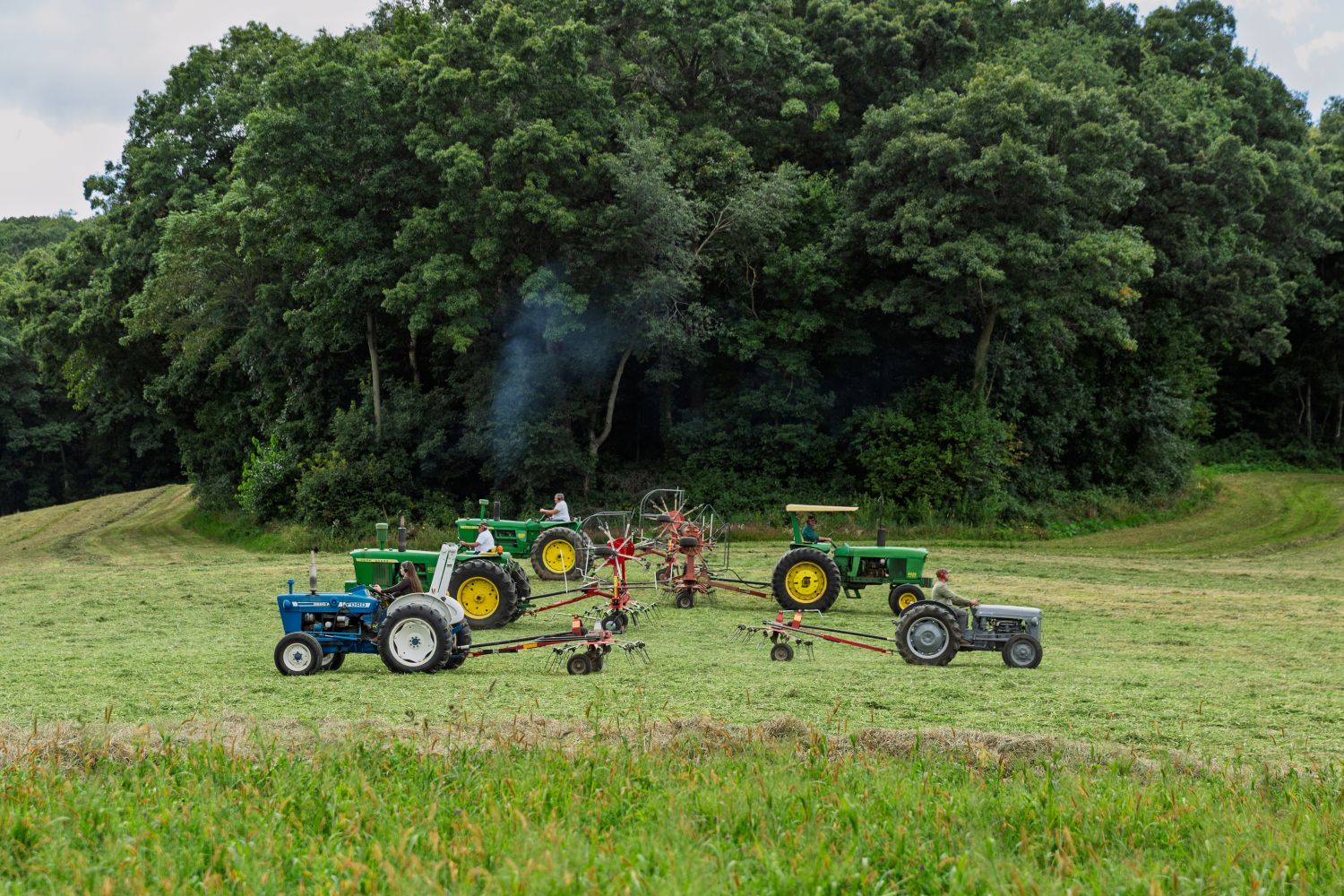
“Hay Rake Ballet” – Tedders – Photo by Ron Lutz II.
Butler searched for artist residencies that had rolling admissions, a college application process where schools review applications and send out acceptance decisions continuously as they arrive, rather than waiting for a single hard deadline. She came upon Wormfarm Institute located in Reedsburg, Wisconsin that had a residency program on a working farm. Participants work in the garden Monday through Friday mornings to support their CSA program ( community supported agriculture) in exchange for studio space and basic room and board. Because of the COVID pandemic, someone had to drop out and the institute reached out to Butler. She had grown up on the west coast and had never been to Wisconsin.
Her residency at the Wormfarm Institute lasted for two months and she really loved it. “The organization is a non-profit that’s been presenting public arts programming in this rural area for 25 years, in addition to the residency program and CSA,” Butler explained. Their mission statement reads in part, “Wormfarm cultivates connections between our rural and urban neighbors through art, food, and the land.”
Butler returned to the institute for six months in 2021 and in 2022 she returned to help produce a big event that they were presenting. She skipped 2023 because she was moving to Berlin.
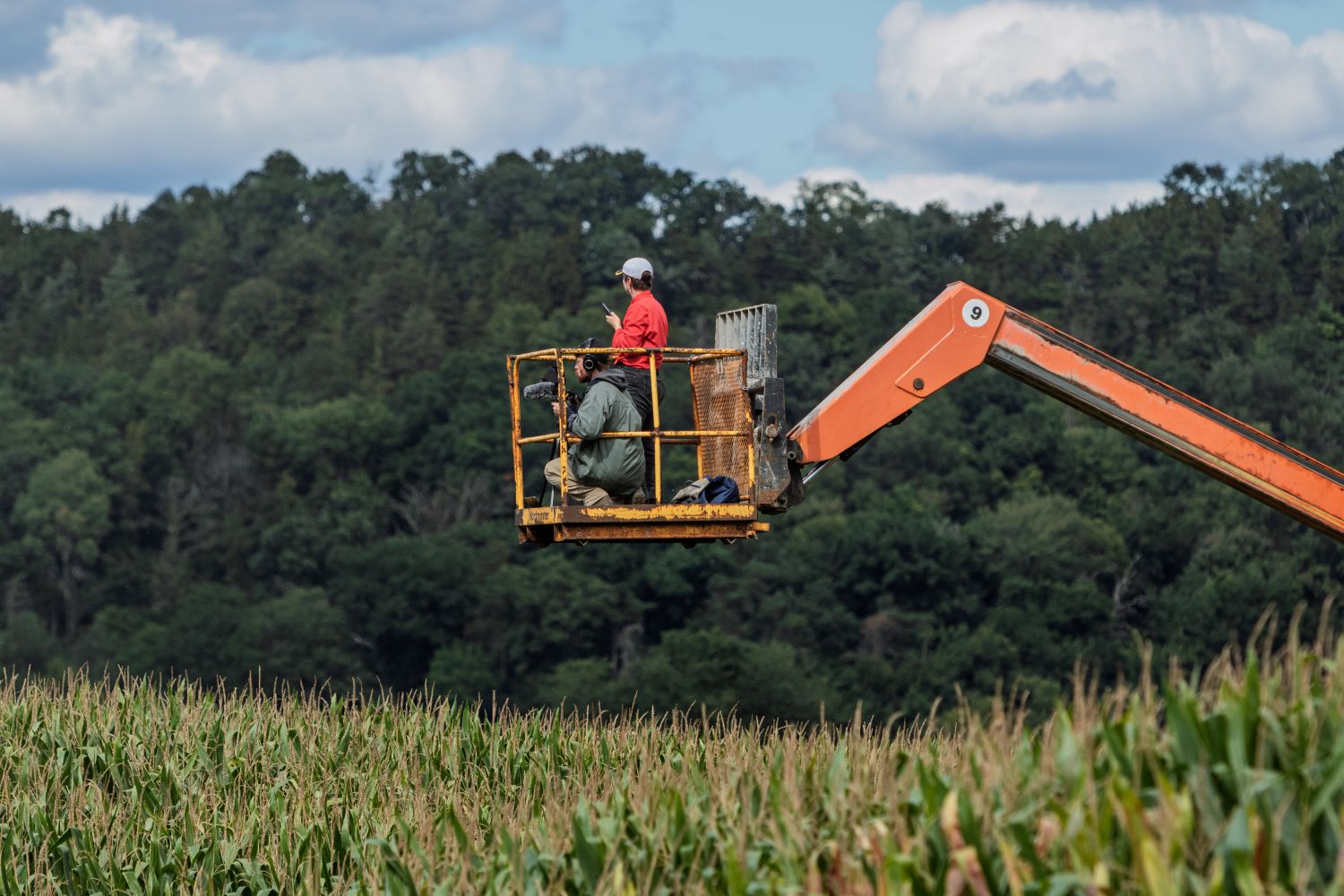
“Hay Rake Ballet” – Sarah Gordon Butler directing farmers – Photo by Ron Lutz II.
Hay Rake Ballet was the idea of co-founder and executive director Donna Neuwirth who had moved to southern Wisconsin from Chicago. Neuwirth did not know what the hay rake farming implements were initially but, like Butler, found them quite beautiful. The idea came to her as she became mesmerized by watching a farmer hay rake his field. Twenty years later when Neuwirth passed the idea past Butler, she right away said, “Let’s do it.”
When considering the hay rake ballet, Butler realized that it brought together several of her skillsets. Meeting people and getting them involved in projects, and obviously the dance and choreography elements played a large part in her decision. Also, after spending time at the Wormfarm Institute, Butler had fallen in love with the land and the people. She knew that it was important to her but didn’t know how this would come together the rest of her creative talents. The idea of Hay Rake Ballet answered that question. “I also had all this producing skills from doing assisting work, so it was like, yeah, I think I can do this,” Butler said.
In 2024 Butler returned to the Wormfarm Institute and created the first pilot performance. The first iteration of Hay Rake Ballet was part of a larger event scheduled that fall and Butler discovered that she was not only responsible for creating the ballet, but for locating and convincing the farmers to take part in the performance. She would also have to find the music to accompany the work.
She drove around the area and when she spotted a hay rake, Butler approached the owner about taking part in this project celebrating family-scale agricultural practices, would they be interested in performing or would their machine be available? She related how she would be speaking with a farmer while he was milking cows in his barn. Some said that she could use their machine but that they did not want to be in the ballet.
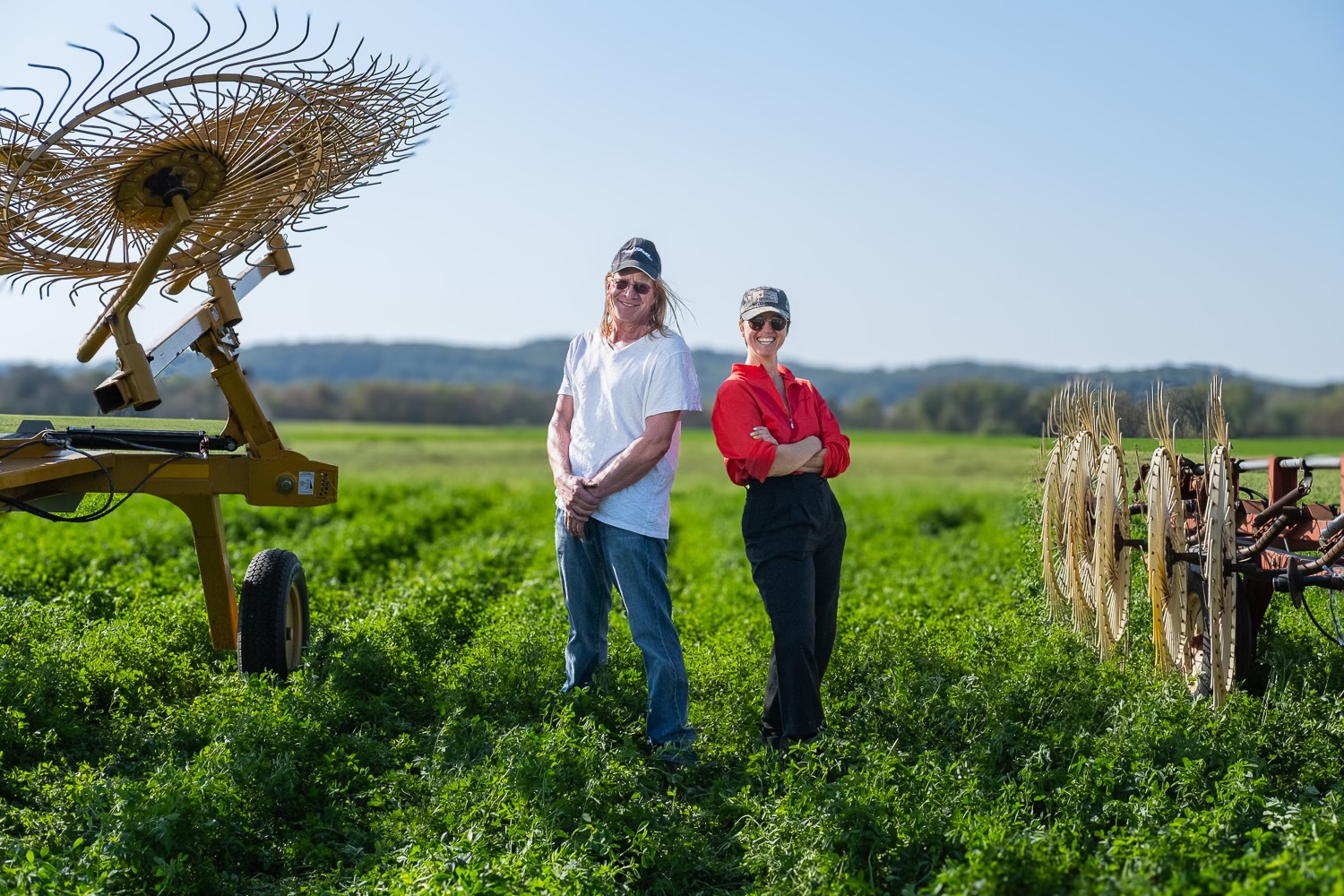
“Hay Rake Ballet” – L-R, Andy Enge, Sarah Gordon Butler – Photo by Alexander Arena.
The first man to say yes and who has been Butler’s main collaborator throughout the project was Andy Enge. “He is kind of the reason that everything has been able to happen,” Butler said. “I even find myself asking him advice about choreography.” This makes sense because Enge understands how the machinery moves and how to guide them.
In 2024, she managed to get three farmers and three hay rakes, three tractors, and a sound engineer who agreed to bring generators, speakers, as well as helping Butler select the music. The finished ballet was a trio to a Berlioz march and the flower duet from Léo Delibes’ tragic opera Lakmé. Butler said that she anticipated that there would be humorous movements in the first Hay Rake Ballet, but she was surprised by how beautiful it turned out to be.
“The experience of seeing these three men feel seen and celebrated by their community for essentially the everyday work that they do where they’re total masters of their craft, but it’s not recognized in the same way that it would be with ballet.” Butler explained. “To see them be seen and running forward and bowing and signing autographs was like oh, we’ve made something really special together in a way that I didn’t quite understand.”
The original three farmers have stayed with the project throughout its progress and this September will be their third performance. Butler has dressed them in fitted black tuxedos.
Hay Rake Ballet is in six acts: Act I involves the entire cast of 18. There are sections with the tractors moving together like the corps de ballet in Swan Lake, and there are solos. “Each act is a stage of the process of making hay,” Butler said. “So, each act has the lead. We met the lead mower, lead tedder, lead rake, lead baler, and then everybody leaves stage and we go into Act II: the tedders quartet. Act III is the rakes quintet. Act IV is the kick balers. I’ve got 3 balers, so the bales should be flying past each other. Act V, there’s an interlude where five vintage Farmall tractors bring the opera singer for and sings an aria. Act VI is the finale.
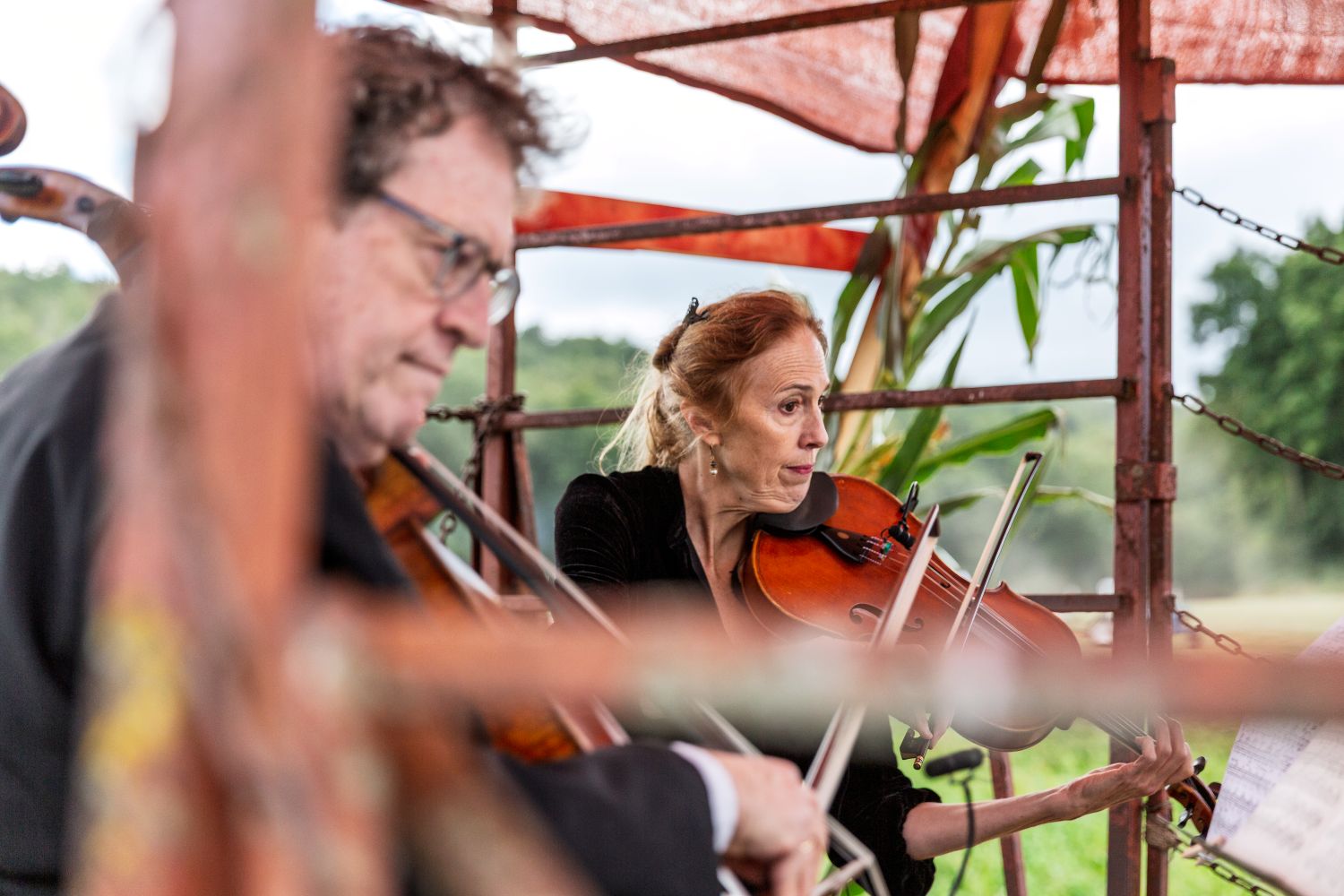
“Hay Rake Ballet” – String Quartet – Photo by Ron Lutz II.
“With hay bales flying it becomes sort of a coda or men’s variation with big music and they’re (the bales of hay) shooting through the air,” Butler described with making large gestures with her arms.
The continuation of the Hay Rake Ballet project 2025-2026 was made possible in part with funding from the Ruth Arts Wisconsin Special Projects Grant.
Listening to Butler describe the first two year performances, the final production with more farmers, more machinery and an opera singer leads me to believe this project can only end up being beyond wonderful, exciting, and fantastically rewarding for everyone involved.
Fortunately, a colleague of Butler’s, filmmaker Shawn Fitzgerald Ahern is directing a full-length documentary of the making of Hay Rake Ballet. For Butler, the documentary will help demonstrate the beauty and richness that occurs when different people are brought together. It shows that a way can be found for them to work together for a common goal and how so much beauty can arise out of that situation. The documentary is scheduled to make the festival circuit in 2028.
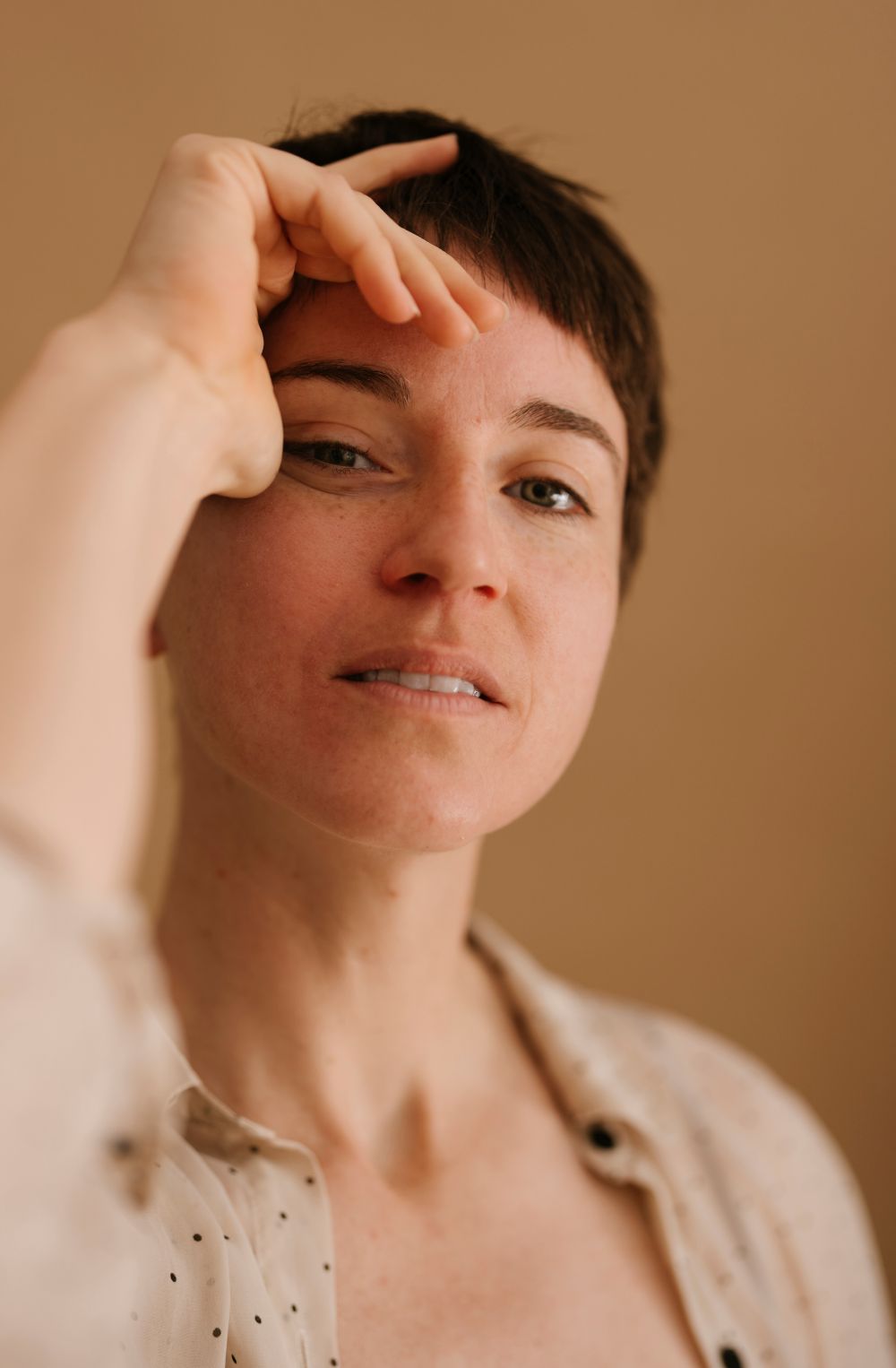
Sarah Gordon Butler – Photo by Janina Steinmetz.
The entire event on September 12th appears under the titled “Make Hay While the Sun Shines” and lasts for two hours. Prior to the premiere of Hay Rake Ballet there will be a performance by the Milwaukee based Wild Space Dance Company led by Founding Director Debra Loewen.
Butler spoke very beautifully about the experience of creating Hay Rake Ballet, so I will end this article with her words.
“That exchange that happened between me and the farmers, it’s just been so beautiful. I’m learning from these master about how they operate – not just the machinery – but their relationship with the land, how they understand the weather, and how they plan for these things. It’s such an artform and they grew up in it, so it’s also in their genetic makeup. You can’t teach that, they just began when they were very young. So that exchange, there’s so much breaking of stereotypes. They now have a totally different idea about ballet as I now have a totally different understanding of farming.”
WHAT: Hay Rake Ballet
WHEN: September 12, 2026, from 2-4 pm. (Rain Date: Saturday, September 26, 2026)
WHERE: Rural Sauk County, Wisconsin; specific location TBA week-of.
Tickets: Available now via Eventbrite.
To learn more about Sarah Gordon Butler, please visit her website.
For more information about the Wormfarm Institute, please visit their website.
This article was edited at 11 am on 8/31/26.
Written by Jeff Slayton for LA Dance Chronicle.
Feature photo: “Hay Rake Ballet” – Photo by Ron Lutz II.