
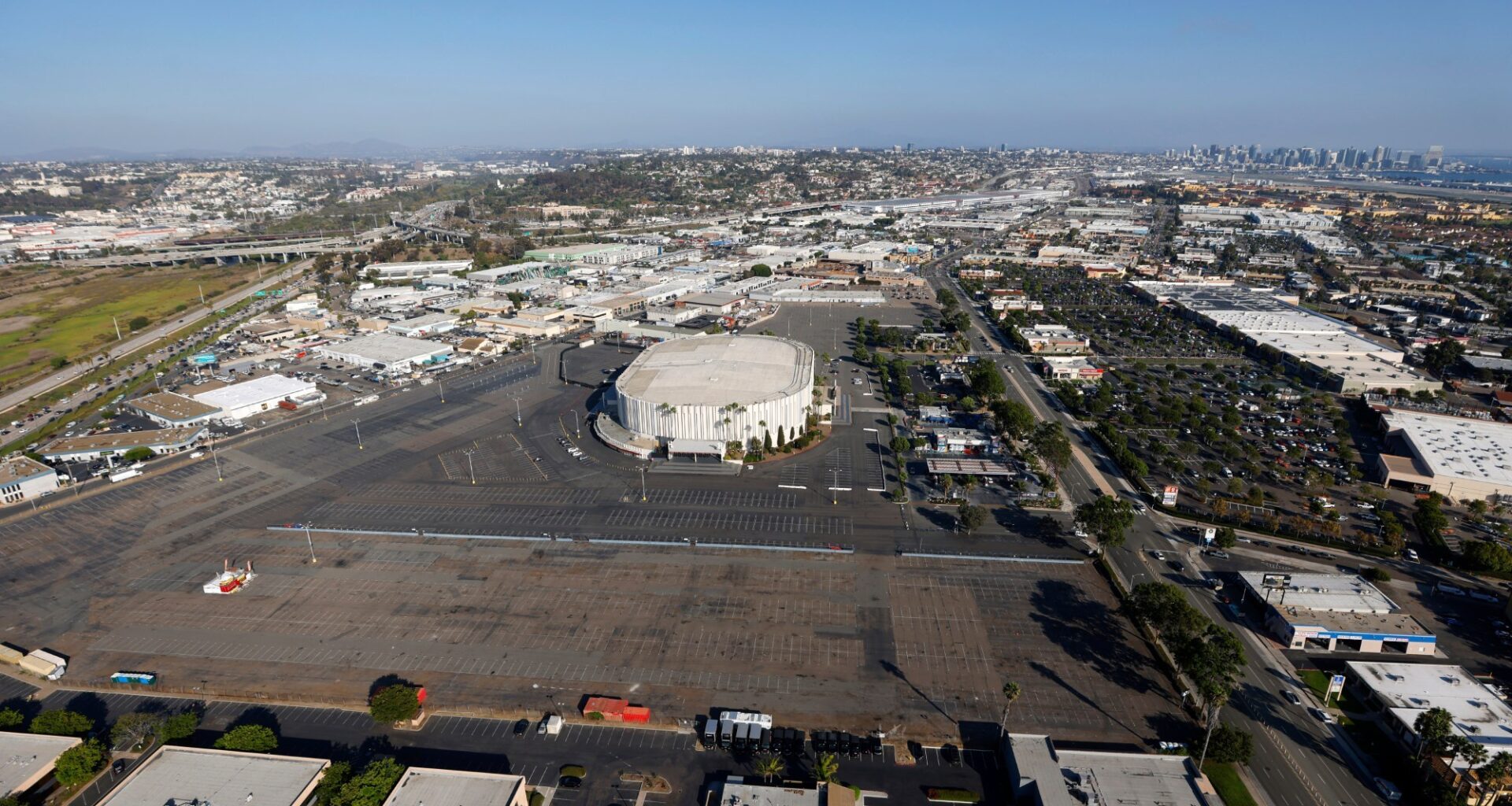
Two state bills designed to insulate the Midway Rising mega project from legal challenges linked to California’s environmental law received their final legislative approval and are headed to Gov. Gavin Newsom’s desk.
Senate Bill 958 and Senate Bill 344 — authored by state Sen. Akilah Weber Pierson, D-La Mesa, and sponsored by San Diego Mayor Todd Gloria — completed their trips through the state Legislature on Sunday, both passing 40 to 0 in the Senate, with the original chamber accepting bill amendments from the Assembly.
If signed into law by the governor, SB 958 would prevent increased building heights from being considered significant impacts under California’s Environmental Quality Act, or CEQA. It was originally written for Midway Rising, but was later amended to apply more broadly to all non-industrial, infill projects with a certified environmental impact report.
SB 344 is a special statute specific to Midway Rising and establishes that the project, upon certification of its environmental impact report, will have fully satisfied the requirements of the state’s environmental law. The bill surfaced in the final stretch of the state Legislature’s regular session and includes an urgency clause, meaning its protections will take effect immediately if signed into law.
“(The bills) provide greater certainty under California’s environmental laws while preserving meaningful environmental protections and public review. Together, these bills will help prevent unnecessary litigation and years of delay from standing in the way of housing and infill development that has already undergone an extensive public planning process,” Gloria said in a statement. “I urge Governor Newsom to sign SB 958 and SB 344 into law so we can turn years of planning into real progress — and get to work building the homes, infrastructure and vibrant community San Diegans deserve.”
The mayor’s victory in the Legislature comes as the city and the Midway Rising development team prepare to wrap up a four-year negotiation period with a long-term ground lease for the city’s real estate at 3220, 3240, 3250 and 3500 Sports Arena Blvd. in the Midway District. The proposed real estate terms for the development deal are expected to be discussed publicly for the first time at a City Council committee on Oct. 8.
San Diego City Council members first selected the Midway Rising development team to lease and redevelop the sports arena property in September 2022. The team is composed of market-rate housing developer Zephyr, affordable housing builder Chelsea Investment Corp., and sports-and-entertainment venue operator Legends. The Kroenke Group, a subsidiary of billionaire Stan Kroenke’s real estate firm, is the entity’s lead investor and limited partner.
The development plan for the 49.2-acre property, or what’s known as the Midway Rising Specific Plan, calls for 4,254 total residential units, a 16,000-seat replacement arena, 130,000 square feet of commercial space, 8.1 acres of parks, and an additional 6.4 acres of plazas and public space. It memorializes the team’s commitment to build 2,000 residential units for households earning 80% or less of the area median income, or what’s considered affordable housing.
The city of San Diego completed an environmental analysis of the specific plan, or what’s called the final subsequent environmental impact report, or FSEIR. The plan allows for a 250-foot residential building, 105-foot mixed-use buildings and a 165-foot arena. The analysis is awaiting certification by the City Council, which is expected to occur at the same time the council approves the real estate deal.
SB 344, if signed into law, will help shield the city and Midway Rising from lawsuits claiming that the project’s EIR does not comply with CEQA, according to a bill analysis prepared for the Senate.
“The purpose of this bill is to essentially state that once the city has certified the EIR, which is generally the last step to CEQA, that it is CEQA compliant,” Weber Pierson said last week at the bill’s hearing in the Assembly Standing Committee on Natural Resources. “If they end up having to go through another round of litigation, it will help in the court system. It will not prevent people from being able to sue, because people can sue here for anything. But it will hopefully help and not delay it another four, five, 10 years.”
The bill also appears to mark the first time the state Legislature has declared a specific project to be fully compliant with CEQA, which gave pause to Assemblymember Al Muratsuchi, D-Torrance, at the committee hearing.
Muratsuchi, who did not vote on the bill at the hearing or during the Assembly vote, said he was concerned that the state’s legislative process was being used for something that should be left to the courts.
The Assembly member whose district includes the project area expressed a similar sentiment on social media.
“I didn’t vote on SB 958 and SB 344 relating to the Midway Rising project. If we want to address California’s housing crisis, we need to allow for public scrutiny, and the public to sue when appropriate, to correct legitimate concerns and mistakes when assessing impacts,” Assemblymember Tasha Boerner, D-Encinitas, wrote in the statement posted to Instagram. “I agree that we need to address the housing crisis, but we must do so in a way that does not sacrifice protections, especially environmental ones, we already have in place.”
The proposed law seems to have in mind opposition efforts like the one telegraphed by Chatten-Brown Law Group. The firm sent a letter, on behalf of clients J. Keith Behner and Catherine Stiefel of Point Loma, to San Diego leaders outlining several ways in which the environmental analysis for the Midway Rising project is said to be substantially deficient.
“The bill eviscerates citizens’ rights of review and comment, and removes decision-making from local jurisdictions in favor of special interests holding sway in Sacramento,” Behner said. “We and our attorneys are continuing to evaluate the passage of these two draconian measures, and we’re attempting to figure out where we go from here.”
Meanwhile, SB 958’s purpose is to blunt the effect of an appellate court decision with statewide implications.
In October 2025, California’s Fourth District Court of Appeal ruled that San Diego illegally asked voters to remove the 30-foot height limit from the city’s the Midway-Pacific Highway Community Plan area without adequately studying the effects of increased building heights. The appellate court not only ordered the Midway District’s height limit restored, but published its decision as a binding precedent on CEQA case law for lower courts.
“Courts have discretion in evaluating whether or not the lead agency adequately considered the environmental impacts of the project. However, the Legislature has the capability to overturn judicial rulings related to CEQA. Most prominently in recent years was the specification in AB 1307 (Wicks Chapter 160, Statutes of 2023) that for residential projects, the effects of noise generated by project occupants and their guests on human beings is not a significant effect on the environment,” a bill analysis prepared for the Senate states. “SB 958 uses a similar approach to AB 1307 by course correcting a court ruling on what constitutes environmental impacts under CEQA — and applying it broadly to all future projects.”
The bill does not revive the invalidated San Diego ballot measure. Last week, city leaders formally reinstated the 30-foot height limit in San Diego’s Midway District. And the Midway Rising development believes that it can legally breach the height limit with the help of other state housing laws.
Instead, SB 958 could clear the way for the city to advance another measure to lift the Midway District’s height limit. It also seeks to protect other projects across the state from CEQA-related lawsuits pertaining to building heights.
Assemblymember Carl DeMaio, R-San Diego, unsuccessfully led the opposition in the Assembly to block both bills.
“Nobody wants Miami Beach-style condos on California’s coast, but this bill makes it easier for that to happen,” DeMaio said ahead of last week’s Assembly vote on SB 958.
Newsom has until Sept. 30 to sign or veto the bills. If he takes no action, the bills automatically become law.