

A new study by researchers at UC Berkeley’s Center for Global Healthy Cities published in the Journal of the American Medical Association Network Open found that the California city of Richmond’s Office of Neighborhood Safety (ONS) was responsible for a 61% reduction in that city’s firearm homicides and injury shootings over the last 14 years.
This is one of the only studies in the country to document the sustained impacts of a community violence intervention (CVI) program on city-wide firearm violence over more than ten years.
According to lead author Alice Bruno, a doctoral student in epidemiology at UC Berkeley’s School of Public Health, “We leveraged data from dozens of comparable cities across the United States to estimate what firearm violence would have looked like in Richmond without the ONS, Peacemaker Fellowship. We found that the Fellowship contributed to long-term reductions in violence, and that the declines only grew as the program operated.” Other UC Berkeley co-authors include Dr. Jason Corburn; Dr. Mahasin Mujahid, chair of the Division of Epidemiology; Dr. Sean Darling-Hammond; and Dr. Juan Cabrera.
Sam Vaughn, director of ONS, said, “The statistics back-up what we have seen in the streets: fewer shootings, fewer deaths and a healthier community overall.”
Homicide rates are down across the country; the FBI recently released data showing murder rates are down a record 18.1% nationally. However, Richmond has consistently out-performed national declines for over a decade, suggesting the results are due to that city’s innovative, street-outreach interventions and their mentorship of active firearm offenders, a program called Operation Peacemaker Fellowship, which was instituted in 2010. The Fellowship uses a public health approach to preventing gun violence.
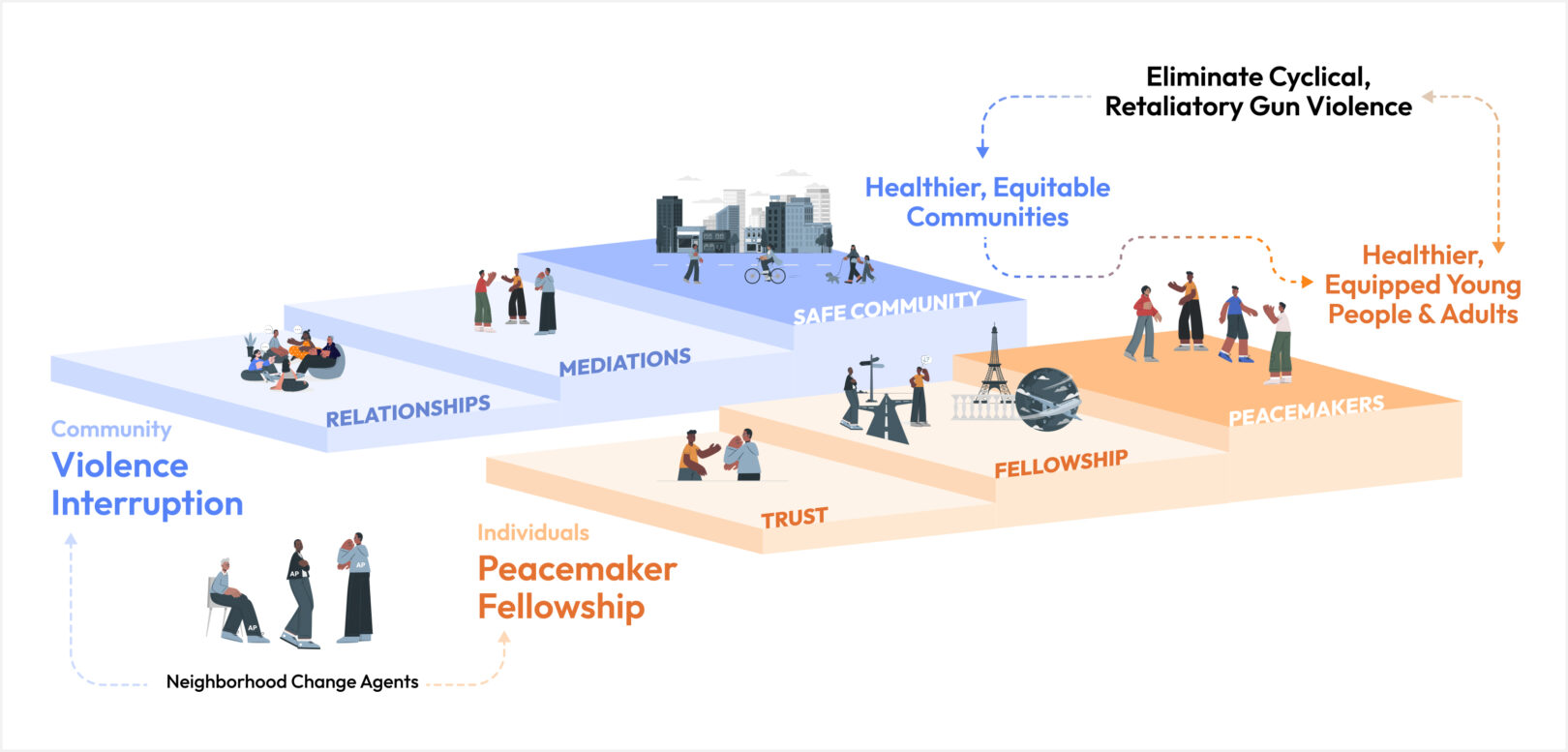
The Peacemaker Fellowship Public Health Model, ©Jason Corburn (Courtesy of Jason Corburn)
According to James Houston, the Program Manager of the ONS who oversees the day-to-day implementation of the Peacemaker Fellowship, including managing 14 street-outreach workers who currently serve 123 participants, “The credit goes to the young people making better decisions and the team that gives them support, mentorship and encouragement every day to make a change.”
According to Shasa Curl, Richmond City Manager, Richmond had over 300 police officer FTE in 2014 and 180 in 2020, but was down to 121 active sworn officers by 2024. Yet, during this time the ONS, through continued city support and grants, was able to expand its staff and increase the number of fellows and participants. Even during the COVID-19 period, the study shows Richmond did not have as significant a spike in firearm violence as most cities did across the Bay Area and nationally.
According to the ONS, the health impacts are lives saved, safer streets, and community members with a renewed positive life outlook.
One former Peacemaker Fellowship participant said, “Before the ONS came to me, I didn’t care if I survived past 19, as long as I had a name in the streets. After my experience with the ONS, with my mentor coming at me every day, I got support for my stress, got a job, paying my bills, and have a kid now. I’m no longer terrorizing my community.”
The paper notes the cascading health benefits for entire communities when gun violence reductions are sustained, such as the case in Richmond. Further research will explore how unique aspects of the ONS might be contributing to declines in gun violence, including that the program is a city government agency, independent from the police department, has had consistent funding, has trained and retained many of the same outreach workers for over a decade (these city staff are well paid with benefits), and the fellowship delivers individualized supports to each participant based on their needs, such as food and housing assistance, cognitive behavioral therapy, addiction and anger management counseling, and other social services aimed at both reducing gun violence risk and addressing trauma.