
People clad in capes, gowns and elaborate character costumes flanked the streets of Anaheim this weekend, but it wasn’t the usual Disneyland crowd.
They were headed to the Anaheim Convention Center, where a global gathering of science fiction and fantasy enthusiasts packed the halls for the annual World Science Fiction and Fantasy Convention, or Worldcon, the longest-running science fiction and fantasy convention around.

Fans arrived to the Convention Center wearing costumes and science fiction-inspired outfits. Author Jasmine Kuliasha poses in a Star Wars-themed dress made by a friend.

Author Amal El-Mohtar, who won the Hugo Award for Best Novella, accepted the Best Novel trophy on behalf of winner Alix E. Harrow.

Canadian poet and writer Amal El-Mohtar accepts the Hugo Award for her novella “The River Has Roots.”

Anaheim’s Worldcon, nicknamed “LAcon V,” is the area’s seventh convention. The Worldcon Heritage Organization, founded in 2011, works to preserve artifacts and memorabilia collected throughout Worldcon’s history.

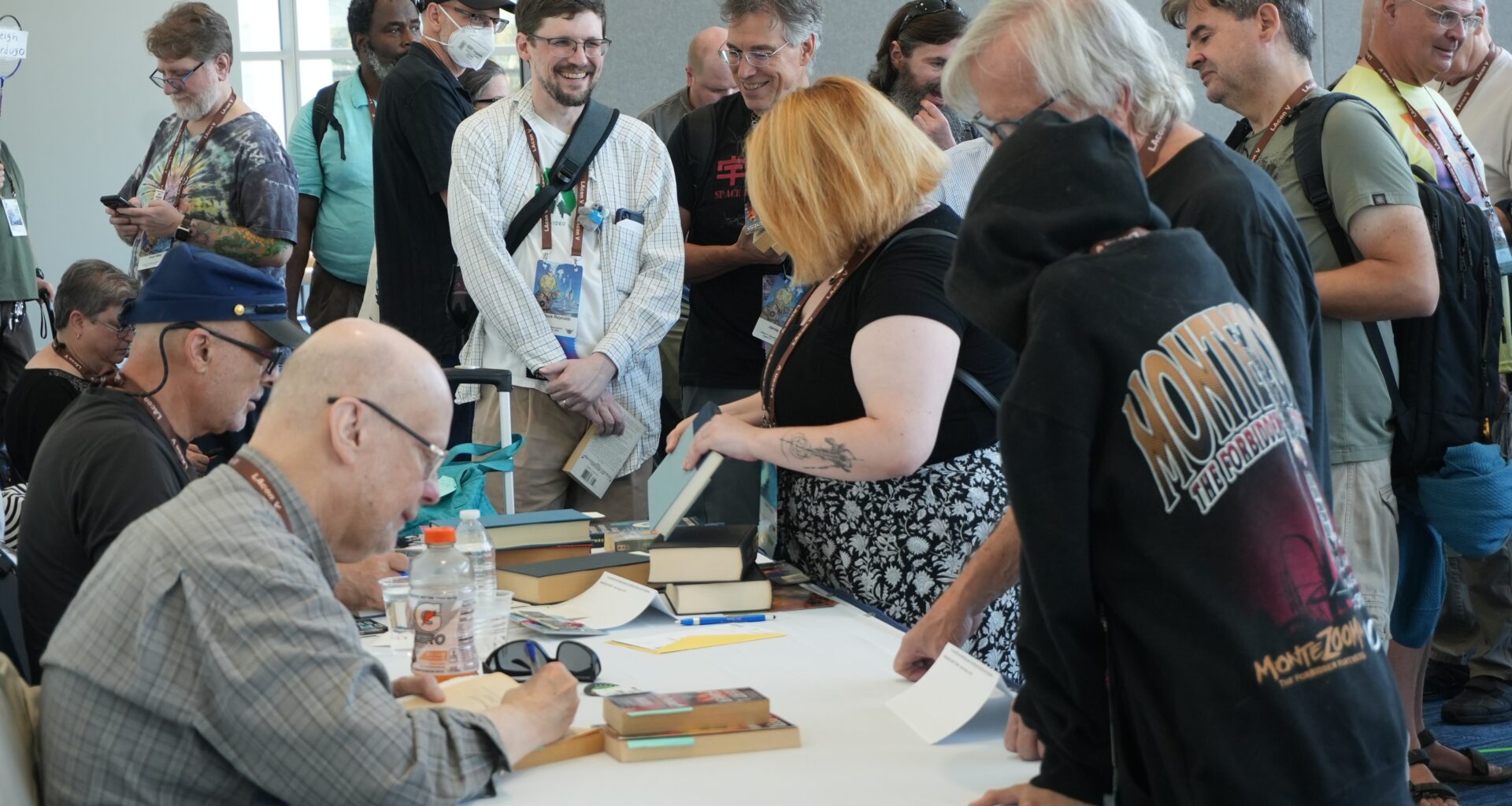
Thousands of science fiction and fantasy fans flocked to Anaheim for a week of panels, workshops and author signings.

The Worldcon expo featured a variety of bookish trinket shops, art exhibits and life-size science fiction models.

The Worldcon expo featured a variety of bookish trinket shops, art exhibits and life-size science fiction models.

Thousands of science fiction and fantasy fans flocked to Anaheim for a week of panels, workshops and author signings.

Dozens wait in line to get their books signed with author Robert J. Sawyer and others.
Show Caption
1 of 9
Fans arrived to the Convention Center wearing costumes and science fiction-inspired outfits. Author Jasmine Kuliasha poses in a Star Wars-themed dress made by a friend.
It was the first time in two decades that the convention landed in the city, and the five-day event included renowned authors, filmmakers, artists and fans — many of whom have been going for years.
“This is my family, the World Science Fiction Convention — wherever it is in the world, you’ll find me there,” author Robert J. Sawyer said.
Sawyer, of Toronto, is the author of 25 novels and has attended 36 Worldcons over the course of almost 50 years. A former president of the Science Fiction and Fantasy Writers Association, he has received numerous awards for his speculative fiction, including the Hugo and Nebula Awards — considered the most prestigious honors for science fiction and fantasy writing among the community.
For Sawyer, the convention was an opportunity to connect with friends new and old, who share his love for the genre.
“It is a family reunion for those of us who write science fiction, those who read science fiction and those who just like really interesting, geeky conversations about big ideas,” Sawyer said. “There are no gatekeepers here. This is the most welcoming, inclusive community you’re ever going to find.”
As one of the community’s earliest large-scale and mainstream events — the first convention took place in New York City in 1939 — Worldcon plays an important role not only in fostering global connections, but also in preserving the genre’s history, he added.
Beyond its celebration of fan culture, the convention also urges readers and artists to think critically about the world around them, Sawyer said.
“It is an important part of our dialogue about social issues, about where we’re going technologically (and) about what kind of future we want to make for ourselves, our children and their children,” he said. “Science fiction is the blueprint for a better future.”
Some of the community’s most-celebrated creatives also made an appearance.
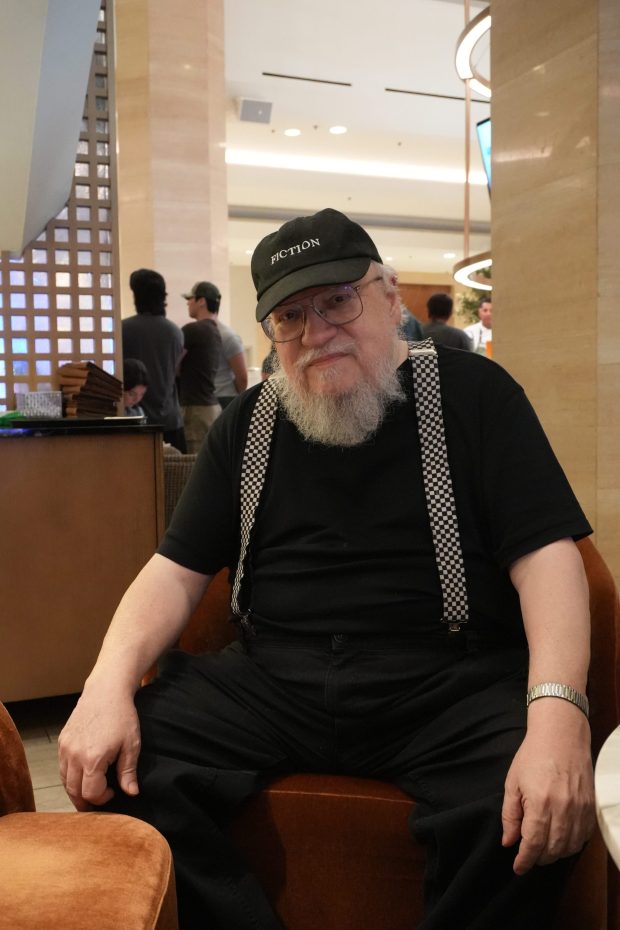 “Game of Thrones” author George R. R. Martin attended his first Worldcon in 1971. During the convention, he could be found at the Hilton bar, chatting with friends and fans.
“Game of Thrones” author George R. R. Martin held a signing Saturday afternoon; the following day, he spent time around the area, casually chatting with readers and friends. Martin attended his first Worldcon in 1971 in Boston, before he published his first novel. Fresh out of his graduate studies, Martin, then 22 years old, found a community of fellow comic book fans and genre enthusiasts.
Those early friendships fueled his love for the community, he said, and it’s what keeps him coming back.
“It was a transformative experience,” Martin said. “Worldcon is the heart of the science fiction fandom.”
Four years later, Martin won his first Hugo Award for his novella, “A Song for Lya,” which made him the award’s youngest winner — a record he held until Sunday night, when 25-year-old Los Angeles writer H. H. Pak took home the award for Best Novelette.
Martin has since sold more than 100 million copies of his “A Song of Ice and Fire” series, which have been adapted into the hit HBO television series “Game of Thrones.” Despite his rise to fame, Martin said he still values face-to-face connection with fans and fellow writers.
There were many opportunities for authors and their audiences to mingle. Throughout the convention, the hotel bar became a main source of camaraderie. Famous authors and fans alike crowded the area for what they jokingly referred to as “Barcon” after a long day of panels and programming.
Author Holly Black, best known for her young adult “Folk of the Air” fantasy series, said it was an opportunity for people to make unexpected friends.
“You get to hear people’s wisdom beyond panels,” Black said. “(My first time) it was such an amazing experience to see these people that I had thought of as very distant right there with me.”
Author Tim Powers, of San Bernardino, also spoke fondly of his earliest Worldcon experiences, where he met prolific authors such as Robert Silverberg, Fritz Leiber and A. E. van Vogt.
Powers, whose 1987 novel “On Stranger Tides” served as the basis for the “Pirates of the Caribbean” movie of the same name, said these gatherings keep fandom culture — a subculture among pop culture and entertainment fan communities — alive.
“All of us started as fans, and we’ve never entirely abandoned that category,” Powers said. “I owe a lot to the writers who came before.”
The convention culminated in its annual awards ceremony honoring the best-voted science fiction and fantasy media from the past year. Initiated in 1953, the Hugo Awards are considered the oldest and most prestigious recognition for science fiction and fantasy work, according to the convention’s chairperson Joyce Lloyd. They honor the traditional categories of Best Novel and Best Dramatic Presentation for television and film, as well as more niche categories such as Best Fanzine and Best Game or Interactive Work.
Hundreds of World Science Fiction Society members filled the convention arena Sunday night to honor the latest winners. The ceremony was hosted by author and illustrator Ursula Vernon, who writes under the name T. Kingfisher.
For short story finalist Isabel J. Kim, the Hugo Awards represented a meaningful celebration of many of her friends in the industry.
“Anyone could win it, and I would be like, ‘You deserved this,’” Kim said. “So much of the time we’re behind a computer screen typing, so to see so many people who love this genre — that they exist in reality — is special.”
Notable writers and artists, such as “Star Trek: The Next Generation” screenwriter Ronald D. Moore and graphic artist Stan Sakai, announced the categories. In their acceptance speeches, winners acknowledged the enduring strength of their community amidst rapidly evolving physical and social environments. They also praised the power of speculative fiction in facilitating dialogue on real-world issues and the importance of human-made art.
Among the winners were C. B. Lee, whose novel “Coffeeshop in an Alternate Universe” won the Lodestar Award for Best Young Adult Book; the team behind Apple TV’s “Murderbot: ‘All Systems Red,” which won for Best Dramatic Presentation, Short Form; and John Scalzi, who took home the trophy for Best Series.
The night concluded with its most anticipated award — Best Novel — which went to “The Everlasting” by Alix. E. Harrow, a fantasy time-loop novel about a scholar forced to rewrite his nation’s history. Canadian writer and Best Novella winner Amal El-Mohtar accepted the honor for Harrow, who was unable to attend.
“This is a moment when both love and stories are being systematically devalued, distorted, suppressed, stolen, banned,” El-Mohtar read from a speech written by Harrow. “I want to thank all of you for loving a love story in times like these.”