
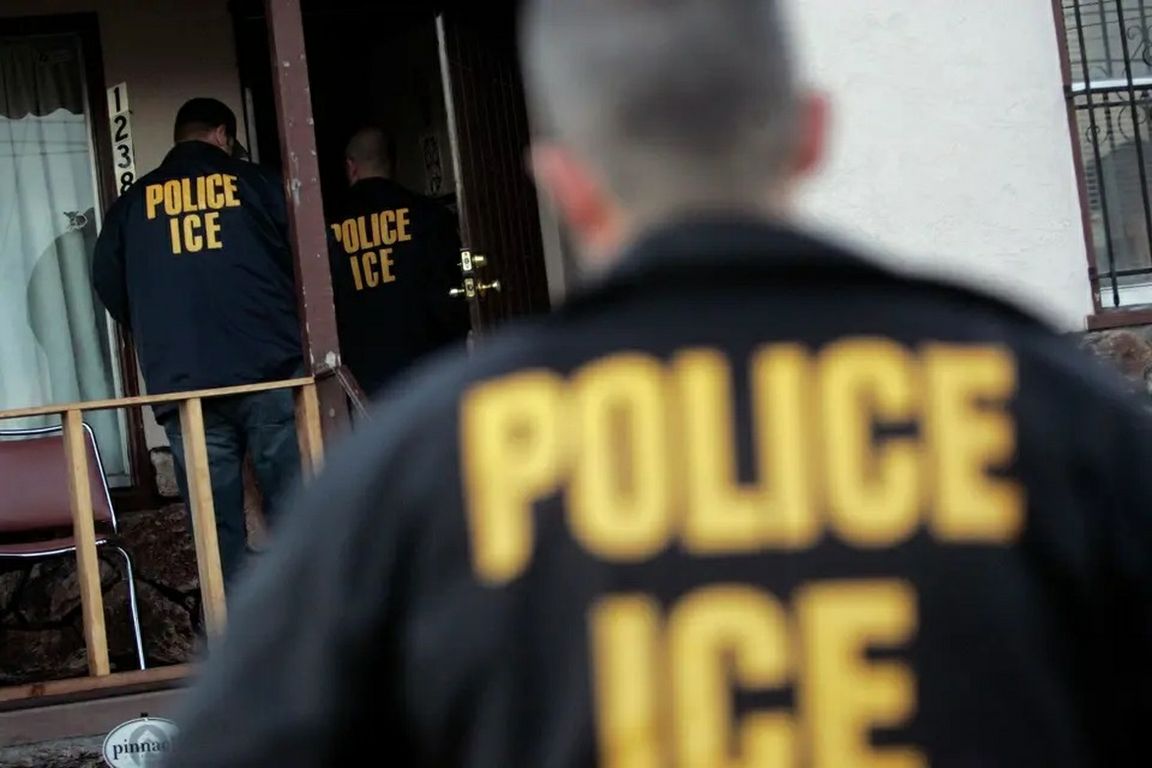
The San Francisco Chronicle reported on newly released data showing that ICE arrests are continuing at high levels across California — even as the agency has moved away from the high-profile raids seen last year. UCLA professor Paul Ong said the agency appears to be shifting toward arrests in places where agents can avoid public scrutiny, such as courthouses and farms, a strategy he believes may explain the recent uptick in arrests nationally and in Los Angeles. Ong also noted that recent changes to immigrants’ legal protections have expanded the number of people vulnerable to arrest and deportation. Read more about UCLA in today’s New York Times, BBC and others.
See our UCLA in the News daily archive.
More highlights from UCLA in the News: August 31, 2026
Meet the inaugural winner of Fat Marmot Week | NPR’s “Weekend Edition”
The Marmot Project has been researching these rodents since 1962. It’s one of the longest-running projects studying individually tagged mammals in the wild. “These long-term studies provide us the insights to understand how organisms, plants, animals, whatever, respond to a changing environment,” said Dan Blumstein, a professor at UCLA who runs the Marmot Project, in an interview with NPR’s Ayesha Rascoe earlier this month. (Also: CBS News and KABC-TV.)
LA couple has bears as neighbors who won’t stay out of the pool | BBC
There are more than 60,000 black bears living in California, says Wilson Sherman, a research fellow at the University of California, Los Angeles. Black bears are an increasingly common sight in LA suburbs. “They are really intelligent, adaptable omnivores. They eat everything and have learned how to gain calories in places where people live,” says Sherman, who studies how communities respond to black bears.
Data now shows unhoused people are far more likely to get sick in the heat | LAist
On Skid Row Los Angeles, UCLA physician Mary Marfisee has treated more and more patients with severe dehydration, heat rashes and heat exhaustion. Among the chronically unhoused, she said, addiction and mental health issues can also interact with heat in dangerous ways. (UCLA’s Dr. David Eisenman was also quoted but not attributed to UCLA.)
A housing alternative right in your own backyard | “CBS Sunday Morning”
“It’s had more impact than any other housing law in the last 10, 12 years … There are 82,000 building permits right now in California,” said UCLA’s Dana Cuff (approx. 1:55 mark).
LA social media trials put teen plaintiffs in uneasy spotlight | Bloomberg Law
For anyone, a trial is an ordeal, said UCLA [Jennifer Silvers, the Bernice Wenzel and Wendell Jeffrey Professor of Developmental Neuroscience]. But teenagers are still in a developmental stage where they may be especially concerned about their perception, she said.
Immigration enforcement leaves Latino businesses struggling for months | Marketplace
More than a year after immigration raids hit Los Angeles, small businesses — like food trucks, restaurants, and retail shops — are still hurting, according to Amada Armenta, director of the UCLA Latino Policy and Politics Institute. “Small business owners have not recovered and are really struggling, and the struggles include things like fewer customers, but they also include things like people taking on really enormous debt to keep their doors open,” she said.
This LA heatwave is hitting Latinos hardest | Los Angeles Times’s “De Los”
Last year, UCLA debuted a data tool called the Latino Climate and Health Dashboard, which tracks the environmental health disparities between Latino and white neighborhoods in Los Angeles. It revealed that Latino communities experience 23 more heat days that their white counterparts and have air quality that is twice as bad.
Heat is pushing older adults beyond the human body’s limits | The Mercury News
Lara Cushing, an associate professor of environmental health sciences at UCLA who was not involved with the research, called the analysis significant. She said the study illustrates a fundamental limit to society’s ability to respond to rising temperatures naturally.
This week’s heatwave broke records, but there’s relief in sight | LAist
Scientists say warming in the equatorial Pacific is one of the early impacts of this year’s El Niño. “It’s the confluence of this somewhat unusual weather pattern with these very unusual temperatures off the coast of Baja and Southern California, layered onto a warmer world,” said Alex Hall, a professor of atmospheric and oceanic sciences at UCLA. “That’s what’s making this such an extreme event.”
France’s wildfire nightmare echoes California’s hard lessons | Los Angeles Times
France has actually been “pretty hardcore” about slowing development in wildlands, but not every region is doing it well, said Paavo Monkkonen, a UCLA urban planning and public policy professor who in 2025 completed a fellowship in Paris. “It’s very depressing,” he said. “You go to these beautiful old cities — then you go outside in the suburbs, and it’s like, ‘Oh no, this just looks like a cuter version of Californian suburbs.’”
Rare cancer stalks children in this wealthy Orange County suburb | Los Angeles Times
One of the only studies that has found an association between environmental toxins and Ewing sarcoma cases looked at airborne chemical emissions from industrial sites across the U.S. … “While causality cannot be inferred, these findings support further investigation of environmental risk factors in Ewing sarcoma, particularly in high-emission geographic clusters,” the study, led by UCLA researchers, concluded.
A MAGA uproar ensued after a bill was given a Nick Shirley nickname | New York Times
But it is not clear what the threshold should be, and courts could ask how California has decided certain groups deserve a higher level of privacy. Eugene Volokh, a First Amendment scholar at the UCLA School of Law, thought the bill could be vulnerable to challenge for protecting one group over another.
California’s fight against Trump’s unhinged war on voting by mail | Los Angeles Times
“An executive order cannot supersede state law,” says UCLA law professor Rick Hasen, who specializes in election law. “But there are all kinds of immunity doctrines and other reasons why a state would have a hard time prosecuting a federal official for violating state law in the conduct of official duties.”
The latest on the conflict in Iran | KCAL-TV
“Let’s not mistake activity for movement. That’s basically what it is. It’s an ongoing war of attrition between both sides,” said UCLA’s Benjamin Radd.