
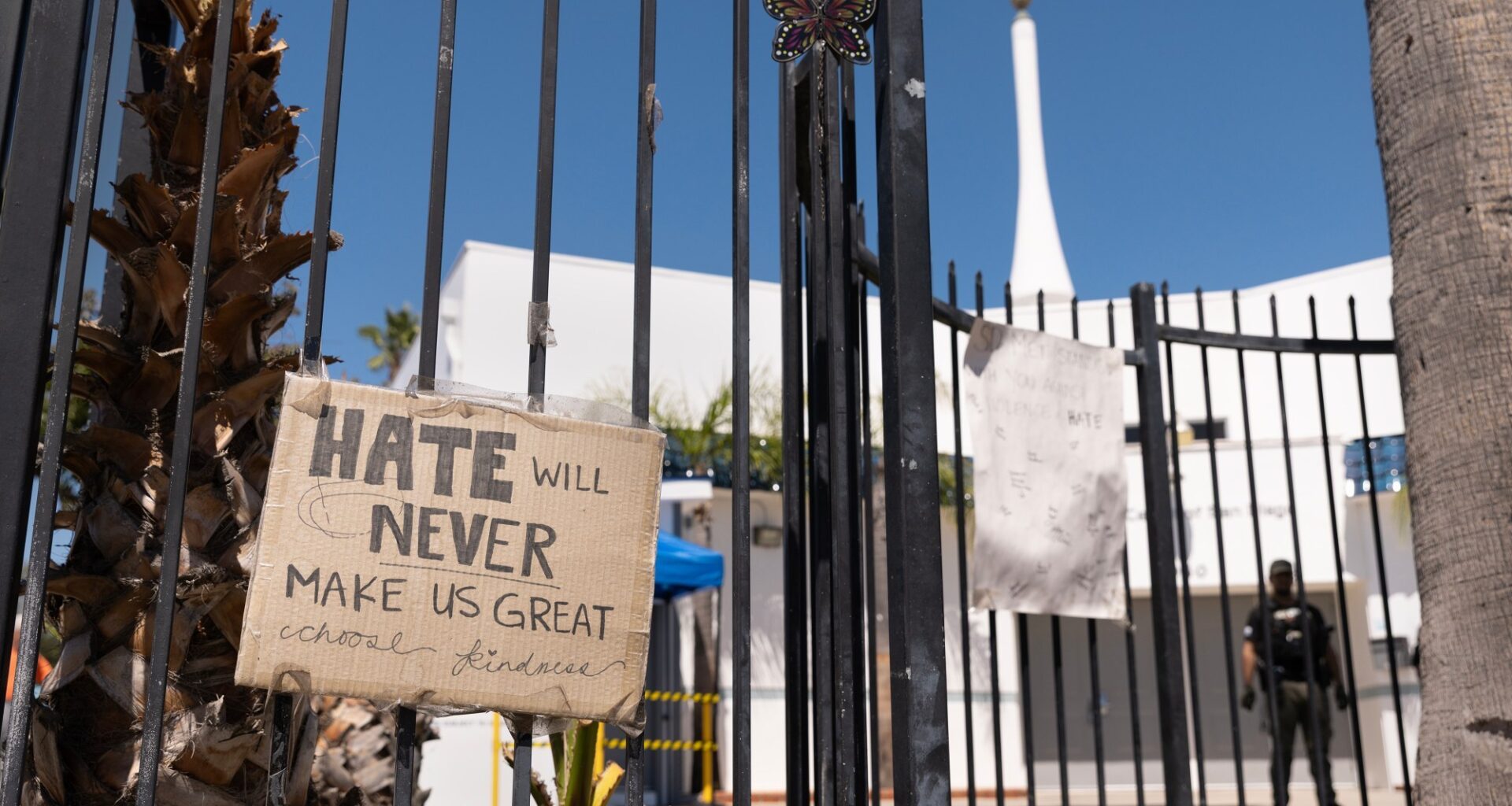
A North Carolina teen was charged Monday with murder and conspiracy, accused of aiding and abetting the two teenage gunmen behind the May shooting rampage at the Islamic Center of San Diego that left three men dead.
Officials said the girl, who turned 17 years old less than six weeks before the attack, helped by disseminating the livestream of the assault and releasing the manifesto the two teens had authored. The teen, identified in court documents as Sarah Lindsey Santiago, was arrested last week and indicted Monday. She is being charged as an adult in North Carolina state court.
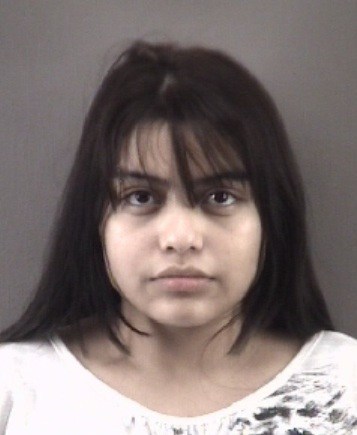 Sarah Santiago. (Winston-Salem Police Department)
On May 18, Cain Clark, 17, and Caleb Vazquez, 18, stormed the Clairemont mosque, killed three men, including a security guard who engaged in a gunbattle with them, then drove off. They fired a shot at a landscaper a few blocks over, then drove a little farther and killed themselves.
Investigators believe that the two teen boys — Clark lived in San Diego, Vazquez lived in Chula Vista — met online, where they were radicalized by hate. Both expressed broad hatred toward multiple groups in a manifesto they had written. Authorities recovered more than 30 firearms and tactical gear during searches of their homes.
Monday’s news conference in Winston-Salem, where the girl lives, included new details of the San Diego attack — including that the gunmen had planned to follow the mosque shooting by going to a nearby Jewish synagogue, then a high school, where they planned to target Black students.
“Cain and Vazquez, by what is contained in their manifesto, seem to hate everyone, regardless of skin color, politics, religion or ethnicity,” Forsyth County District Attorney Jim O’Neill told reporters. Winston-Salem is in Forsyth County.
Authorities did not name the synagogue at the news conference. However, the indictment identifies it as Kehilat Ariel Messianic Synagogue, which is less than 2 miles northwest of the Islamic Center. No one from the synagogue responded Monday to a request for comment.
Authorities likewise did not name the high school, and neither does the indictment. San Diego police also declined to identify the school. The synagogue sits roughly a half-mile from Madison High School. Clark, a senior, was loosely associated with Madison but not a student there; he attended an online school and had wrestled with Madison’s team for three years. Vazquez had graduated in 2025 from High Tech High in Chula Vista.
O’Neill said the teens wore GoPro helmets to livestream the attack. Investigators learned that three people were watching it, including a female. But all they knew about her initially was she was in the Eastern time zone.
O’Neill said the teen was arrested before a grand jury could indict her because, with the new school year approaching, “we didn’t know what she was capable of.”
The girl’s defense attorney, Alan Doorasamy Sr., confirmed he had been hired to represent her. “(A)t this time, I can confirm that my client is innocent of all these charges,” he said in a statement to the Union-Tribune.
He elaborated more fully in a statement to the New York Times: “This case is a major tragedy for the victims, their families, communities and America at large. This incident touches on major issues in the U.S., including youth and social media and mental health.”
“The world will soon know the facts that caused this major tragedy,” he added.
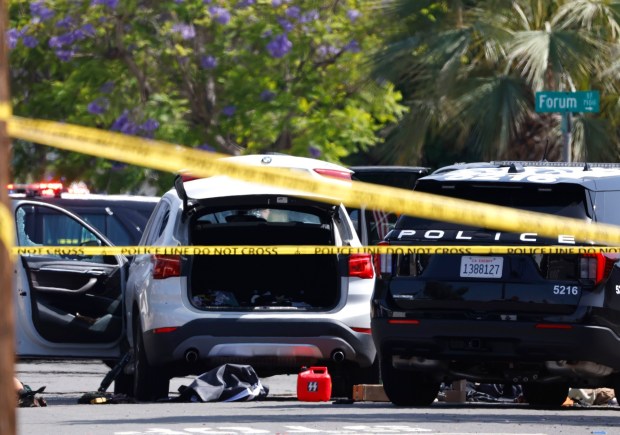 The vehicle of the suspects in the shooting at the Islamic Center of San Diego is seen on Hatton Street. (K.C. Alfred / The San Diego Union-Tribune)
O’Neill said that federal authorities evaluated whether to prosecute Santiago, but under federal law she was looking at maybe three or four years in prison if convicted, so officials approached his office about prosecuting under North Carolina law.
The online court docket indicates her first appearance in court was Friday. She was denied bond. Her next court appearance is set for Sept. 21.
The state law she is being charged under is “clear,” O’Neill said. “Although he or she personally does not do any of the acts necessary to constitute the crime, a person who aids and abets another to commit a crime is guilty of that crime,” he said.
FBI Charlotte Special Agent in Charge Reid Davis said the girl had “multiple opportunities” to alert authorities about the plan, and that failure to do so must have consequences.
“Too often in this age of technology, people attempt to disappear behind their keyboards and their screens. You’re still responsible for what you do,” Davis said.
The indictment also alleges the teen girl bought a patch bearing a Nazi symbol and sent it to one of the teens, who wore it during the attack.
O’Neill said the evidence shows the San Diego County teens’ “purpose and plan” that day was twofold: “Number one was to kill as many people possible on that day. And secondly, they wanted this — their carnage and destruction — recorded, livestreamed and disseminated out.” He said the teens had communicated using the online messaging platform Signal.
Killed in the attack were Nadir Awad, 57, husband of a teacher at the mosque’s school and a neighbor who ran to help after hearing gunshots; Mansour Kaziha, 78, a founder and caretaker at the mosque; and Amin Abdullah, 51, a security guard at the mosque.
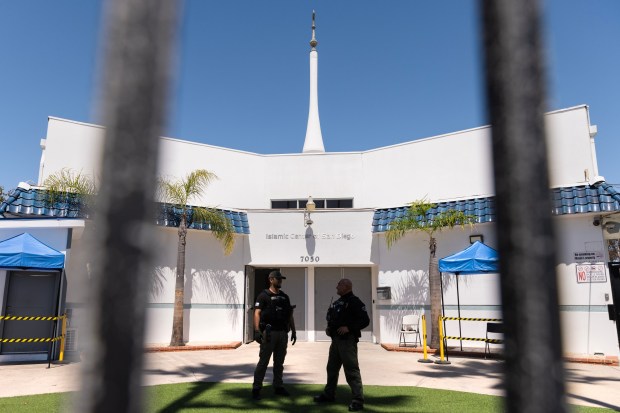 Security guards stand in the front of the Islamic Center of San Diego on Monday. (Luke Johnson / The San Diego Union-Tribune)
When the teens pulled up and walked inside the facility, Abdullah opened fire and engaged them in a gunbattle. He also alerted the school to go on lockdown — an action that authorities said saved lives. There were 140 people, most of them schoolchildren, at the site when the teens opened fire.
Abdullah got off a shot that struck and wounded Clark, O’Neill said Monday, a detail not previously shared publicly.
After the attack at the mosque, the teens apparently headed south — not north toward the synagogue — and were found dead in their vehicle about a half-mile away from the mosque.
Imam Taha Hassane, the leader of the Islamic Center of San Diego, said law enforcement has stayed in touch with the mosque’s leadership since the shooting without revealing details of its investigation. He said investigators have assured him that they are going after “anyone who was part of this terrorist attack” and that he and the victims’ families welcomed the news of Santiago’s arrest Monday.
“We don’t believe the shooters acted on their own,” Hassane told the Union-Tribune. “We believe they were part of a network, a movement based on the ideology of White supremacy against immigrants, Muslims and refugees.”
Hassane said he hopes investigators go “as deep as possible to uncover the reality of what happened” and why, exactly, the shooters targeted the Islamic Center of San Diego.
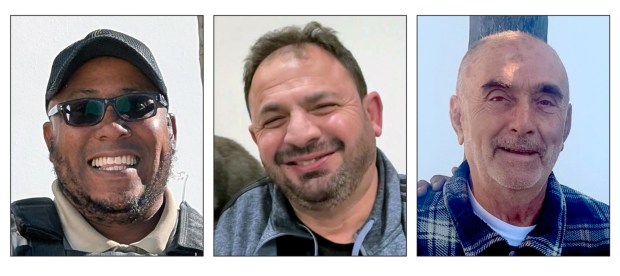 Amin Abdullah, Mansour Kaziha and Nadir Awad were shot and killed in an attack at the Islamic Center of San Diego on May 18, 2026. (San Diego Police Department)
San Diego police are investigating the killings as a hate crime.
Monday’s news was the first mention that the teens had connected with anyone outside the region.
Mark Remily, special agent in charge of the FBI’s San Diego field office, said in a statement that investigators, together with the FBI’s Joint Terrorism Task Force in San Diego, conducted more than 100 interviews, served upward of 30 search warrants and reviewed more than 4 million messages as part of the probe into the rampage.
Monday’s announcement is the first arrest in the case. San Diego is also part of the investigation, and on Monday, Police Chief Scott Wahl said the arrest is “a meaningful step toward justice for the three irreplaceable lives that were lost that day.”
The manifesto that circulated online repeats tropes and rails against a cross-section of groups — including religious, ethnic and LGBTQ+ communities —and cites neo-Nazi ideology. It praises mass shooters, and there are repeated references to a young man who opened fire at Chabad of Poway in 2019, killing one congregant and wounding three a month after he’d set fire at an Escondido mosque.
But it also contains personal grievances. Clark empathized with short men who tried but failed to find a girlfriend. Vazquez wrote of being bullied and of years of ridicule and rejection. He wrote that while it’s OK for girls to be short or shy, he is treated as “subhuman” or seen as “weird and awkward.”
More than a year before the shooting, officials at High Tech High reached out to police in that city in late January 2025 to report troubling behavior by Vazquez, including a fascination with mass killings, dressing like the fictional TV serial killer “Dexter,” and specifically because he’d told a friend not to go to school the next day. The then-high school senior was placed on a 72-hour involuntary hold for a mental health evaluation, feared to be a danger to himself or others. His parents voluntarily stored the family’s 26 guns with a licensed gun dealer.
Tazheen Nizam, executive director of the San Diego chapter of the Council on American-Islamic Relations, said she and other Muslim community members were unaware of the alleged connection between the North Carolina teen and the shooting until Monday’s announcement.
“It just reinforces one very important thing: that Islamophobia is such a public safety issue across the nation,” Nizam said. “Online hate, radicalization, threats, and real-world violence is what our community deals with.”
The National Council on American-Islamic Relations also issued a statement welcoming news of the indictment.
“Today’s indictment is an important step toward ensuring that anyone who allegedly helped facilitate or support this horrific White supremacist attack on the Islamic Center of San Diego is held accountable,” said CAIR National Executive Director Nihad Awad.
Union-Tribune staff writer Caleb Lunetta contributed to this report.