
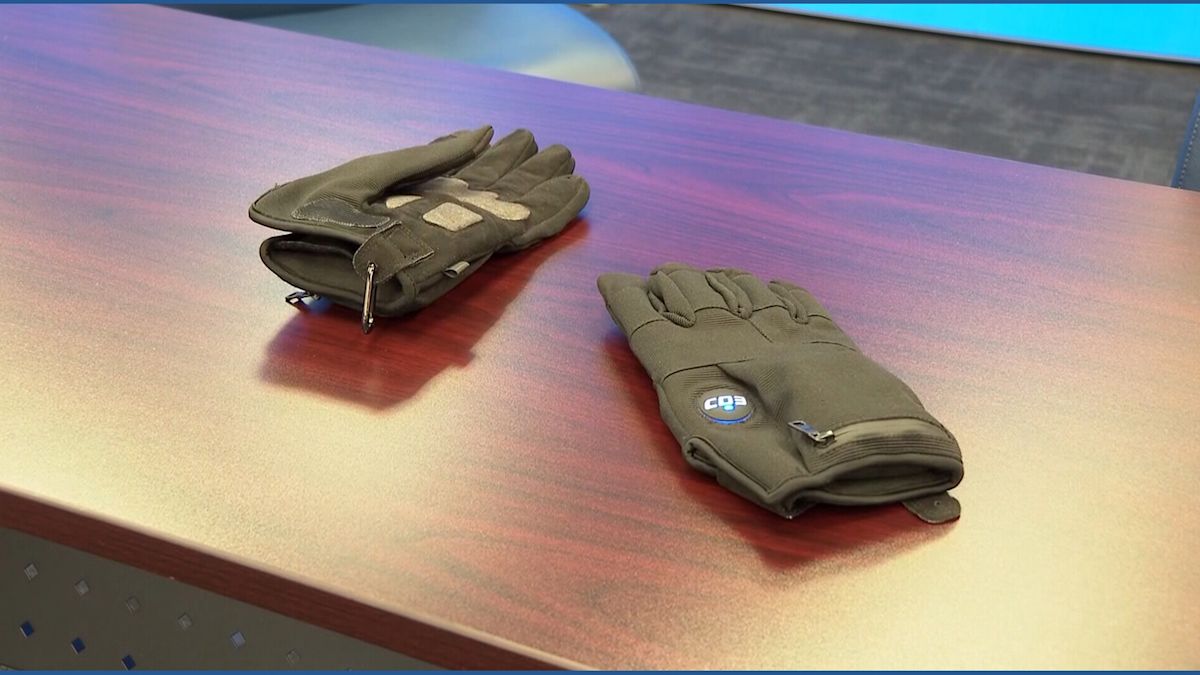
California lawmakers approved legislation Monday night that would temporarily ban state and local law enforcement agencies from using electroshock devices — known as “shock gloves” — and require a state study of their safety and community impacts.
Assembly Bill 2760, authored by Democratic Assemblymember Dr. LaShae Sharp-Collins, now heads to Gov. Gavin Newsom’s desk for consideration. If signed, the measure will ban the gloves until at least Jan. 1, 2030.
In addition to prohibiting state and local law enforcement agencies from using “shock gloves” in the state, it also would ban state and local agencies from spending state funds to buy the devices and require agencies to update use-of-force policies.
The bill was revised before its final passage to make clear that it does not apply to conventional tasers, stun guns or similar weapon designed to be held like a pistol and temporarily incapacitate someone through a controlled electric shock.
Supporters have raised concerns about the damage “shock gloves” can do at close range during physical encounters, as well as the lack of clear statewide standards governing their deployment, training and oversight.
On Monday night, Democratic Assemblymember Rhodesia Ransom spoke on the Assembly floor in support of the measure, saying, “This is not something we can just step aside and wait for people to die on our streets.” Ransom said the devices are not broadly used or advertised within the public safety system and should be studied before they are adopted more widely.
The measure drew opposition from Republicans, including Assemblymember Carl DeMaio, who criticized the legislative process surrounding the bill. “This is a significant policy change. This is controversial,” DeMaio said. “To ram it through would suggest that you are not interested in study or input.”
The legislation was introduced earlier in August after a Department of Homeland Security memo revealed U.S. Immigration and Customs Enforcement could spend up to $20 million to purchase the devices.
The devices are formally called G.L.O.V.E., an acronym for “Generated Low Output Voltage Emitter.” According to Compliant Technologies, the veteran-owned company that manufactures the devices, the gloves are designed to deliver a conductive distraction upon contact with skin and can be used as a de-escalation tool.
The Department of Homeland Security has pushed back against this legislation, saying California cannot regulate federal law enforcement.
A spokesperson told ABC10 in August, in part, “ICE is constantly assessing the needs of our officers in the field to ensure they have the tools and equipment necessary to safely arrest and remove criminal illegal aliens from our country. Every decision is made with careful consideration and appropriately reviewed to ensure that any technology ICE utilizes is consistent with all applicable law enforcement policies and standards. Our officers are highly trained in de-escalation tactics and regularly receive ongoing use of force training.”
Sacramento County Sheriff Jim Cooper also opposes the bill, previously telling ABC10 its language could inadvertently prohibit traditional tasers while failing to specifically outlaw stun gloves.
Cooper said his department views the gloves as a lower level of force that could help officers achieve safer outcomes.
Following Assembly Bill 2760’s passage, the Sacramento County Sheriff’s Office provided the following statement to ABC10:
A lot of misinformation has come out on this topic. It’s unfortunate that this only became an issue once ICE purchased the G.L.O.V.E. In today’s political climate, anything associated with ICE immediately becomes radioactive. Unfortunately, the fallout won’t be felt by the federal government, it will be felt by local law enforcement officers who are losing a valuable compliance and de-escalation tool.
What somehow continues to be overlooked is that California cannot dictate the tools and tactics used by federal law enforcement. Just like the state’s mask restrictions, this legislation will have no effect on federal agencies. The unfortunate result is that local law enforcement officers will be negatively affected, while the federal agencies remain unaffected.