
This story first appeared on The LA Local.
Inglewood plans to break ground next month on a $287.5 million network of stadium shuttle buses that are slated to roll out in April 2028, linking the city’s stadiums to the Metro system just in time for the Olympics.
City officials hope the Inglewood Transit Connector — a pared-down version of the nearly $2 billion automated rail line that was first proposed in 2018 — will ease traffic pressure on locals and boost foot traffic for businesses in the city’s historic core.
Verona Burks, one of the owners of Little Belize Restaurant on Nutwood Street, thanked the city for working to improve the Market Street area.
Keep up with LAist.
If you’re enjoying this article, you’ll love our daily newsletter, The LA Report. Each weekday, catch up on the 5 most pressing stories to start your morning in 3 minutes or less.
“It has been a pleasure being there, watching it grow,” Burks said during the City Council meeting last week.
The shuttle network is designed to ferry visitors between the stadium and Metro K Line and C Line stations at the north and south ends of the city.
Four transit hubs will anchor the network with parking for cars and bikes along with drop-off points for rideshares. The four hubs include three on Market Street and one at Hawthorne Boulevard and 111th Street.

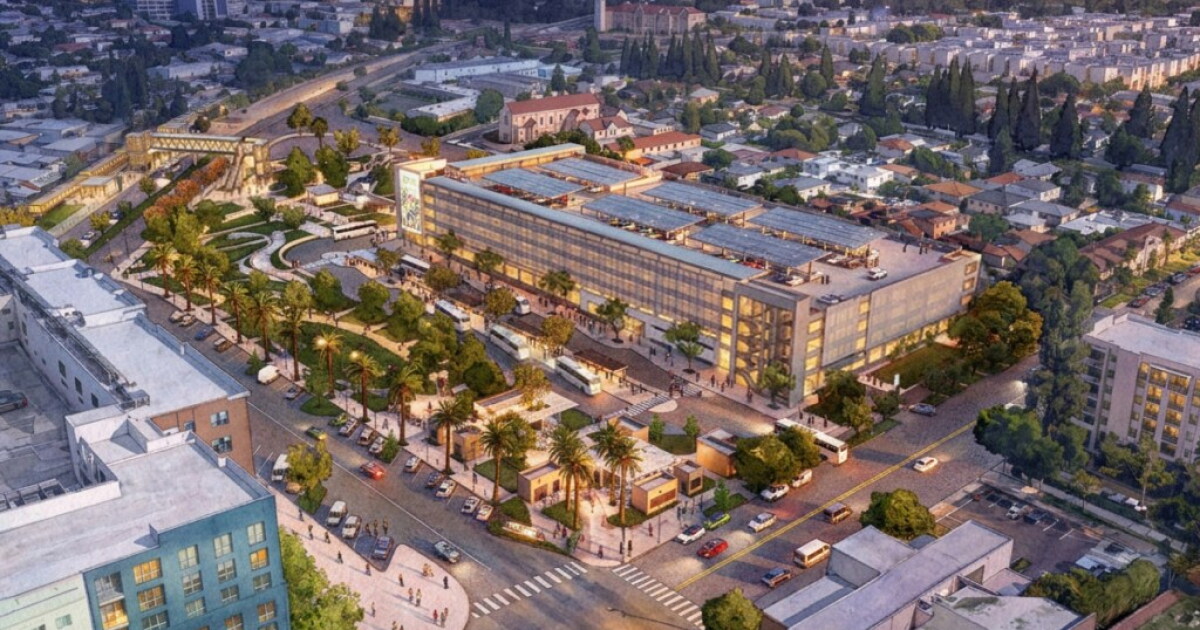
The Inglewood Transit Connector will link the Metro K and C Lines to Inglewood’s stadium district.
(
Courtesy Inglewood Transit Connector
)
The largest hub will cover nearly a full city block at the corner of Market Street and Florence Avenue. The intersection is currently home to a shopping center that the city is taking over and demolishing through eminent domain. Some business owners in the shopping center told The LA Local they weren’t ready to move.
Locals will see the largest changes along that Market Street corridor, where the city is also putting money into refreshing sidewalks, landscaping and storefronts.
Support the local news you rely on
LAist is free for everyone because listeners and readers like you choose to support it. Make a gift today to help fund independent journalism across Southern California.
Here’s what to expect from the project, according to the city.
Market Street and Florence Avenue hub: A pedestrian bridge across Florence Avenue will link the K Line’s Downtown Inglewood Metro Station to this transit hub, which will have a five-level parking structure with about 1,000 spaces and seven retail spaces between 90 and 270 square feet each. Market Street and Manchester Boulevard hub: This hub will get a new 38-space parking lot and serve for rideshare drop-off or other transportation functions. South Market Street and Hillcrest Boulevard hub: This hub will be focused on pedicab and bicycle services, and will have a reconfigured parking lot, refreshed lighting and landscaping. Manchester Boulevard sidewalks: Wider sidewalks along Manchester will connect Market Street with Prairie Avenue, the stretch of road that gets heavy pedestrian traffic on event days. Market Street and Queen Street streetscape: The corner of Market and Queen streets will get new sidewalks, seating, bike racks, landscaping and a shaded plaza.
The shuttle project layout leaves room for the city to revive its plan for a rail line in the future, if funding and needs align.
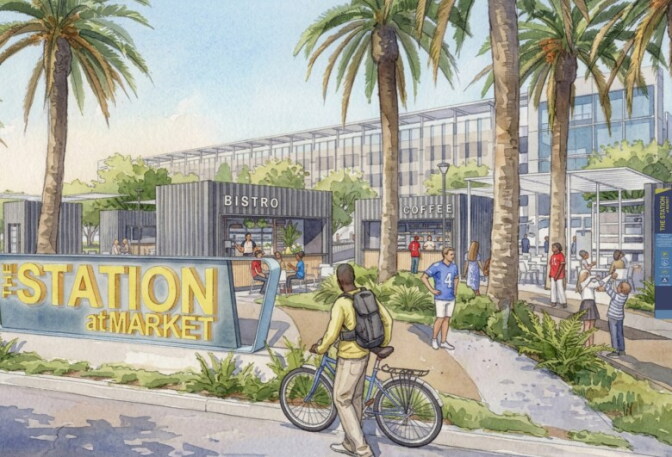
The largest hub of the Inglewood Transit Connector will be on the corner of Market Street and Florence Avenue in place of the current shopping center. The shuttle network will link the Metro K and C Lines to Inglewood’s stadium district.
(
Courtesy Inglewood Transit Connector
)
At Tuesday’s City Council meeting, Mayor James Butts said the transit network is the single largest project the city has undertaken itself.
“We’re building for opening day in 2028 and for every ordinary day after that,” Butts said. “We’ll have a new front door to Inglewood.”
All of the project’s budget is covered by a batch of state and local grants, according to the city.