
A century ago in 1926, “crowds of Berkeleyans were leaving the city this afternoon to take advantage of the Labor Day holidays at weekend resorts, the state fair and in the country, while other thousands were prepared to enter the East Bay cities from San Francisco in celebrating of Labor Day exercises.”
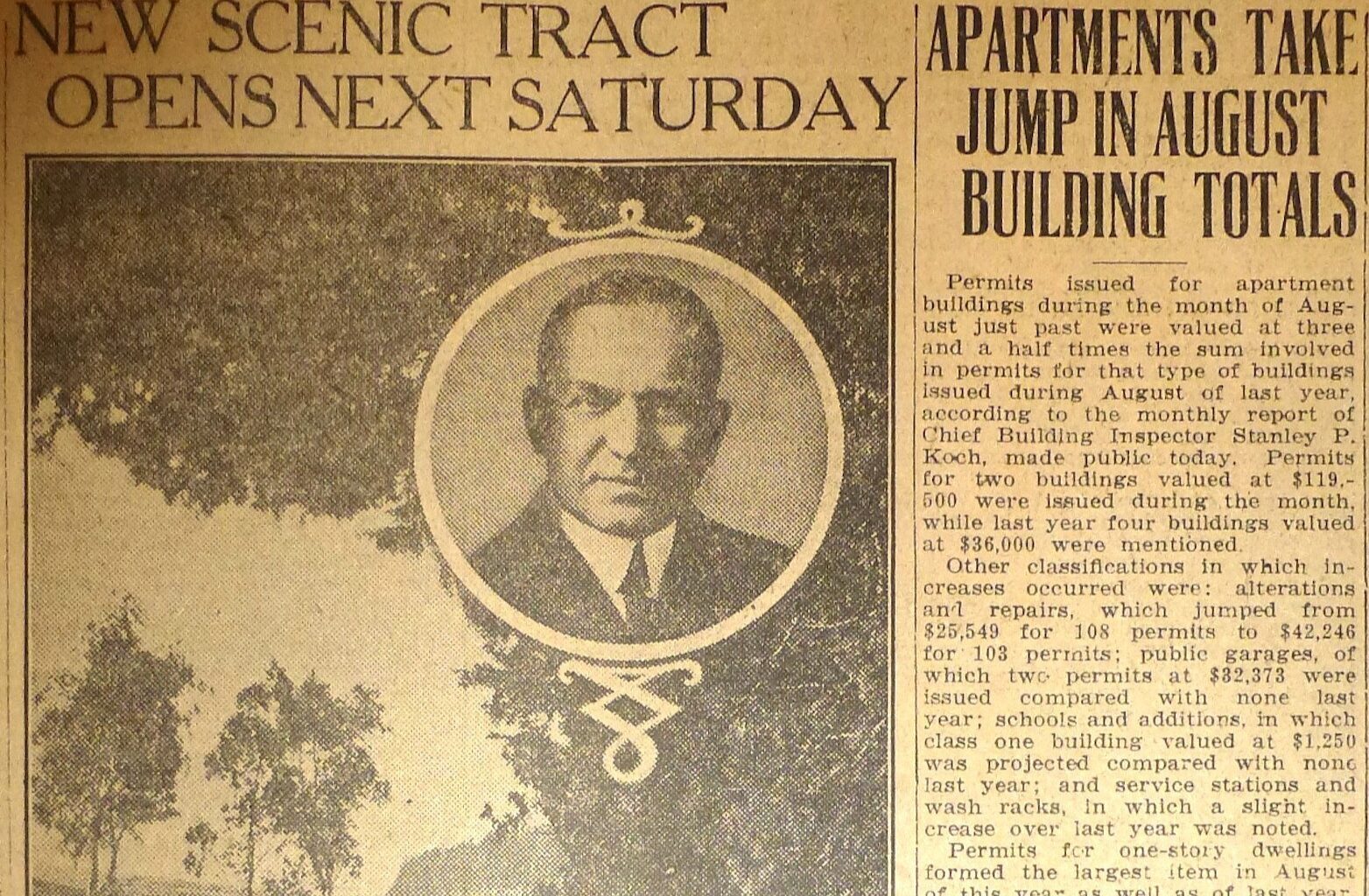
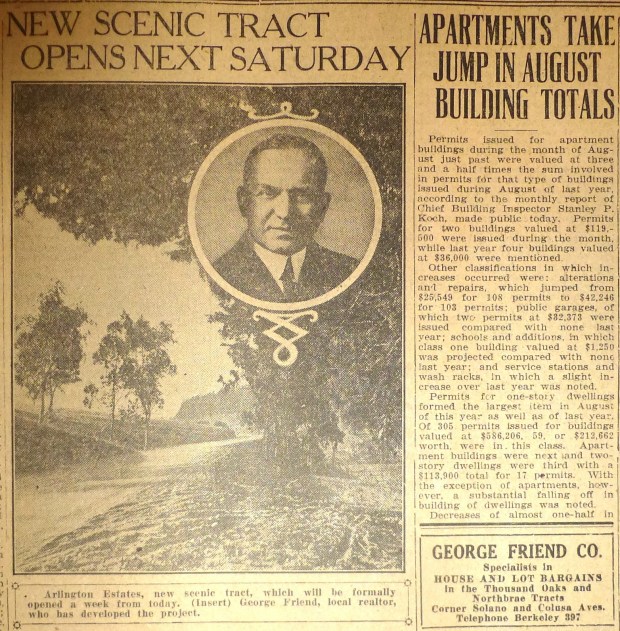 A Berkeley real estate agent had a publicity piece in the Sept. 4, 1926, Berkeley Daily Gazette promoting the city’s new “Arlington Estates” development. (photo courtesy of Berkeley Historical Society and Museum)

Some of those were taking advantage of a double holiday during the week. First, there was the Labor Day weekend, followed by a Thursday holiday celebrating California Admission Day, commemorating the state’sSept. 9, 1850, admission to the union. Banks and many businesses were closed both days, and they were also academic and administrative holidays on the UC Berkeley campus.
Berkeley held a Labor Day event in Harmon Gymnasium on the UC campus with the campus ROTC band providing music and speeches. Principal speaker Henry P. Boyen, a “San Francisco attorney and labor leader,” advocated for a November ballot issue that would provide the University of California with $6 million to modernize UC Berkeley’s campus and build the first structures of the new UCLA campus in the Westwood neighborhood of Los Angeles. Admission Day was celebrated with picnics for local groups at Lake Orinda, Hinkel Park and Thousand Oaks Park.
New subdivision: Berkeley real estate agent George Friend had a publicity piece in the Sept. 4, 1926, Berkeley Daily Gazette promoting “Arlington Estates,” a new development “along Arlington Avenue from the Thousand Oaks District out towards the Berkeley Country Club.”
A photo with the article showed a bucolic tree-lined country road through the “scenic tract.” Friend noted that it was just 12 minutes from downtown Berkeley and would have “rock-bordered macadamized drives following the contours in graceful curves and dividing the property into spacious blocks of villa sites.”
State election: The battle between two Berkeley men for leadership of the state government was over this week in 1926. C.C. Young had defeated incumbent Friend Richardson for the Republican nomination for governor and would later sweep to a massive November victory.
In Berkeley, Richardson had been the favorite among five candidates. In his “home precinct” around Allston and Milvia, the vote went 61 for him to 41 for Young, and 12 for the third-place finisher. In Young’s home precinct, Richardson prevailed 131 to 68.
Berkeley had a “heavy vote”, the Berkeley Gazette said, with eastern precincts including the Claremont, Thousand Oaks and North Berkeley neighborhoods in general going strongly for Richardson, West Berkeley precincts forming a “stronghold” for Young, and areas elsewhere in the city split, with several precincts registering a near-tie between candidates.
Archaeological finds: “Rare archaeological treasures unearthed by Dr. William Frederic Bade during his recent excavations at Telien-Nasbah north of Jerusalem where he discovered the Mispah of Benjamin have arrived at the Pacific School of Religion and are being unpacked today,” the Gazette reported Sept. 4, 1926.
Objects were quickly put on display in the hall of the administration building, including “more than 40 pieces of Bronze and Stone Age pottery, beads, rings and portions of a gold necklace, going back 5,000 years … .” They had been found in “three Bronze Age tombs, grain bins and nine cisterns, all containing rare objects.”
On Sept. 3, 1926, Professor Bade and his wife had “entertained a group of friends at the school for the first exhibition of his collection.” “In the chapel during the evening, Dr. Bade showed color stereopticon views of his excavations and the people at work.”
Court cases: August 1926, provided a “bumper crop” of cases in the municipal police court of Judge Robert Edgar, the Gazette reported Sept. 4 of that year. He had heard 701 cases “involving $3,668 in fees, fines and forfeitures of bail.” Of those, 564 cases were “for violations of traffic ordinances.”
Bay Area native and Berkeley community historian Steven Finacom holds this column’s copyright.