
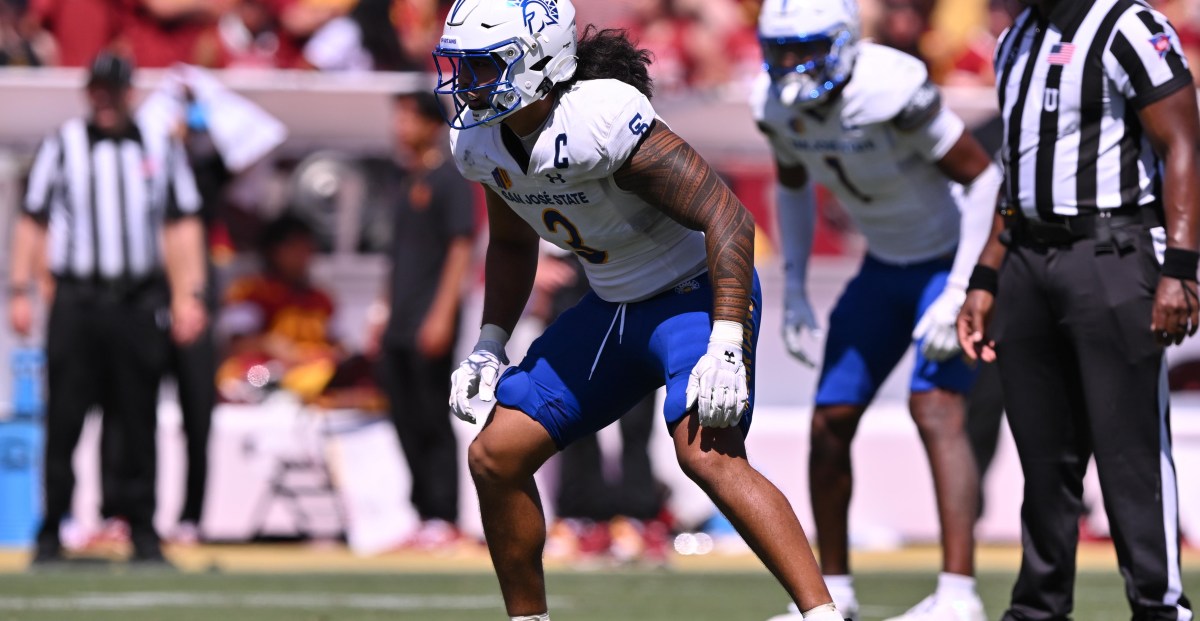
Almost every program outside the Power 4 builds its non-conference schedule the same way, one game up a level, one game at your level and one game down a level.
It’s not unique to San Jose State. Boise State does it. James Madison does it. Most of the Group of Six does it.
What makes the format worth covering isn’t about the Spartans specifically; it’s what these three games are supposed to tell a coaching staff and where that read breaks down.
SJSU’s opening slate: USC then Eastern Michigan then Cal Poly just happens to be a clean example of the pattern in real time.
A different animal in the trenches
San Jose State’s season opener answered one question fast.
USC is not a Mountain West problem and Ken Niumatalolo didn’t hedge on it after the 42-26 loss; calling the Trojans’ offensive and defensive lines a “different animal” from anything else on the schedule. The same words he reserved when his Spartans played Texas last season.
That’s not a knock on Eastern Michigan or anyone else SJSU plays this fall. It’s context. When Niumatalolo says a USC lineman makes more in revenue share than San Jose State’s entire roster, he’s not complaining. Niumatalolo’s setting the scale.
What SJSU actually walked away with matters more than the score.
Luke Weaver took over at quarterback and didn’t turn the ball over; going the distance without an interception or a fumble while completing his rookie start with the kind of poise both coordinators kept circling back to.
OC Craig Stutzmann pointed to the offensive line holding up through 30-plus dropbacks against a USC front stacked with future NFL players. Defensively, DC Bojay Filimoeatu was blunter about his own unit, saying flatly that Saturday “wasn’t our best performance” and that includes his own game planning in his first Saturday as a full-time coordinator.
2,400 miles away this Friday in the city of Ypsilanti comes Eastern Michigan, a MAC team San Jose State treats as the closest thing to conference-caliber competition outside the Mountain West.
Niumatalolo’s scouting language on the Eagles sounded almost identical to how he talks about his own league: well-coached, physical, tough kids who won’t be fooled. Niumatalolo drew the comparison to Central Michigan a year ago; another MAC opponent that gave the Spartans a real look at grinding, gap-sound football.
The short week also complicates it.
SJSU plays Saturday to Friday with a cross-country flight in between; a scheduling quirk both coordinators addressed as a logistics problem more than a talent gap. Filimoeatu leaned on sleep and recovery over scheme installs. Stutzmann called the compressed week a hidden advantage, since there’s no time for players to overthink a simple game plan.
Eastern Michigan carries real confidence off a win over Sacramento State and Niumatalolo made a point of warning his team not to look past a program like EMU and they won’t.
Cal Poly and the illusion of easy
Week three brings Cal Poly at home, an FCS opponent and, on paper, the softest matchup of San Jose State’s non-conference slate, but certainly don’t say that to Niumatalolo.
It’s also the game most likely to get treated as a formality, which is exactly the trap Niumatalolo warned about in a different context this week. His message about Eastern Michigan doubles as his message for any “lower-tier” opponent: respect it or get embarrassed by it.
EMU just watched its MAC team beat the Hornets in its first year in the MAC by two scores and even the Eagles must know these results don’t always translate cleanly.
What three tiers actually measure
Stack the three together and you get a rough gauge of where a team sits, not just SJSU.
The high-tier game tells you what elite size and speed look like and how your line holds up against it.
The medium-tier game tells you how you handle a team built the way most of your own conference is built; physical, disciplined and confident; the kind of team you’ll see nine more times before December.
The low-tier game tells you whether a talent gap on paper shows up in execution or gets squandered by complacency.
Win or lose, how a roster performs across that spread should preview how the conference slate goes, from the ground game to red zone execution to whether a short week or a long flight throws the operation off.
For SJSU, that means USC as the ceiling test, Eastern Michigan as the conference-caliber test and Cal Poly as the discipline test — three data points before a single Mountain West snap is played.
None of that makes a tiered non-conference stretch a perfect crystal ball for any program.
Teams change week to week. Injuries hit. A quarterback who looks unshakeable against a blue blood can look different against a mid-major defense that’s seen his tape three times. A team that struggles with a supposedly lesser opponent in September isn’t automatically the team that shows up in November.
Stutzmann summed up the only metric that survives contact with a 13-game season, regardless of who’s on the schedule; score one more point than the other team. Everything else, tier of opponent included, is context for a story, not a verdict on one.