
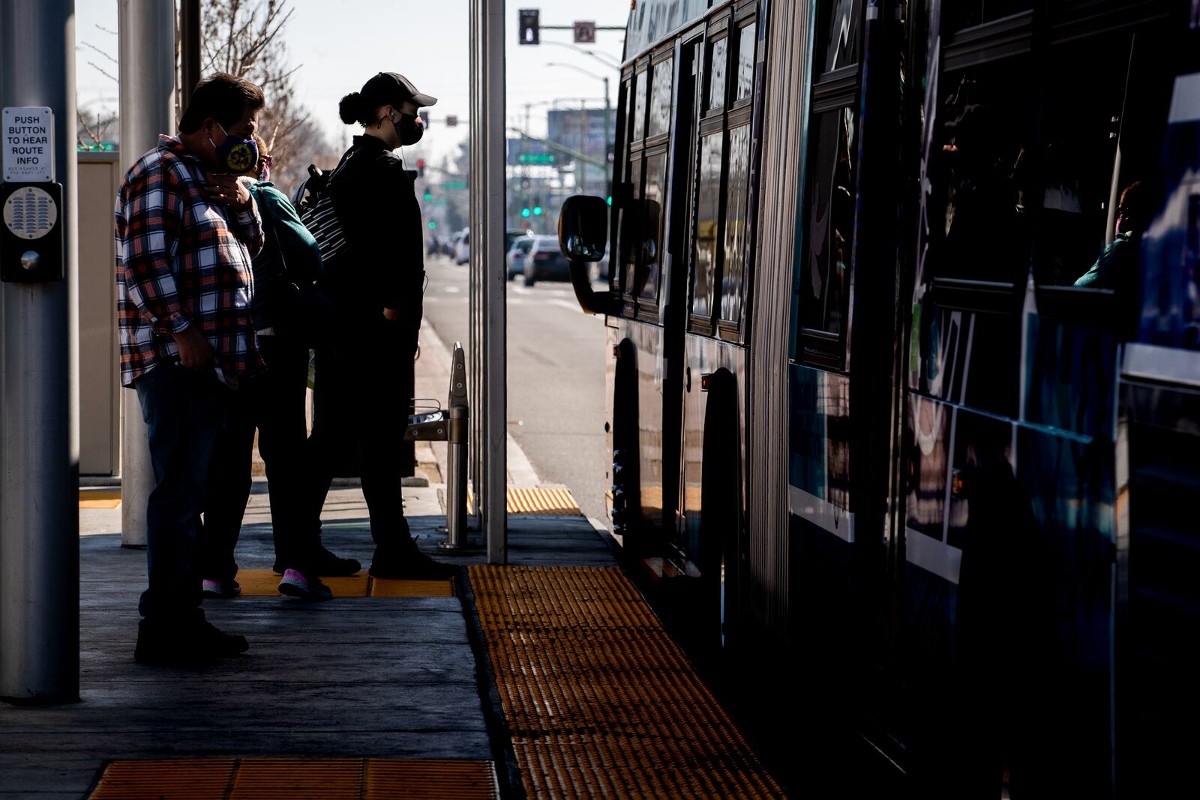
Six years after its launch, AC Transit’s controversial TEMPO rapid-transit bus has become a critical part of Oakland’s transportation network, carrying an average of 15,500 people each weekday on its route from San Leandro to downtown Oakland, mostly across International Boulevard.
The express line costs about $23 million a year to operate, and according to the agency, about a third of that cost has been covered by state cap-and-trade funds. Thanks to a recent move by a state environmental board, that funding stream is now at risk.
The change has sparked intense pushback from advocates and state legislators, including Rep. Buffy Wicks, who represents parts of Oakland. In the face of that pressure, Gov. Gavin Newsom has agreed to backfill the lost funds for the 2027-2028 fiscal year, postponing the crisis.
The cap-and-trade program, now known as Cap-and-Invest, charges energy companies subsidies for their carbon emissions above increasingly tight annual caps. It has brought in about $35 billion in revenue since the program began in 2013. This money has been used to pay for everything from infrastructure and maintenance of mass transit (such as BART’s purchase of new trains) to operational funds for transit agencies and housing development. Recent changes have substantially reduced those revenues.
The first major change came with the passage of Senate Bill 840 in 2025, which created tiers for allocating Cap-and-Invest funds, slightly reducing the dollars available to mass transit operators.
Then this year, the California Air Resources Board, which oversees the program, decided to grant energy companies an additional 118 million carbon permits from 2028 to 2035. The board said the change was necessary to encourage investment in electrification and renewables through the Manufacturing Decarbonization Incentive and prevent companies from taking their energy businesses elsewhere. They also said it would lead to $10 billion in electricity bill consumer credits.
The board made its decision in late May, after the state’s legislative analysis, released on May 6, found that the plan would reduce revenues by about $2 billion a year, starving statewide transit and affordable housing programs. For example, the Transit and Intercity Rail Capital Program, which funds rail, bus, and ferry services, would lose about $400 million a year, the analysis found, while the Low Carbon Transit Operations Program, which funds transit systems serving low-income communities, would lose about $200 million.
In the last fiscal year, AC Transit was awarded $7 million by the latter program to pay for TEMPO operations.
‘A major blow to California’s ability to fight climate change’
The Air Resources Board decision was applauded by some energy associations but immediately criticized by some elected officials and advocates as a giveaway to energy companies. The change, State Sen. Catherine Blakespear said, was especially galling as oil companies saw revenues explode this year amid spiking gas prices due to the U.S. war on Iran.
The California Transit Association, the California Federation of Labor Unions, and the Greenbelt Alliance were among those who opposed the change. Seamless Bay Area, an advocacy network, called the decision a “major blow to California’s ability to fight climate change and make the state a more affordable place to live.” In July, Californians for a Better Environment, a nonprofit, sued the Air Resources Board over what they saw as a “flawed environmental review” of the decision.
A group of state assemblymembers, including Wicks, wrote a letter on August 10 to Speaker Robert Rivas explaining their concern about the air board’s decision. They said it was expected to reduce proceeds to the Greenhouse Gas Reduction Fund by up to 50% and provide $4 billion in additional incentives to the state’s largest polluters, “gutting critical programs that help our state reach our climate goals and address affordability in our communities.”
“The Board acted in a manner that we consider contrary to our collective efforts to renew the Cap-and-Invest program in 2025, and to our larger work to keep California on track to meet our climate goals as equitably and quickly as possible,” the legislators said.
An additional analysis by the California Department of Finance projected a $900 million annual reduction in total Cap-and-Invest revenue and an 82% cut in funding from the program for transit operations programs in the 2026-27 fiscal year. According to the analysis, annual Cap-and-Invest revenue directed to transit operations, which had averaged $144 million since the program’s inception, would drop to about $38 million.
Gov. Newsom, responding to the pushback, approved additional general funds last week for transportation, climate, and environmental justice programs, including $160 million for the Low Carbon Transit Operations Program, which supports Oakland’s TEMPO line operations.
A coalition of transit organizations sent Newsom a letter last week thanking him for the decision. They noted that the transit operations program had resulted in the implementation of 1,123 projects statewide over its history and had led to a reduction of 7.4 million metric tons of carbon dioxide equivalent, a traditional greenhouse gas metric that measures carbon dioxide along with other emissions such as methane and nitrous oxide.
The state’s backfill money means that AC Transit and other agencies that depend on Cap-and-Invest money won’t face a major shortfall this year or next. Robert Lyles, the agency’s communications director, told The Oaklandside that the new funds provide “some important breathing room as we continue navigating significant financial challenges,” including a projected $200 million structural deficit over the next four years.
“Without long-term, sustainable funding, service cuts and layoffs could become necessary,” he said.
And the loss of the Cap-and-Invest revenue will hurt over the long term.
‘A $2 billion hole in funding transit‘
Carter Lavin, advocacy director of the Transbay Coalition, a group that works for improved transit and safe streets in Oakland and other Bay Area cities, said that while Wicks contributed to the effective pressure campaign, Oakland’s other state rep, Mia Bonta, stayed on the sidelines
“Oakland depends on transit, and these cuts from Sacramento are going to hurt our community,” Lavin told The Oaklandside yesterday. “Right now the future of our bus, BART and paratransit service is at stake. We need action and leadership from Assemblymember Bonta in Sacramento and in the district supporting the regional transit measure — not silence.” Bonta did not immediately respond to a request for comment.
Lavin and other advocates have personally been out in the streets in the last few months to gather signatures for the Bay Area Regional Measure, a November ballot measure that, if passed, would add a half-cent sales tax in Alameda County and other local jurisdictions to create a $14 billion fund to help pay for regional mass transit. Many transit advocates, including volunteers with Streets for All, also recently traveled to Sacramento to protest the air board’s decision. Transbay Coalition volunteers also created a spreadsheet showing how much money the state’s Low Carbon Transit Operations Program has awarded to projects statewide this decade.
AC Transit’s Lyles told us that if the agency loses operational funding from Cap-and-Invest, it doesn’t mean TEMPO’s bus service will automatically be reduced, as any decision would be part of a broader budget discussion. “Any decisions about how to address that funding gap would be considered through that larger budget process,” he said.
Sarah Syed, an AC Transit board director representing Ward 3, which includes parts of Oakland, had harsh words for the California Air Resources Board, which, she said, “caved to the oil industry” with its May decision and “blew a $2 billion hole in funding transit riders were already promised.”
“This budget doesn’t fix that,” she said of the legislature’s backfill funding. “It barely dents it. The programs that pay for new buses and trains, and keep the ones we’ve got running, are still stuck at about a quarter of what was promised. I’m not going to pretend that’s progress. Transit riders, low-income families, and frontline communities are paying so the state can protect oil company profits.”
“*” indicates required fields