
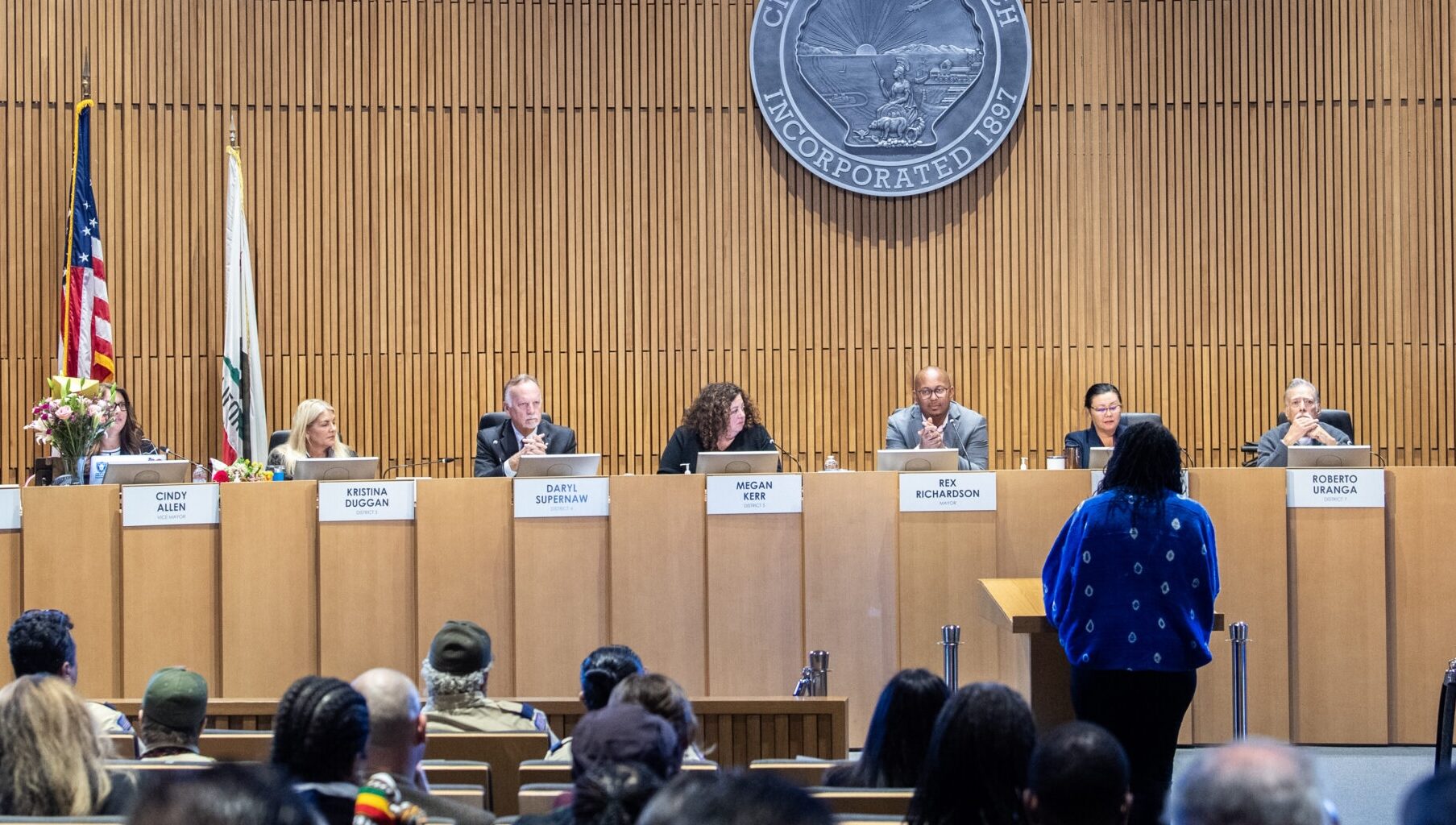
The Long Beach City Council wants to limit how many times members of the public can speak at their meetings despite unanimous opposition from dozens of constituents who wrote in and showed up in person to voice their disapproval.
In a 7-to-2 vote, with Councilmembers Kristina Duggan and Cindy Allen dissenting, the council is advancing plans to consolidate its public comment periods, currently spread throughout each meeting, into one block at the beginning. The measure still requires final approval from the City Council before it can take effect.
Under the current rules, people have multiple opportunities to give public comment. The first is after the roll call, ceremonies and presentations, where people can speak about anything they want. Other periods to speak on specific agenda topics are parsed out throughout the meeting during the consent agenda, regular agenda and public hearings. A second general public comment period is held near the meeting’s end. Rules allot speakers time limits depending on the number of those signed up for each period: three minutes for 10 or fewer, 90 seconds for 11 to 20 people, and 60 seconds each if there are 21 or more people signed up.
In the newly proposed rules, almost all of the public comment periods would be condensed into a single such period at the start of the meeting that could be capped at 90 minutes. Anyone hoping to address council members on agenda items like staff reports, contracts, resolutions, appointments and specific items brought forward by the City Manager or a council office would have to sign up to speak during this period.
The exception would be public hearing items, which are things like zoning and land use, ordinances, certain budget or tax items, and appeals of planning commission or other body decisions. Those would still have their own dedicated public comment periods, ranging from 60 to 90 seconds depending on if there are more or fewer than 10 speakers.
City leaders framed the overhaul as a matter of fiscal necessity, tied to the rollout of Senate Bill 707, a state law that took effect July 1 and requires cities to offer live, call-in public comment during meetings.
Monique De La Garza, the city clerk, said implementing the law will cost the city roughly $487,000 this fiscal year — about $150,000 more than what was budgeted, largely because of overtime pay for staff who stay late on meeting nights, including Khmer and Spanish interpreters and a call center team that manages the Zoom line. “That is a huge amount of overtime throughout the fiscal year,” she told the council.
Adopting the ordinance before Oct. 1, council members argued in the letter, would free up about $150,000 that could be spent on “vital community priorities, such as Quality of Life [police] officers and expanded library services.”
But opponents argued it was a thinly veiled attempt to limit their voice rather than a genuine cost-saving measure.
“[It] is nothing but a sneaky, underhand attempt to stifle and limit discussion, and I profoundly object to this,” said Stuart Callaway, who was among the dozens of people who showed up during public comment to oppose the measure. “You and the city departments make long, self-congratulatory presentations that we all sit through patiently, and now you want to deny our right to question those presentations when they are made.”
The Long Beach City Council posts its agendas here, where you can read upcoming proposals, submit written comments and see call-in to meetings.
Ian Patton, with the government watchdog group Long Beach Reform Coalition, pointed out council members rejected a similar push to restructure public comment in June after it faced seemingly unanimous public opposition.
He called the roughly $150,000 budget gap driving the change accounted for “less than 500ths of 1 percent of the general fund.” The money would not be enough to pay for a single police officer.
Resident Amanda Ford argued the changes ran counter to the spirit of both the Brown Act, California’s open-meetings law, and Senate Bill 707 itself. “It spits in the face of SB 707 and the entire Brown Act,” she said.
Several residents also complained they routinely wait days or weeks for responses from city staff on basic matters like street repairs, a grievance they said made the loss of comment time — an opportunity to make sure they are heard — feel especially unfair.
Mayor Rex Richardson defended the change, drawing on his own experience representing a North Long Beach district whose residents found it difficult to organize against city decisions when they had to show up to the meeting early and then wait hours for their turn to speak.
“Having a dedicated time certain for public comment, some families would certainly appreciate that,” he said.
Councilmember Megan Kerr agreed to pass the motion on the condition that the rules allow, at the meeting chair’s discretion, to add 30 minutes to public comment if there are more speakers waiting past the normal 90-minute period.
Councilmember Cindy Allen opposed the item, saying it would inevitably cut down the average time each person can speak, looking at past meetings that have had dozens of speakers across all comment periods.
“I can’t imagine we’re going to have a council meeting where there’s not at least ten people showing up to speak,” Allen said. “Let’s say, for instance, they have three items they want to speak on … that gives them thirty seconds to speak on each item… That means residents will not be able to speak specifically on the items of their choice, and they won’t be able to elaborate on their choice.”
Her frustrations extended to how the city provides staff presentations and updated materials on agenda items, she said, saying they sometimes do not reach the public until the Monday before a Tuesday meeting, leaving little room for residents to study it before the start of the session.
City Manager Tom Modica pushed back on concerns about late materials, saying staff now post nearly every presentation by Friday and rarely make changes afterward beyond fixing typos.