
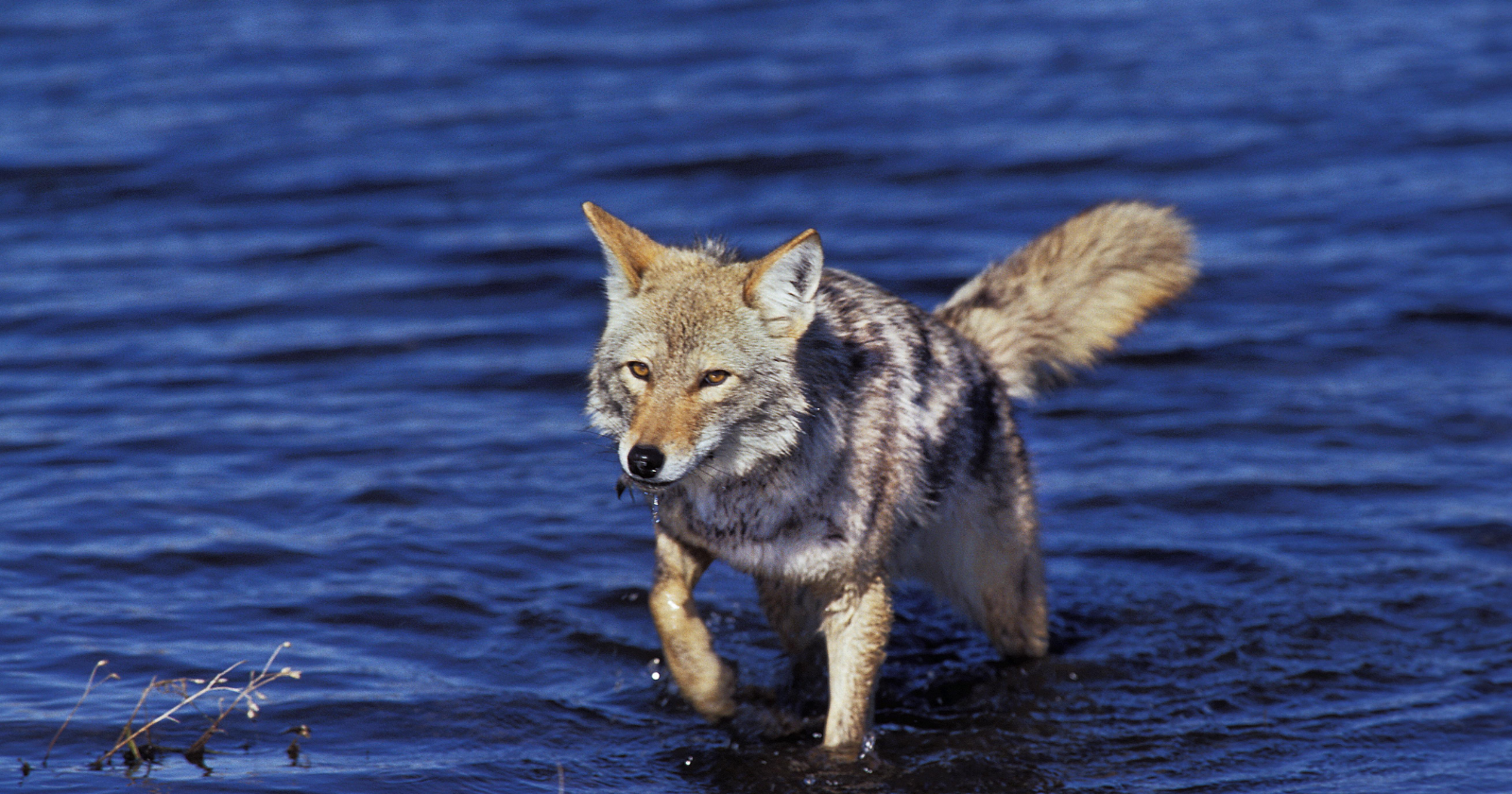
Alcatraz was built on the assumption that its water would do the guarding. Cold, fast and mean enough that, per Associated Press reporting on the island’s history, 36 men attempted 14 escapes and nearly all were caught or didn’t survive the crossing. In late January, a coyote swam the other way, hauled himself onto the rocks, and had a look around.
A visitor named Rebecca Husson photographed him on 24 January during a morning tour of the island. She told the Associated Press he had looked like a drowned rat on arrival, and that by the time her family spotted him he seemed healthy and well fed.
Park biologists moved fast. Staff surveyed the island for tracks, bolted up trail cameras and audio recorders, and bagged whatever the animal had left behind.
What the droppings gave away
Coyote scat carries enough intact cellular material to identify an individual animal, which is why samples from Alcatraz went to the Mammalian Ecology and Conservation Unit at the UC Davis Veterinary Genetics Laboratory. Results confirmed a male, and then delivered the part nobody had ordered.
Geneticist Ben Sacks, quoted in a National Park Service news release, said three populations were in the frame: San Francisco, Southern Marin and Angel Island. His lab matched the sample to a coyote previously sampled on Angel Island.
San Francisco sits a little over a mile from Alcatraz. Angel Island sits about two.
Twice the distance biologists had assumed
“We are surprised by the coyote’s origin,” park service wildlife ecologist Bill Merkle said in the release, adding that the shorter crossing from the city had been the working assumption all along and that the animal’s feat was hard not to admire.
A scat sample can place an animal in a population. It cannot draw his route on a chart. Nobody watched the whole crossing, so a two-mile swim from Angel Island is the likeliest reading of a single sample from a single animal, and UC Davis’s own account of the case is careful to say the same thing: he likely started there.
Camilla Fox, who founded the nonprofit Project Coyote, said in the same Associated Press report that coyotes swim readily but are almost never seen doing it, and that nothing in her experience matched a journey of this length through that kind of current. Her guess on motive is the boring, universal one: a young male looking for territory or a mate.
Everyone on Angel Island descends from a swimmer
Angel Island had no recorded coyotes at all until about 2017, when, as California State Parks recounts, a single animal is thought to have paddled the mile across Raccoon Strait from Tiburon. Staff could hear it calling to the mainland. Another coyote appears to have followed, and the first litter of pups turned up around 2019.
Every coyote on the island now, somewhere between 14 and 17 of them, traces back to that pair, according to CDFW senior environmental scientist Brett Furnas. The genetics point specifically to a mother or grandmother among them as the common ancestor. State Parks environmental scientist Bill Miller describes the coyotes as the island’s new top mammalian predator, occupying a role raccoons used to hold.
Since 2024 the population has been the subject of a five-year study by State Parks, the California Department of Fish and Wildlife and UC Davis. The pitch for funding it practically writes itself: a small, closed, entirely related coyote population is a rare natural experiment in what a new predator does to an island ecosystem.
Raccoon Strait is not a gentle mile. Bay Nature reports that kayakers give the channel a wide berth in wind and heavy tide. The same coverage notes that state scientists have been documenting what the new predators are doing to the island’s deer, most likely by picking off fawns in their vulnerable first year.
So the Alcatraz swimmer came from a colony of swimmers, founded by a swimmer, in a family line where crossing open water is simply how you get anywhere new.
Why the park service wanted him gone
Alcatraz has a second identity that tourists tend to miss on the way to the cell house. Spanish explorer Juan Manuel de Ayala named it for its birds, and the island still runs as a working seabird colony, with Brandt’s cormorants packed along the western cliffs and western gulls nesting on ledges, rooftops and flat rock across the site.
Drop a hungry, resourceful predator into a dense ground-nesting colony and the maths goes badly for the birds. Park staff were prepared to trap the coyote and move him to better habitat elsewhere in the recreation area.
They never got the chance. Months of monitoring produced nothing: no fresh sign, no camera frames, nothing on the recorders, no remains.
Merkle allowed himself one hope in the release: that a proven swimmer had made it back to Angel Island. Nobody knows if he did. The scat that answered where he came from has nothing to say about where he ended up.